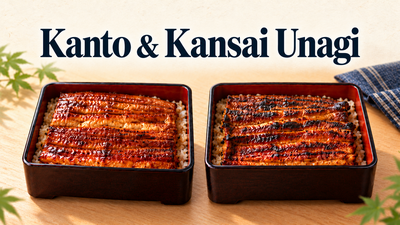
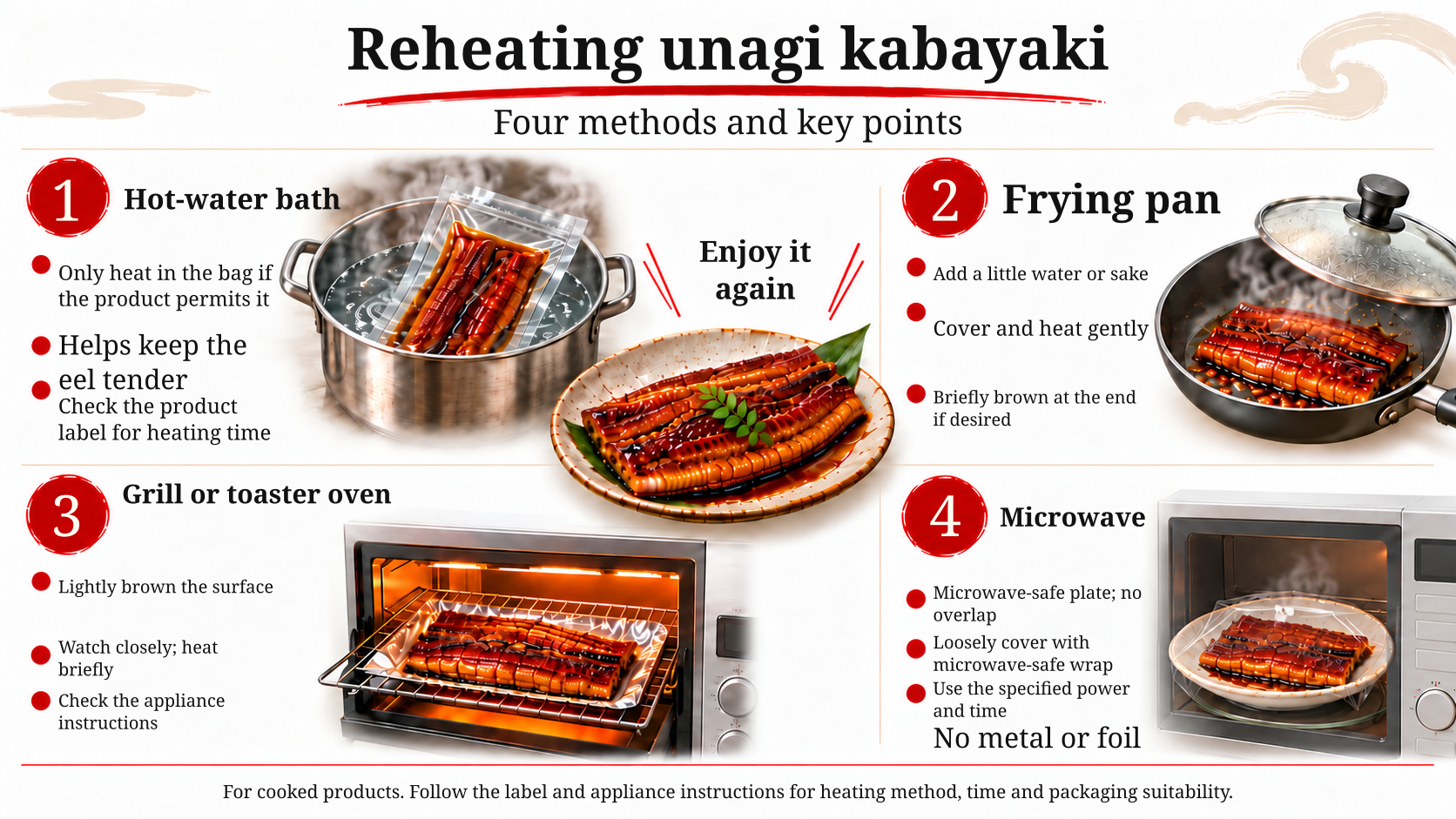
For tender unagi kabayaki, a hot-water bath is an option when the pouch is approved for it. A pan or grill can add a toasted finish, while a microwave is convenient for a small portion. Start with the product instructions: frozen or chilled condition, packaging suitability, heating time and power matter more than choosing a universally “best” method. This guide covers already-cooked eel, not preparing raw eel.
Which reheating method should you choose?
Start with the eel and its packaging. Check whether it can stay in its pouch or needs to be transferred to a dish. Then choose an allowed method according to the finish you prefer: retain moisture, add a lightly toasted surface, or warm a small serving conveniently. There is no one appliance that gives the best result for every product.
A water bath followed by a brief grilled finish is one possibility for products that allow it, but two stages are not compulsory. Finish the prescribed heating before adding an optional sear. Prepare the rice and serving dish beforehand so the eel can go straight to the table.
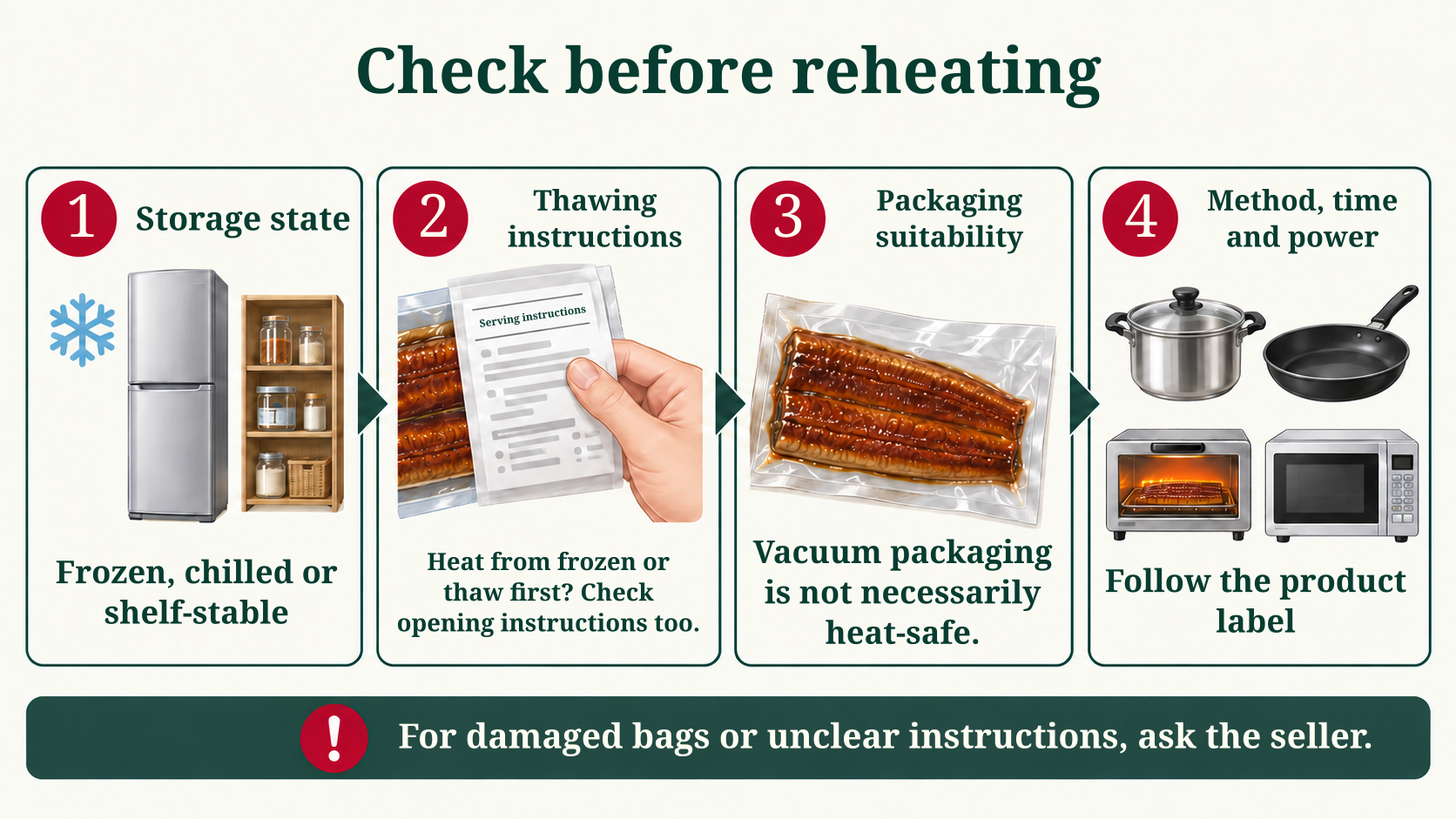
Read the label before opening or heating the pack
A supermarket tray, frozen vacuum pouch and shelf-stable pack are not interchangeable. Vacuum sealing describes packaging; it does not prove that the bag can be boiled or microwaved. A cooked appearance also does not tell you whether further heating is required before eating.
If instructions are missing, the label is unclear or the pack is damaged or leaking, contact the seller. Give the exact product and portion size. Do not borrow another brand’s timing or assume that a sauce sachet can be heated with the eel.
- Confirm that the product is already cooked.
- Identify frozen, chilled or shelf-stable storage.
- Check whether thawing is required and whether the pouch must be opened before thawing.
- Find the permitted method, time and power setting.
- Check instructions for the sleeve, tray, outer bag and sauce sachet.
- Check the date, opening instructions and packaging condition.
Frozen versus chilled eel: do you need to thaw it?
Some prepared eel is heated from frozen; other products should be thawed first. Follow the specified starting condition. Using a chilled-product time for a frozen portion can leave a cold centre even when the glaze looks hot.
When thawing is required, follow the label and avoid leaving the eel on the counter. With vacuum-packed fish, look specifically for directions to open or remove the packaging before thawing. A sealed pouch in the refrigerator is not a universal instruction. If microwave defrosting is permitted, continue promptly with the required heating rather than saving partly warmed fish for later.
Hot-water bath: use only a pouch approved for heating
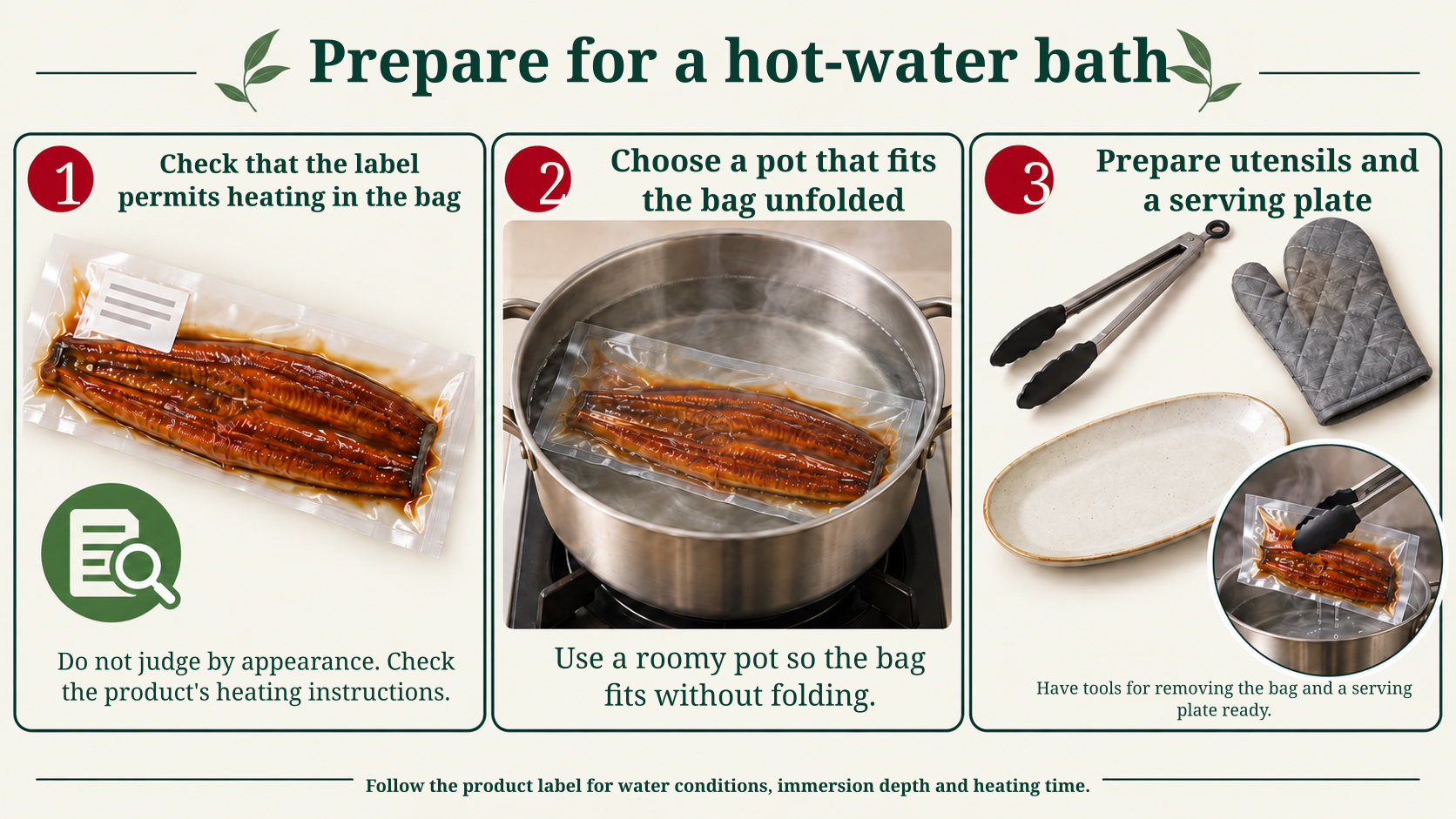
This method warms the eel inside suitable packaging, not loose in the water. An ordinary storage bag is not a substitute for a boil-in-bag pouch. Keep the product in the specified bag and handle outer sleeves, labels and separate sachets as directed.
Use a pot that accommodates the pouch without forcing it against the sides. Follow the specified water conditions and heating time. The illustration is schematic: actual immersion and placement should follow the product directions. Hot water, the bag and escaping steam can all burn, so open it away from your face and support the soft fillet when plating.
- Check boil-in-bag suitability and any thawing requirement.
- Prepare the water and pouch exactly as instructed.
- Heat for the prescribed time, then remove carefully with suitable utensils.
- Open away from your face and hands; transfer to a clean serving dish.
Frying pan: warm gently under a lid
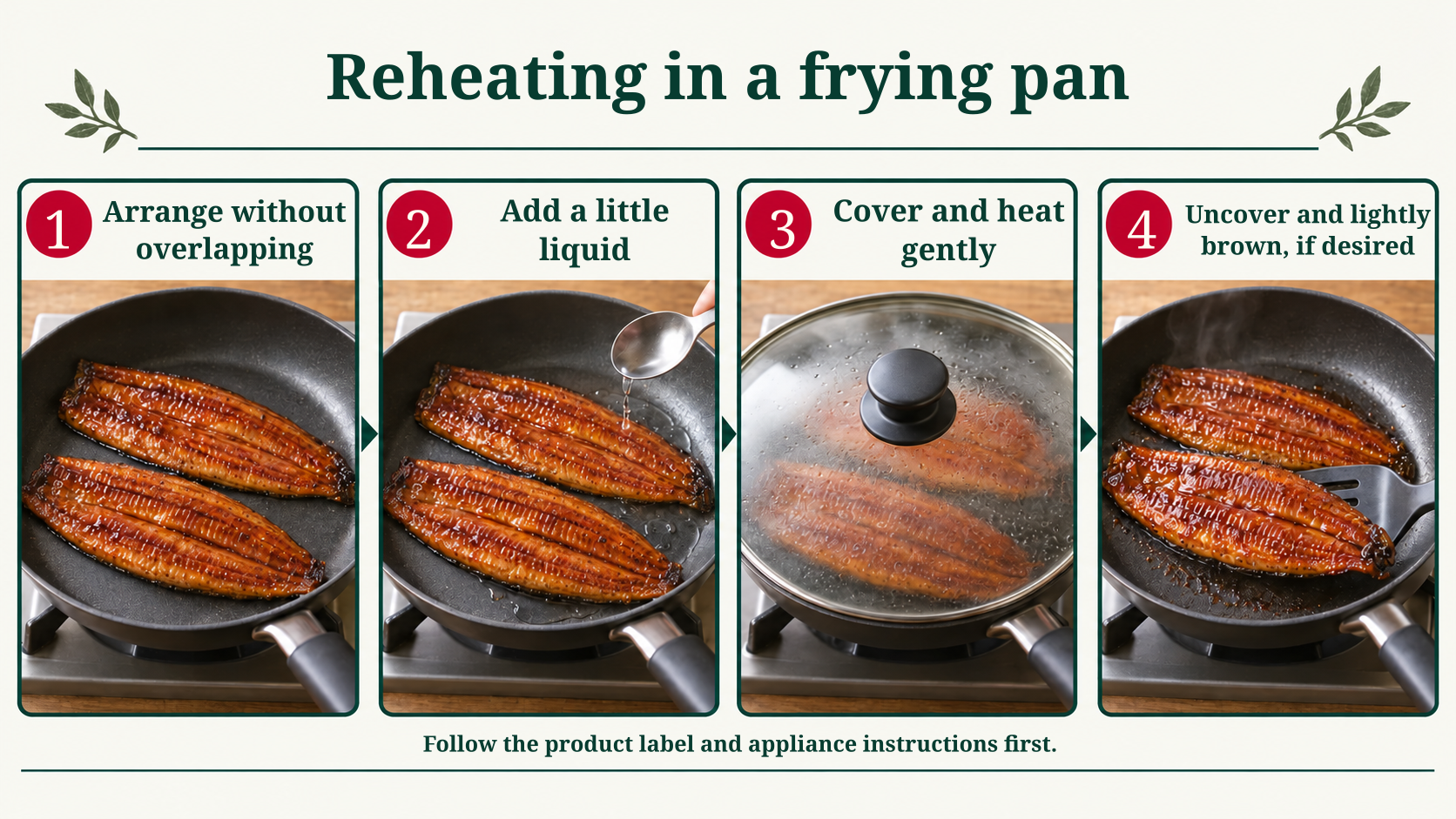
For a product that permits pan reheating, arrange the unpacked eel without overlapping. A little water or sake and a lid can provide gentle moist heat. Use the product’s quantity and heat setting; the aim is not to submerge the eel in liquid. Water is an option when you do not wish to add alcohol.
An optional light sear comes after the centre has been warmed according to the instructions. Do not start with intense heat just to brown the glaze. Avoid repeatedly flipping soft eel, and use a broad spatula to support it when moving it. Salted cooking sake may also change the seasoning.
- Complete any required thawing and confirm pan suitability.
- Remove packaging and place the eel in a single layer.
- Add the instructed small amount of liquid, cover and warm gently.
- Complete the necessary heating before an optional brief sear, then plate.
Grill or toaster oven: toast the surface without burning it
A toaster oven here means a small oven with a door and a tray, not a pop-up bread toaster. The sugary kabayaki glaze can scorch, so watch the surface rather than leaving it on high heat.
Check whether your appliance requires preheating and permits foil or a cooking liner. Keep foil clear of heating elements and do not cover the whole interior. Browning the outside does not establish that the middle is hot: do not skip any specified thawing or initial heating.
- Carry out the product’s required thawing or preliminary heating.
- Remove packaging and use a tray approved for the appliance.
- Heat using the stated setting, checking the surface frequently.
- Remove when the prescribed heating is complete, before excessive scorching.
Microwave: check the power, container and cover
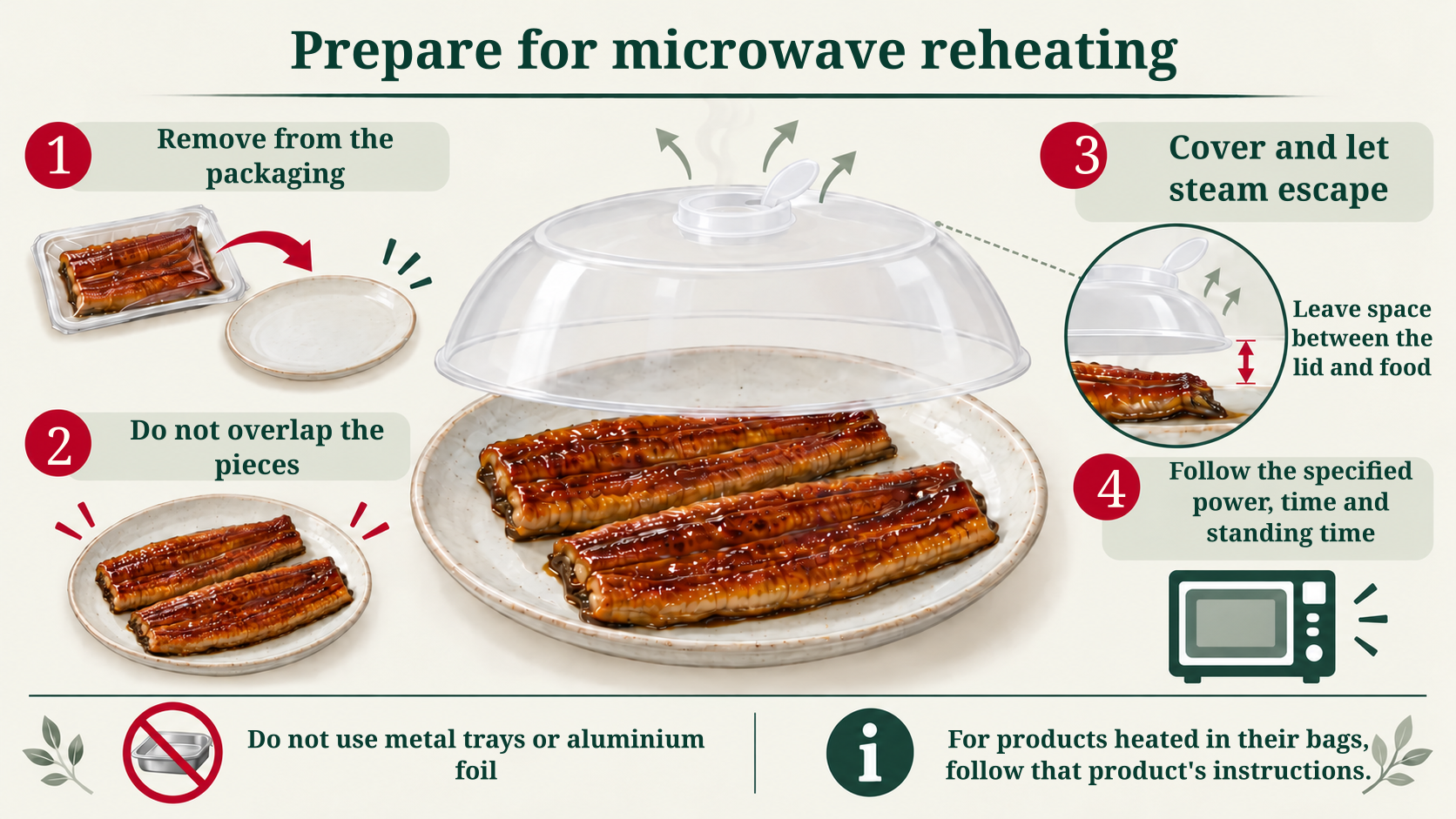
Only microwave eel in its bag when the label explicitly permits this, including the instructions for venting. Otherwise remove the packaging and use a microwave-safe dish. Do not transfer the foil used for grilling into microwave mode.
Use a microwave-safe lid or wrap, leaving a vent for steam. Keep wrap away from the eel’s oily, sugary surface; a deeper dish can help maintain the gap. Complete any specified standing time before checking the result.
Check that any wrap is suitable for the intended food as well as microwave use; some manufacturers restrict its use with fatty foods. Leave a gap above the eel and use a suitable microwave lid instead when appropriate. The food and covering instructions take priority over the way the illustration looks.
Heating in short bursts helps control extra heating, but is not permission to stop before the food is adequately heated. Check thick areas and follow the product’s directions for additional heating when needed.
- Match the label’s power and time and check how to handle the pouch.
- Arrange eel evenly in a suitable dish and cover loosely if instructed.
- Heat as directed, including any standing time.
- Check for uneven heating, adjust according to the instructions and remove carefully.
How many minutes? Why one time cannot fit every pack
A whole fillet, cut portions and chopped eel differ in thickness and amount. Starting temperature and appliance output also matter. Producer instructions vary, so a universal “three to five minutes” would be misleading for this guide.
Microwave output and electrical power consumption are different specifications. When food instructions state 500W or 600W, check the cooking output selected on the controls, not the appliance’s electrical input rating. If your oven has only high, medium and low settings, look up their corresponding output in its manual rather than choosing by the wattage on the electrical rating plate.
Converting a 500 W instruction to 600 W by arithmetic alone does not account for packaging and cold spots. Select the stated power when possible; otherwise use the manufacturer’s guidance for another setting. Do not assume that doubling the quantity means simply doubling the time.
Leftovers are a separate case from a newly opened commercial pack. USDA guidance calls for reheated leftovers to reach 165°F (74°C), checked with a food thermometer. That is a leftover-safety reference, not a universal heating specification for every unopened eel product. Appearance and visible steam alone do not establish the temperature throughout.
Troubleshooting dry eel, burnt glaze and a cold center
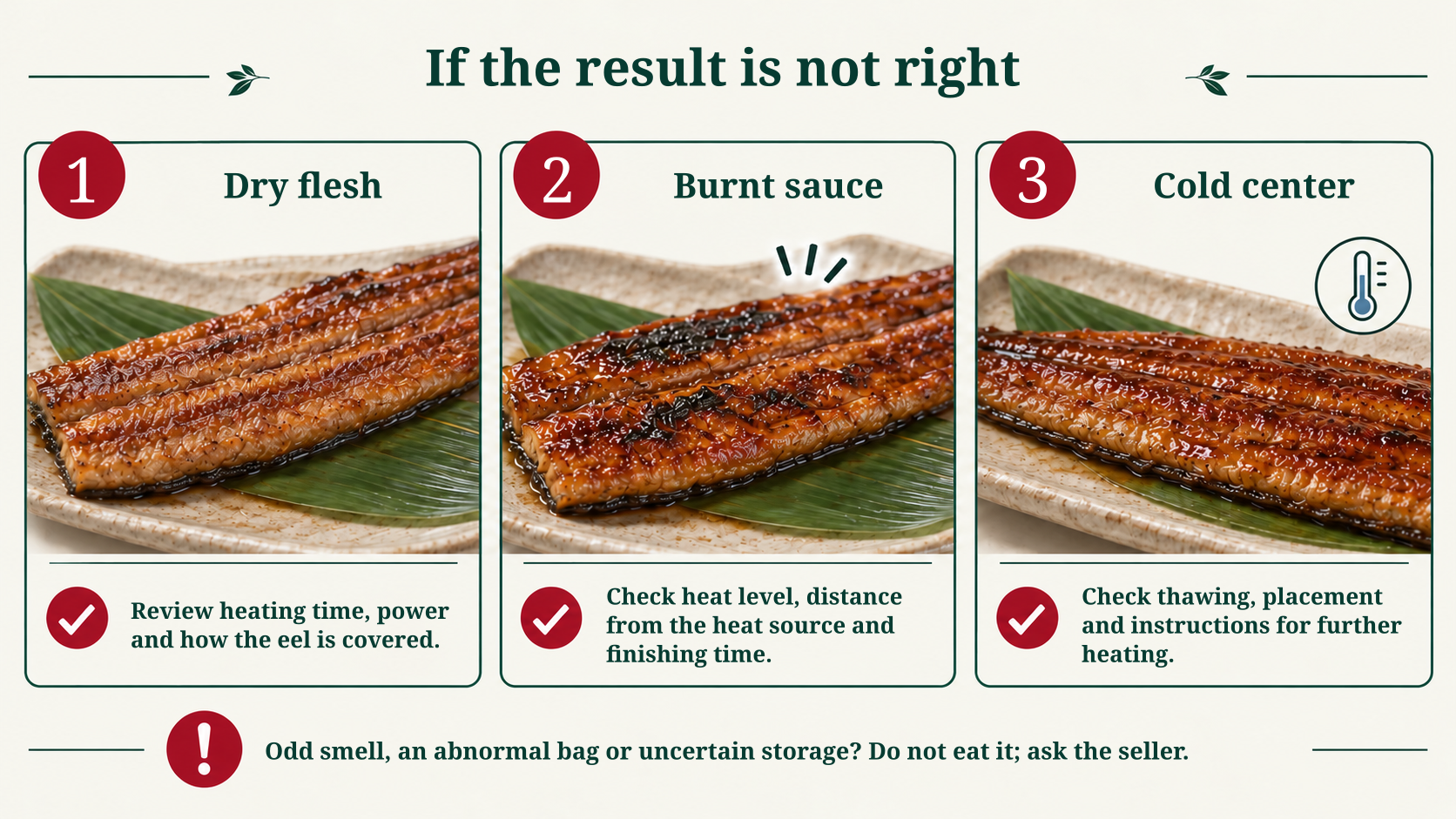
If the surface is hot but the middle is cold, first check the method, power and arrangement rather than browning the surface further. For microwaving, reposition the food when instructed, then complete any additional heating and standing time. Extra sauce cannot reliably restore dried-out flesh. An unusual smell, damaged packaging or uncertain storage history is a reason to stop and check with the seller, not to try to rescue the texture.
When the texture disappoints, change one factor next time so you can identify the cause. Do not confuse a quality problem with a storage-safety problem: more cooking is not a reliable way to rescue food with an unsafe history.
Should you rinse the sauce or add sake?
Rinsing off the glaze is not a necessary step for every product. Some instructions include it, but eel designed to be heated with its sauce should first be prepared as directed. Add a separate sauce sachet gradually after tasting with rice rather than automatically using it all.
Sake is optional, not a safety requirement. To avoid adding alcohol, choose water or an approved pouch method and also check the eel and sauce ingredients. Reheating does not establish alcohol-free status. A dish name is not evidence of halal certification or freedom from wheat, soy or other allergens.
Serve promptly with rice and condiments
Get the rice, clean plate, sauce and condiments ready before the eel finishes heating. Support the fillet as you transfer it over rice, then adjust sauce or sansho pepper to taste. Hot rice is not a substitute for reheating a cold piece of eel properly.
For a hitsumabushi-inspired meal, cut the eel smaller and try a portion plain, another with sliced green onion, shredded nori or wasabi, and a final small bowl with warm dashi. Add broth to an individual portion rather than the whole serving so you can compare the different ways of eating it.
Storage and leftovers: reheat only what you will eat
Follow the pack’s storage conditions and date before opening. The unopened shelf life is not automatically valid after thawing, opening or serving. Portion leftovers into clean shallow containers and refrigerate promptly rather than leaving a large dish on the table to cool.
FDA guidance limits room-temperature exposure of perishable seafood to two hours, or one hour when it is above 90°F (about 32°C). These are upper limits, not target waiting times. When food has been left out too long or its storage history is uncertain, do not taste it to test safety or assume reheating will make it safe.
Frequently asked questions
- Can I reheat unagi straight from frozen?
- Yes, when the product specifically provides instructions for heating from frozen. If thawing is required, do that first. The words “vacuum-packed” or “microwave” do not settle the question.
- Can a vacuum pouch go in the microwave?
- Only if it is explicitly microwave-safe and you follow its venting instructions. A boil-in-bag pouch may not be microwave-safe.
- Which method keeps eel most tender?
- An approved hot-water pouch is one useful option; a covered pan with the specified small amount of liquid is another. Results depend on the product and heating conditions, so there is no universal ranking.
- How long should I microwave unagi?
- Use the product’s time and wattage for its portion size and starting condition. There is no single correct time for all eel. Ask the seller when the instructions are missing.
- Do I need sake?
- No. Water or another product-approved method can be used. If avoiding alcohol, also inspect the original glaze and sauce ingredients; brief heating is not proof that alcohol has been removed.
- Should I wash off the kabayaki sauce?
- Not as a general rule. Follow the product directions first. Rinsing can remove seasoning and is only an optional step in recipes or instructions that specifically call for it.
- Can I use an air fryer?
- Use it only with suitable product and appliance guidance. Do not copy a toaster-oven time without checking: airflow can affect drying and surface browning.
- Can I reheat eel and rice together?
- Only when both have been stored properly and your method heats them evenly. Do not rely on hot rice to heat cold eel; separate them when their reheating requirements differ.
- Should the skin face up or down?
- There is no single orientation for every method or product. Follow any specified direction and arrange portions without stacking them. Turn only when needed, using a broad spatula to support the soft flesh rather than repeatedly flipping it for color.
- Can I eat kabayaki without reheating it?
- Already cooked does not automatically mean ready to eat without further heating. Consider this only when the label permits it and all storage and thawing conditions have been met. If the label requires heating before eating, do not skip that step because the eel looks cooked.
Notes and references
This is a general guide for already-cooked eel, not a raw-eel recipe or a tested specification for a particular Katana Unagi product. Follow the product label and appliance manual.
Numeric safety references apply to the food and circumstances stated by the source. Initial heating of a commercial pack, thawing and reheating leftovers are different situations.
Text and explanatory images were checked against the published sources below. The illustrations are not product photographs or records of comparative cooking tests.
Related articles