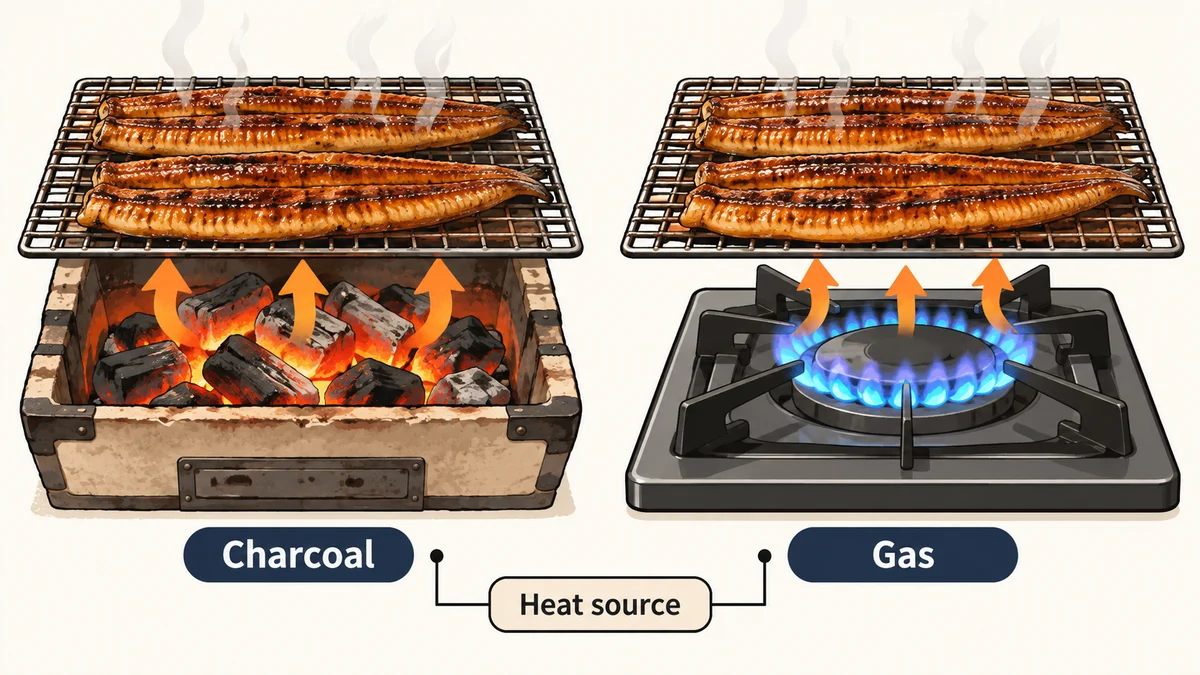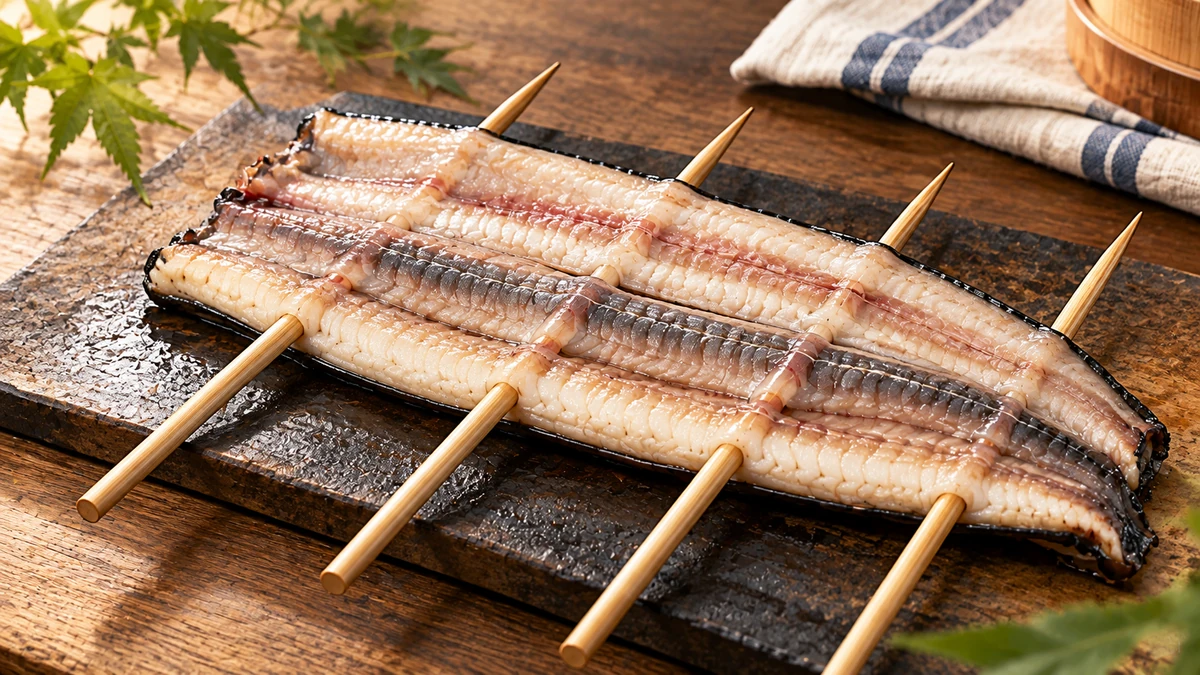
Skewering unagi means inserting skewers through a split eel fillet so that it keeps its shape and can be moved or turned during cooking. This preparation step differs from making bite-size skewers to serve as a dish. This article draws on a February 2023 survey commissioned by Japan’s Agency for Cultural Affairs, a Ministry of Agriculture, Forestry and Fisheries (MAFF) account, and published processing descriptions from eel businesses. The illustrations are editorial schematics, not measurements or documentation of a visit to a particular restaurant.
Why the fillet is skewered
Keeping a split fillet flat
A split fillet varies in width and thickness along its length and is awkward to lift or move over the grill unsupported. Several skewers provide support points that help retain its spread-out shape for the next stage. The 2023 government-commissioned report explains, for an Edo-style example, why the flesh must not be cut too thin and why thick sections matter when placing skewers. This does not prescribe universal spacing or a universal number of skewers. 1
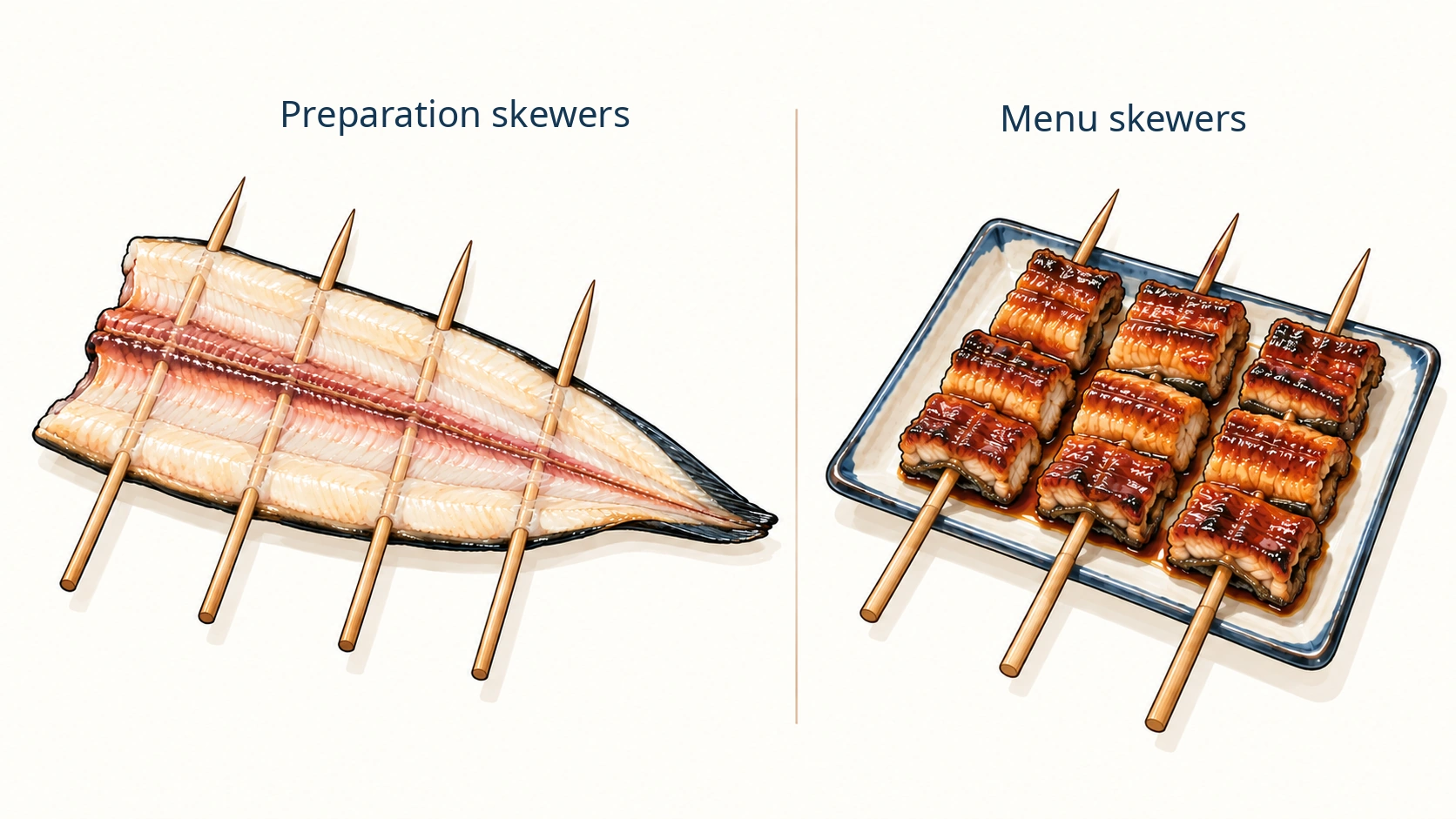
Preparation skewers versus menu skewers
Here, skewers support the fillet during cooking, from grilling without sauce to glazing. A restaurant’s bite-size eel, offal, or other menu skewer instead describes a portion served to eat. The shared word does not make these identical operations. MAFF’s account of Tokyo-style eel kabayaki explicitly describes splitting, skewering, grilling without sauce, steaming, and finally grilling with sauce. 1 2
How skewers interact with the flesh
Bamboo and metal are alternative tools
The cultural survey records individual establishments; materials and processes vary. Maruni describes a product process using bamboo skewers, while Okuniya describes metal skewers and charcoal. The 2023 report includes descriptions based on earlier publications; it does not establish current practice at each shop. 1 4 5
Where the skewer travels through the flesh
The point is not to imitate a visible hole pattern but to find a route that supports the flesh without damaging its integrity. The cultural survey stresses substantial flesh at the skewer path. In its own Kanto-style process, Uoi says it stitches the skewer through without piercing through the skin. These are examples from different sources, not the sole correct procedure. 1 3
Support points and curling edges
The cultural survey also describes some directly grilled eel shops straightening flesh that has contracted during cooking. The practitioner must consider thickness, length, equipment, and heating method rather than apply a fixed visual formula. 1
From preparation to grilling
Turning the supported fillet together
Skewering becomes part of grilling because a supported fillet can be turned, moved, and repositioned as a unit. The cultural report treats frequent turning in Edo-style cooking and repositioning in direct grilling as ways to manage uneven heat. Uoi’s published plain-grilling process likewise mentions repeated turning and moving the eel across the fire bed. 1 3
Keeping the gripping end away from the heat
Grills, steam, and bamboo or metal skewers can become very hot. Even away from the heat source, the gripping end can become hot; there is no guarantee that it is safe to touch. Actual work requires training, appropriate heat protection, and hygienic handling. This article is not a home guide to preparing raw eel. 1
Why the sequence differs
Grilling, steaming, and removing skewers depend on the method
A representative Edo-style sequence is split → skewer → grill without sauce → steam → glaze and grill. Direct-grilling methods may omit steaming, and the point at which skewers are removed varies with the product and process. The 2023 cultural report describes removing skewers after grilling in one Osaka example, while MAFF describes steaming in Tokyo-style cooking. Uoi also separates its plain grilling, steaming, and finishing stages. No single sequence applies nationwide. 1 2 3
How to interpret demonstrations and source material
To understand the technique, read each primary source in context. This article draws on published accounts, not firsthand observation of a demonstration. The February 2023 Agency for Cultural Affairs survey (especially pages 148–152) includes interviews and traditional sayings about years of training; these are not measured learning timelines. Uoi, Maruni, and Okuniya describe their respective businesses’ practices. The Sakai knife-industry association catalogs several shapes of eel-splitting knife, but the shape of a knife alone does not establish how skewers are used. 1 6
Limits of the diagrams: These editorial schematics are not experiments, on-site observations, or proof of the species of eel used. Check the source-specific conditions before generalizing the number of skewers, movements, equipment, or use of steam.
Primary sources consulted
Uoi, published Kanto-style splitting, skewering, grilling, and steaming process
Maruni Unagi, production description including bamboo skewers
Okuniya, published account of metal skewers and charcoal grilling
Sakai Knife Commerce and Industry Cooperative Federation, types of eel-splitting knives
Further reading
Related articles