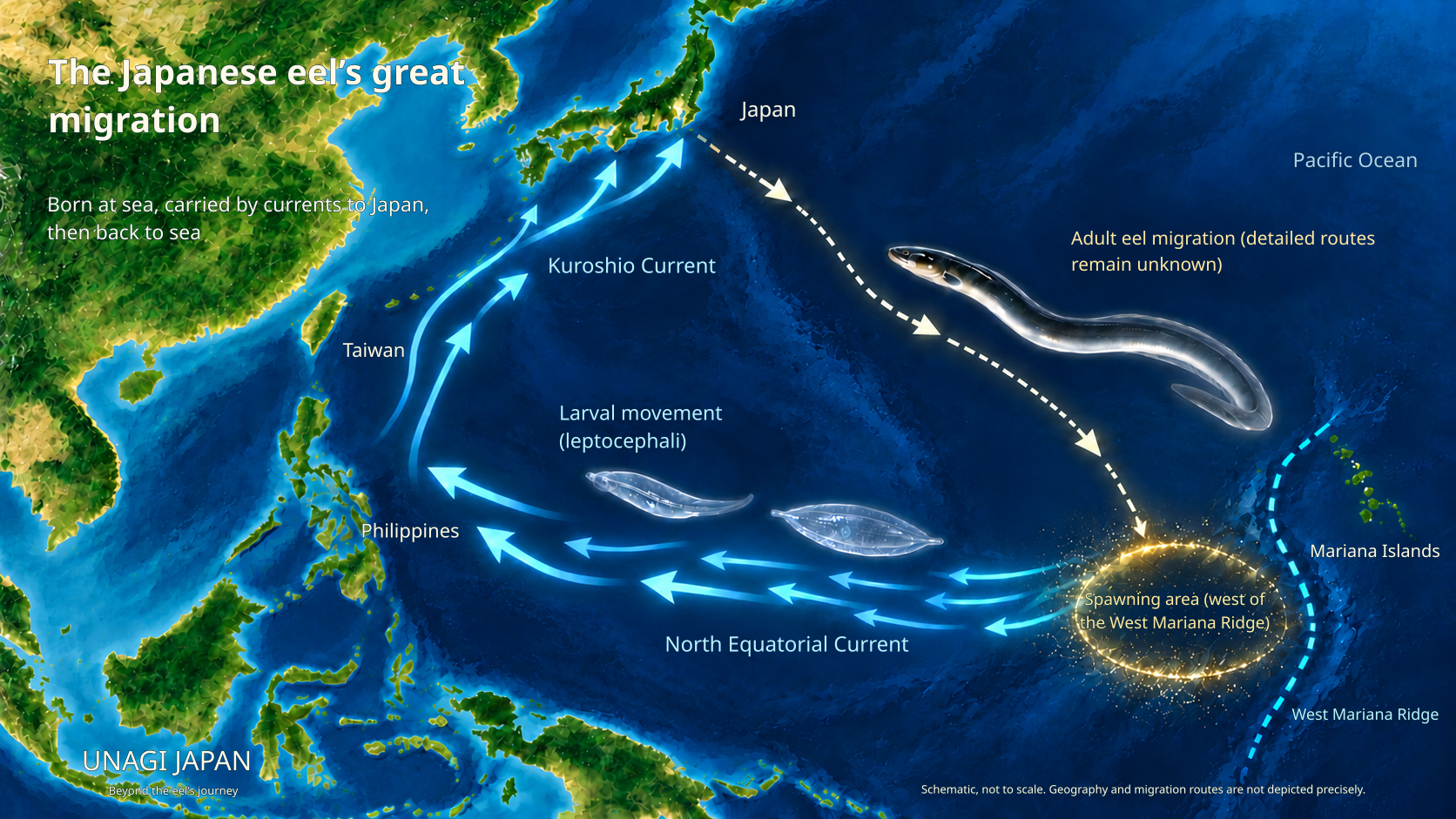
Japanese eels are born in the open ocean, change from larvae into glass eels, grow in rivers, estuaries or coastal waters, then return offshore to reproduce. Not all ascend rivers, and their growth habitats differ. Follow the stages from eggs to the familiar shape seen at the table. Fisheries Agency and Japan Fisheries Research and Education Agency: Japanese eel
Before following the cycle: these names are stages, not species
Leptocephalus, glass eel, yellow eel and silver eel describe life-history stages or bodily condition. The same Japanese eel has different names at different stages. Distinguish these from species differences, such as Japanese eel versus giant mottled eel. Life-history overview
Equal-sized drawings of the stages do not mean the real animals are the same size. Arrow length does not show stage duration either. Learn the order first, then add where they live and how their bodies change to connect the life cycle.
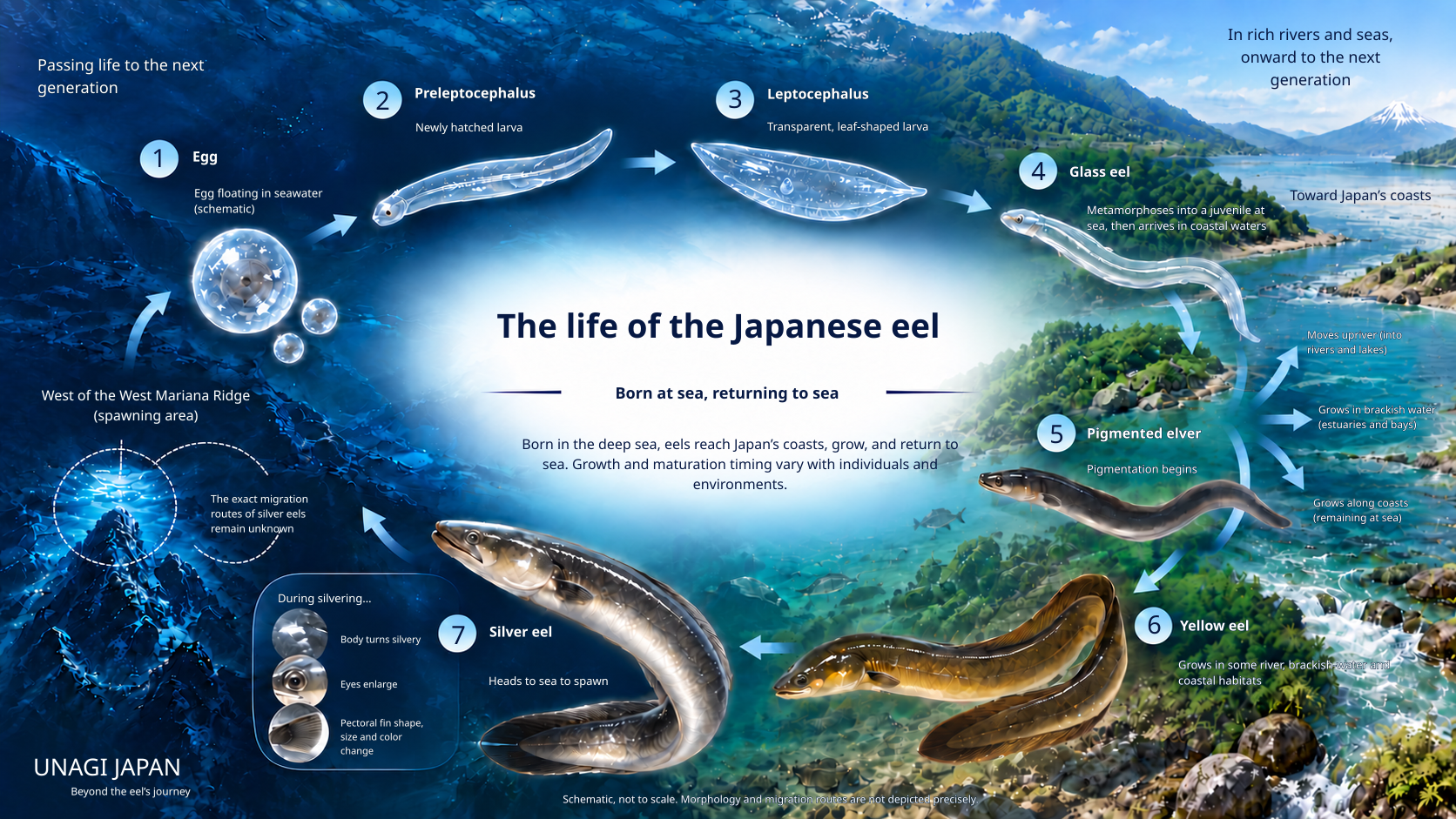
1. Eggs and newly hatched larvae: a distant ocean beginning
Wild Japanese eel eggs have been collected near the West Mariana Ridge. Eggs collected in 2009, together with mature adults and newly hatched larvae, support the identification of this open-ocean spawning area. Tsukamoto et al. (2011)
Newly hatched larvae are not miniature versions of slender adults. Researchers distinguish this earliest stage as the preleptocephalus. Genetic identification of newly hatched larvae collected in 2005 was an important step in locating the spawning area. Tsukamoto (2006)
The discovery history and difference between collection and spawning depth are covered in Where Japanese eels spawn (article-10). Here, distinguish eggs and newly hatched larvae from the leaf-shaped stage that follows.
2. Leptocephalus: travelling with a leaf-shaped body
Growing larvae become transparent, laterally flattened and leaf-shaped: leptocephali. Their feeding mechanisms as well as body shape differ greatly from adults. Research on Japanese eel larval digestive tracts has examined their fine structure and function. Otake (1996)
Marine snow—aggregated organic material in seawater—is considered important food at this stage. These are not simply tiny eels chasing small fish. Studies of wild larval gut contents, isotopes and other evidence support this feeding mode. Review of larval feeding research
However, the detailed composition of the particles eaten in the wild and the nutritional contribution of each component have not been fully established.
3. Metamorphosis and glass eels: from flat to slender
Leptocephali metamorphose into slender, nearly transparent glass eels. This is more than growing larger in the same shape. A study of glass eels entering rivers in northern Kyushu in 1994 used otolith structure to distinguish the leptocephalus, metamorphic and seawater glass eel stages. Kawakami et al. (1998)
Their mean age at estuarine recruitment was 169 days. This applies to particular locations, year and samples, not a timetable saying every eel enters a river at 169 days. Accounts of growth or transport times need the survey conditions. Conditions and results of the same study
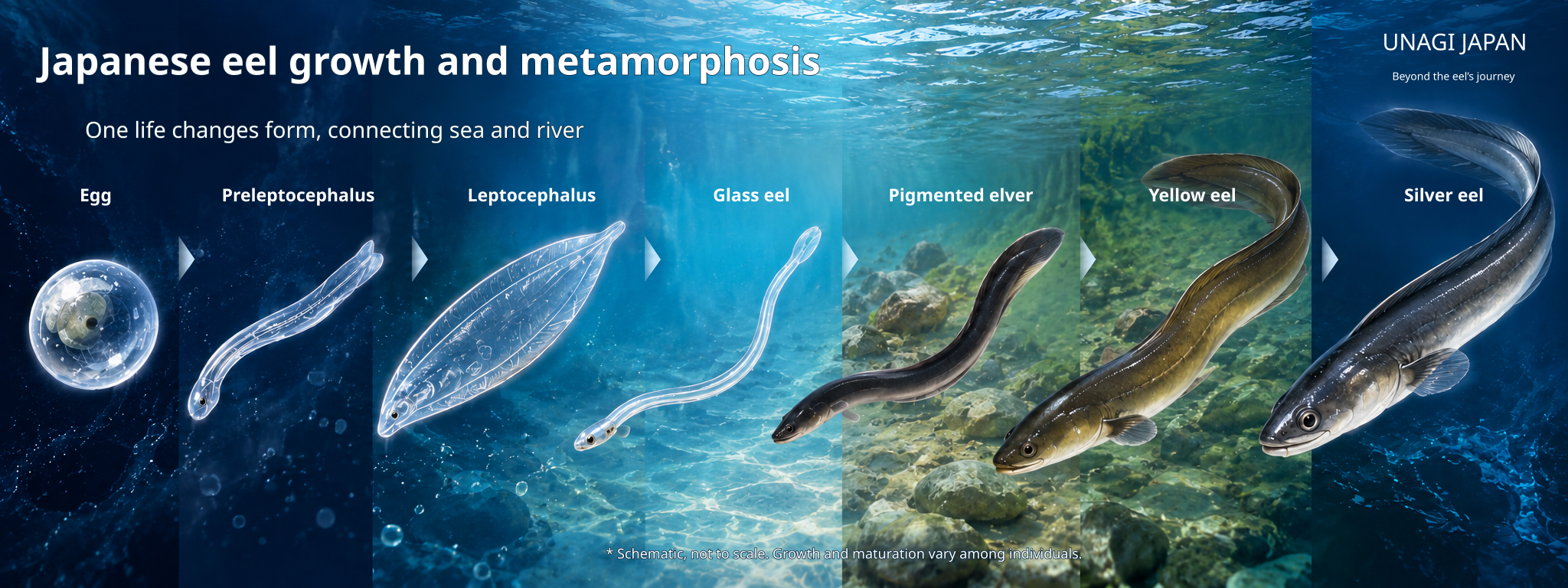
Do glass eels grow without eating?
Metamorphosis and renewed feeding involve transitions. A 2023 experiment with artificially reared Japanese eels examined individual differences in feeding onset, feeding rates and digestive-organ development after metamorphosis. This does not mean that all wild individuals begin feeding at the same time or in the same way as soon as they become glass eels. Study of post-metamorphic feeding and digestive organs
4. Increasing pigmentation and growth as yellow eels
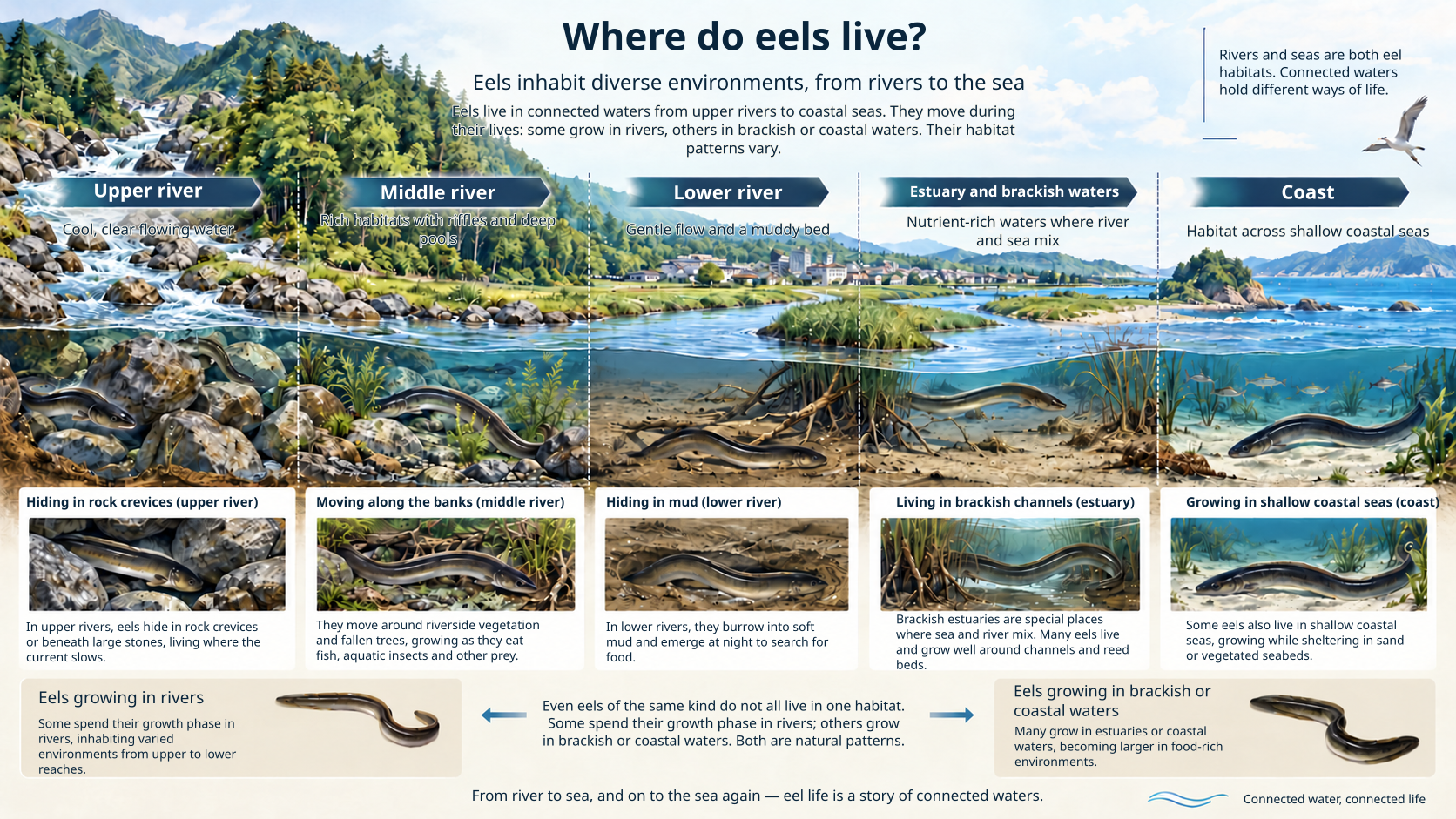
Pigment increases in the nearly transparent body. After the juvenile stage called kuroko, eels enter the yellow eel growth stage. This is the period of increasing body size. Fisheries Agency and Japan Fisheries Research and Education Agency
Growth is not confined to rivers. Analyses of elements in otoliths have identified individuals that lived in marine waters without entering freshwater and others that used different environments. Otoliths provide clues to past salinity exposure. Tsukamoto and Arai: Facultative catadromy
A single river-growth pathway is easy to draw but omits real diversity. This article's migration map is also an outline, not a lifetime tracking record of one fish. Habitats and daily activity are discussed in Japanese eel ecology (article-13).
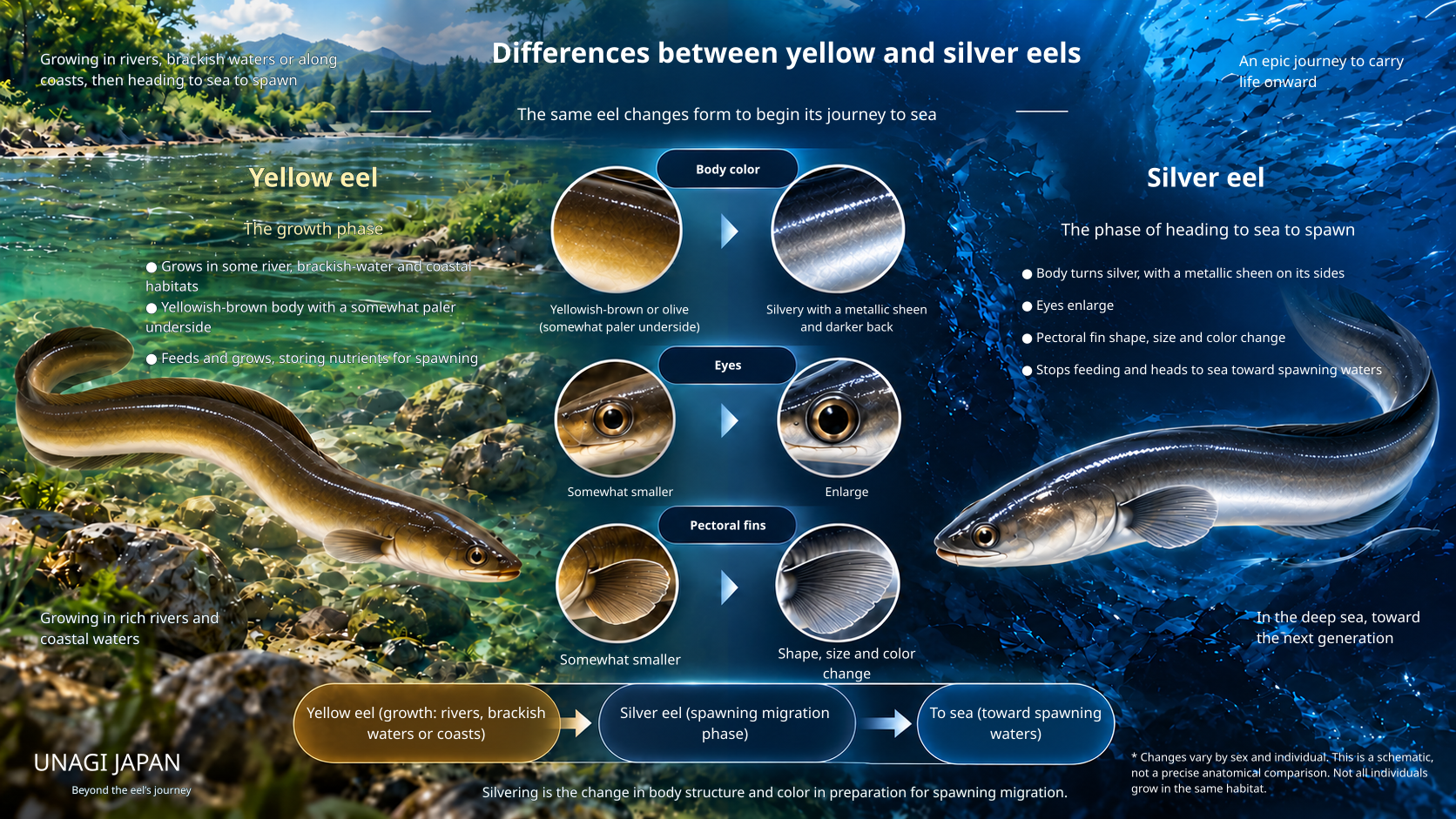
5. Silvering: from growth to spawning migration
As spawning migration approaches, body colour, eyes, fins and other features change. This suite of changes is silvering. Japanese eel studies assess progression from yellow to silver eel using features including pectoral-fin and belly colour. Okamura et al.: silvering index
Silver eel does not mean a different species. Nor does a silvery appearance alone reveal the entire state of maturation or migration. Studies combining morphology and gonadal development illustrate why external and internal changes must be understood together. Study of silvering and gonadal development
Silvering is not the same as completing final maturation and being able to release eggs or sperm.
6. Offshore migration and the next generation
Silver eels head toward the offshore spawning area. A study releasing tagged eels along the West Mariana Ridge recorded day–night vertical movements in tracked individuals. Release locations and tracking duration were limited; one individual's data cannot establish the routes of all East Asian eels. Higuchi et al.: tracking study
The cycle can be drawn as a circle linking the final eggs to the first. This represents generations continuing, not the same individual repeatedly travelling between river and sea. For wild spawning behaviour, distinguish estimates based on eggs and mature fish from direct observation. Study estimating spawning time
How many years does an eel live? Why there is no single answer
Age varies with species, sex and habitat. The study compared growth and age composition by region and sex in 597 yellow- and silver-stage Japanese eels collected along Japanese coasts at different latitudes. Which population was studied and how matters more than claiming all eels reproduce at a fixed age. Comparative study of coastal eels
Time to market size in farming is different from years between birth at sea and spawning migration. Reaching food size does not mean lifespan or reproduction is complete. Farming and full-cycle aquaculture are distinguished in Eel farming (article-01) and Full-cycle eel aquaculture (article-04).
Frequently asked questions
- Do they return to their birth river?
- Japanese eels are not born in rivers; their eggs are collected offshore. Describing them as fish returning to the river where they were born is incorrect. Tsukamoto et al. (2011)
- Do all individuals grow in rivers?
- No. Some documented life histories involve marine growth without entering freshwater. Rather than always growing in rivers after ocean birth, they have several growth-habitat options. Habitat histories reconstructed from otoliths
Related articles