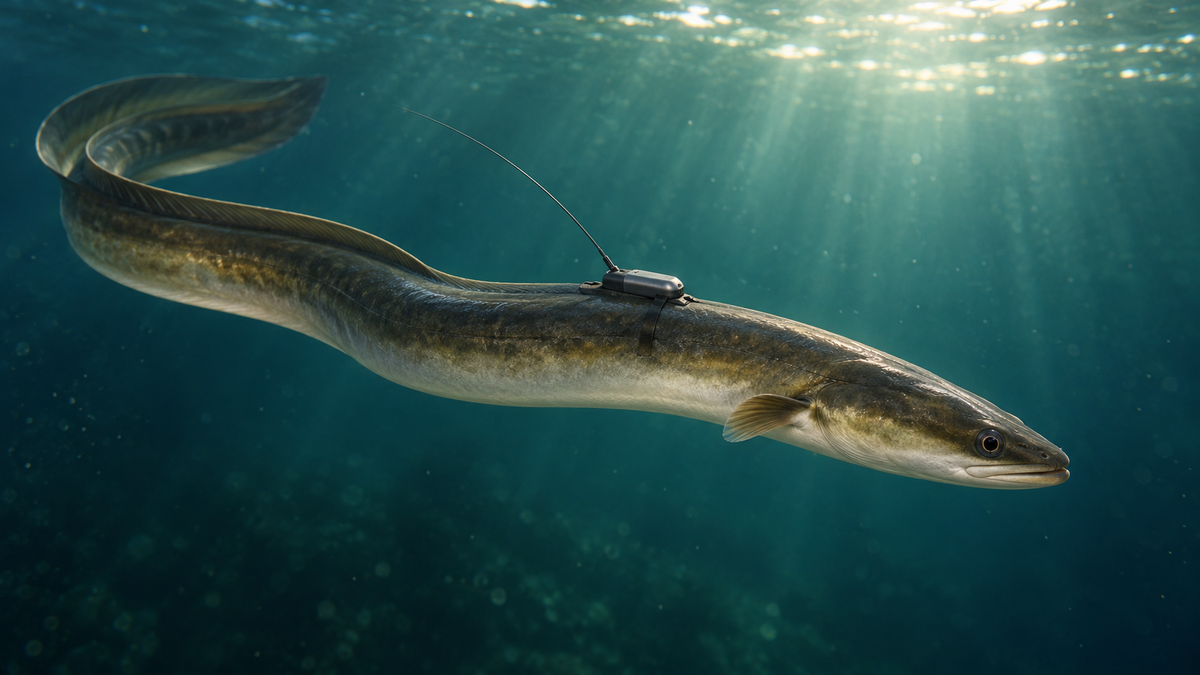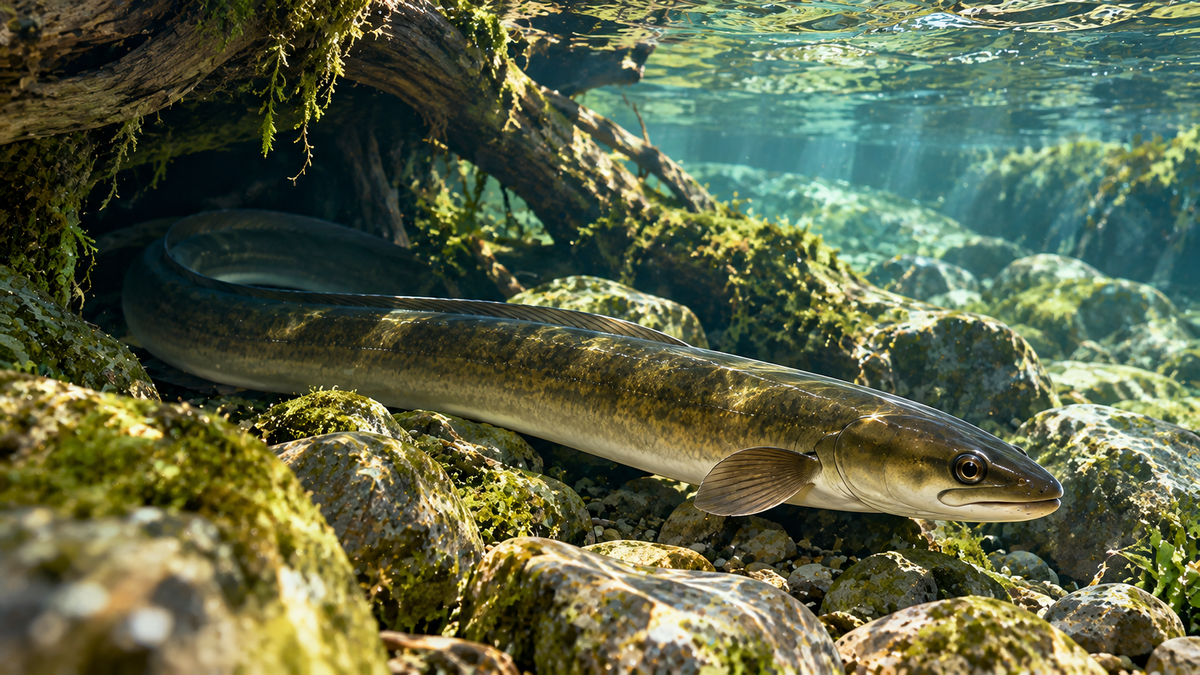
The New Zealand longfin eel, Anguilla dieffenbachii, is a freshwater eel endemic to Aotearoa New Zealand. It is not the same species as the Australian “longfin eel.” Its life connects rivers with the ocean, and the New Zealand conservation assessment for 2023, published in 2025, lists it as At Risk – Declining. Although it can live for many decades, its precise spawning site and aspects of reproduction in the wild remain unresolved. The following sections distinguish documented observations from scientific inference.
Name and form
Identifying an endemic species by name
The dependable starting point for identification is the scientific name Anguilla dieffenbachii, not a common name. New Zealand’s Department of Conservation (DOC) lists three eel species recorded in the country and identifies this one as endemic. The Māori word tuna refers broadly to freshwater eels rather than to this species alone. Dark coloration and large size may help with a first impression, but neither is sufficient by itself to determine the species.
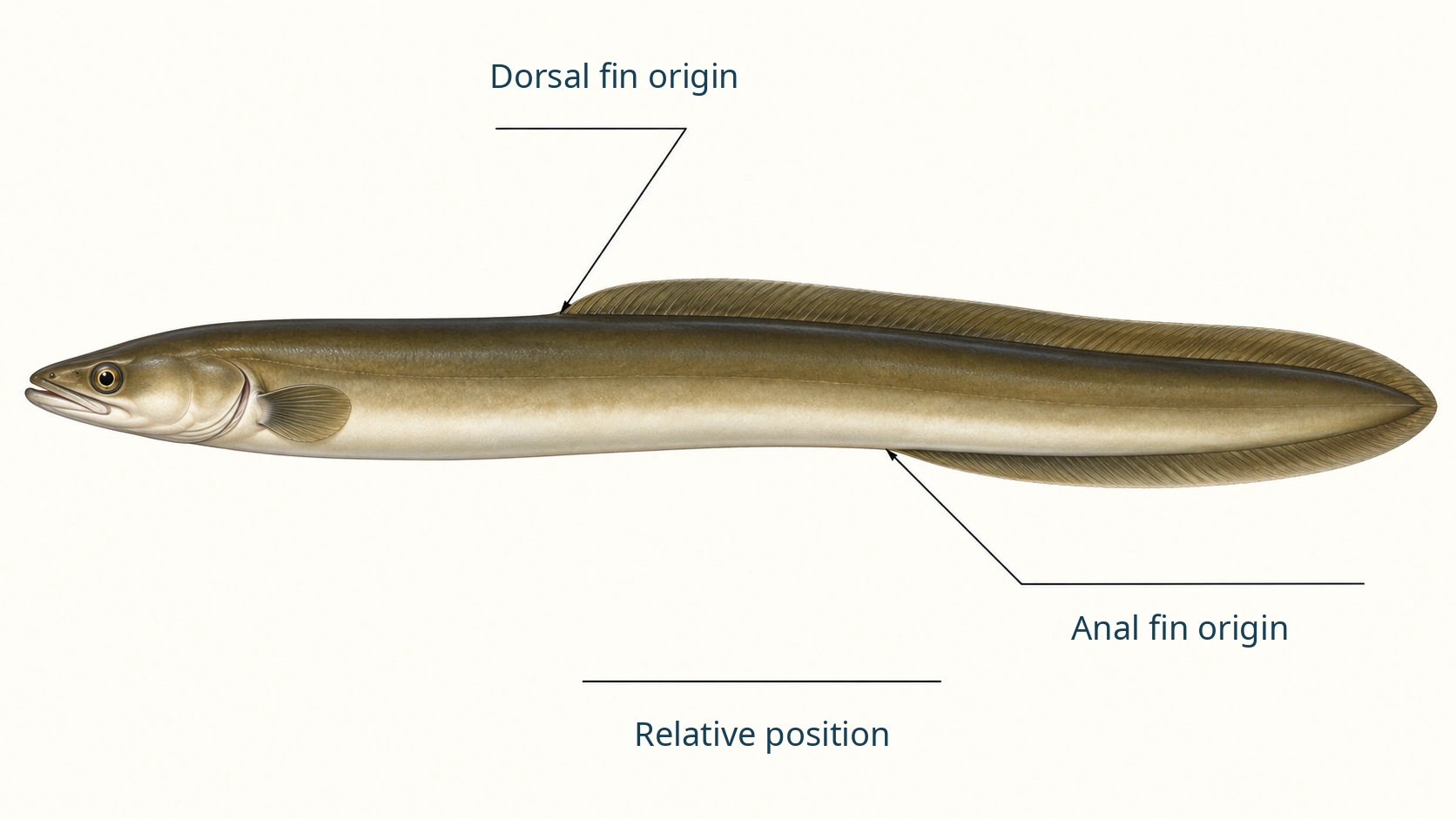
Comparing dorsal and anal fin origins
The position where the dorsal fin begins relative to the anal fin is an important identification feature. In New Zealand longfins, the dorsal fin starts noticeably farther forward, toward the head, than the anal fin. In shortfin eels, these starting positions are much closer together. NIWA also describes the pronounced skin folds visible when a longfin bends as a supporting clue. The diagram presents this relationship schematically; its arrows do not represent measured distances or fixed proportions.
Evidence: NIWA
Why the Australian “longfin” is a different species
The shared word longfin does not make New Zealand’s A. dieffenbachii and Australia’s A. reinhardtii the same species. DOC describes the latter as a visitor from Australia and notes dark blotches along its upper body as a distinguishing clue. The shortfin eel, A. australis, is a third species. Conservation assessments and ecological traits should not be transferred between these eels based on their common names or the country where an individual happens to be encountered.
Habitat and growth
A life cycle connecting estuary, river and ocean
Freshwater eels begin life at sea. Transparent juveniles called glass eels enter estuaries, become pigmented elvers and move upstream. After growing, adults return toward the ocean to reproduce: this is a catadromous life cycle. New Zealand longfins occur well inland in rivers and lakes. Connectivity among freshwater, river mouths and the sea is important.
Why submerged cover matters
During daylight, eels often shelter beneath woody debris and rocks, under overhanging banks, among roots or in aquatic plants. They generally become more active after dark. NIWA reports that adult longfins are often associated with flowing, stony river reaches and upstream habitat.
A long life does not give a simple age–length rule
Longfins may take many years to mature, but body length alone cannot reliably reveal an individual’s age. NIWA gives a striking conditional example: a 500 mm longfin could be about 2 years old in low-competition or cultured conditions, yet about 30 years old in a cold lake. These are contrasting environments, not a normal age range for every eel. Some females have been estimated to exceed 90 years. Scientists study layers in otoliths to estimate age, subject to reading uncertainty; traditional detailed sampling also entails killing the fish.
Reproduction and limits of knowledge
Adults leave for the sea, but the spawning ground is unconfirmed
Maturing eels undergo changes, including a silvery appearance, before migrating downstream and out into the Pacific. Tagging studies suggest a broad southwestern tropical Pacific destination, but the precise spawning site of A. dieffenbachii has not been verified. The sources cited here do not establish direct field observation of this species spawning at sea.
Separating observations from inferred steps
Glass eels entering estuaries, adults migrating downstream and tagged adults moving at sea are supported by observation or research. In contrast, the exact location of egg release, species-specific spawning behavior underwater and parts of the link between larvae and breeding adults remain uncertain. Te Ara’s life-cycle illustration explicitly notes that its spawning stage is inferred.
Evidence: NIWA · Te Ara · NIWA
People and conservation
Why recovery can be slow
The 2023 assessment by Dunn and colleagues, published in 2025, categorizes this species as At Risk – Declining and highlights habitat degradation and impaired upstream and downstream passage. Juveniles need access to suitable growing habitat, while adults that have developed over many years must be able to reach the sea safely. This is a New Zealand conservation category, not by itself a blanket fishing ban. MPI commercial quota management, recreational rules and voluntary fishing-industry agreements are distinct instruments.
Conservation rooted in a place and its communities
Conservation measures need local evidence rather than a universal template. In a documented North Island case, Māori organizations and researchers conducted a baseline eel survey in 2008 around Lake Ōmāpere and the Utakura River to support ongoing understanding of the catchment. Tuna are also taonga, treasured beings for Māori, but practices and knowledge must not be generalized indiscriminately across communities. Anyone considering eel harvesting should separately check current MPI rules, protected-area restrictions and rights or arrangements applicable to that specific place.
Understanding the New Zealand longfin begins with correct species identification, connected freshwater and marine habitats, and restraint about unverified breeding details.
Sources and records consulted
NIWA: Tuna identification — anatomy and distinguishing species
NIWA: Life cycle and leptocephalii — larvae and juvenile transitions
NIWA: Age and methods of ageing — growth variation and otoliths
NIWA: Lake Ōmāpere and Utakura River — community research case
Sources checked 2 November 2026.
Related articles