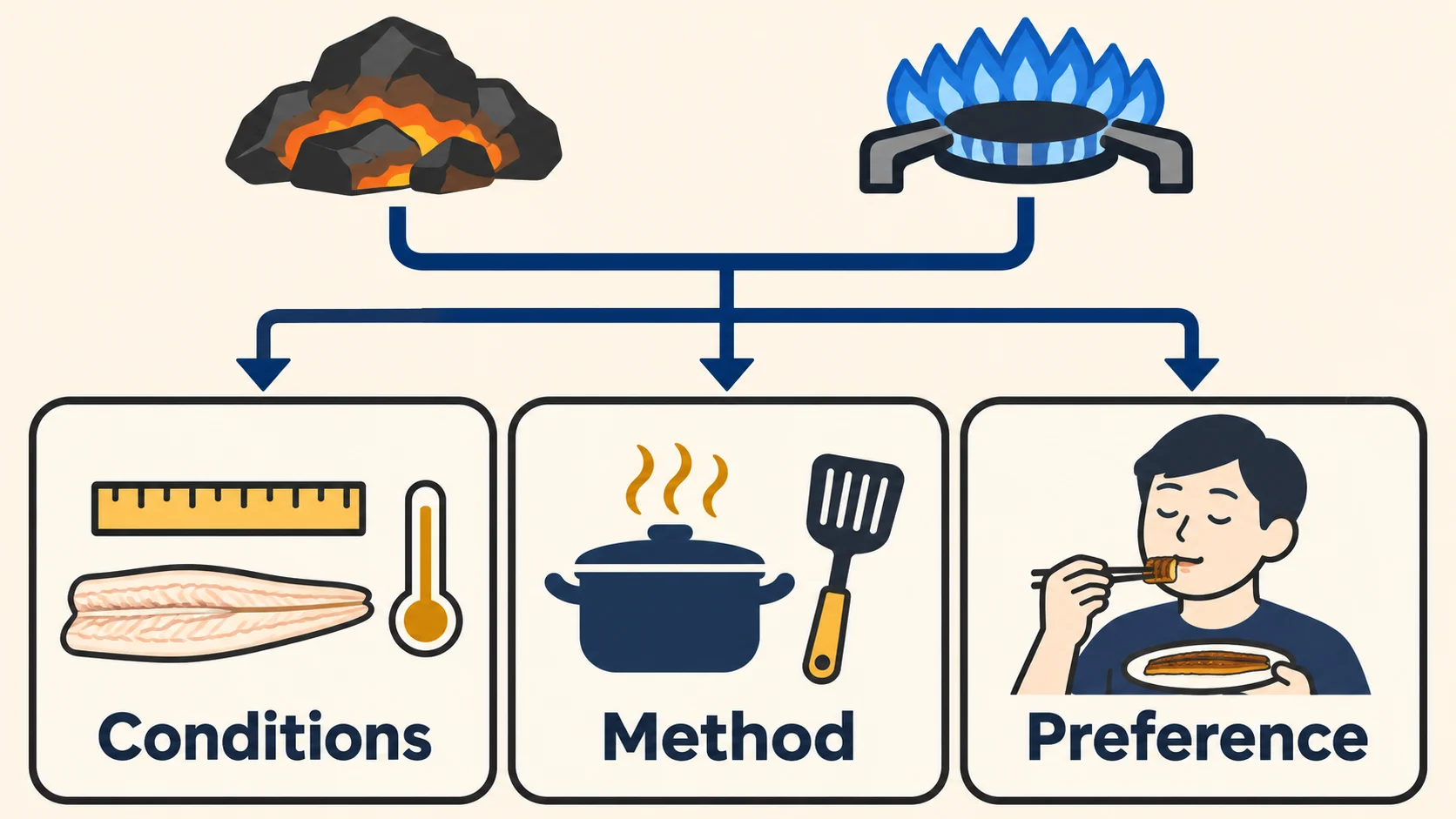
To understand the difference between eel grilled over charcoal and eel grilled over gas, we need to look beyond the fuel's name to how heat reaches the fish, its distance from the heat source, the sauce, and the steaming step. Drawing on heating studies and public information, this article explains which factors should be compared separately. We did not conduct an eel comparison experiment for this article, and we do not conclude that either method always tastes better.
Differences between heat sources
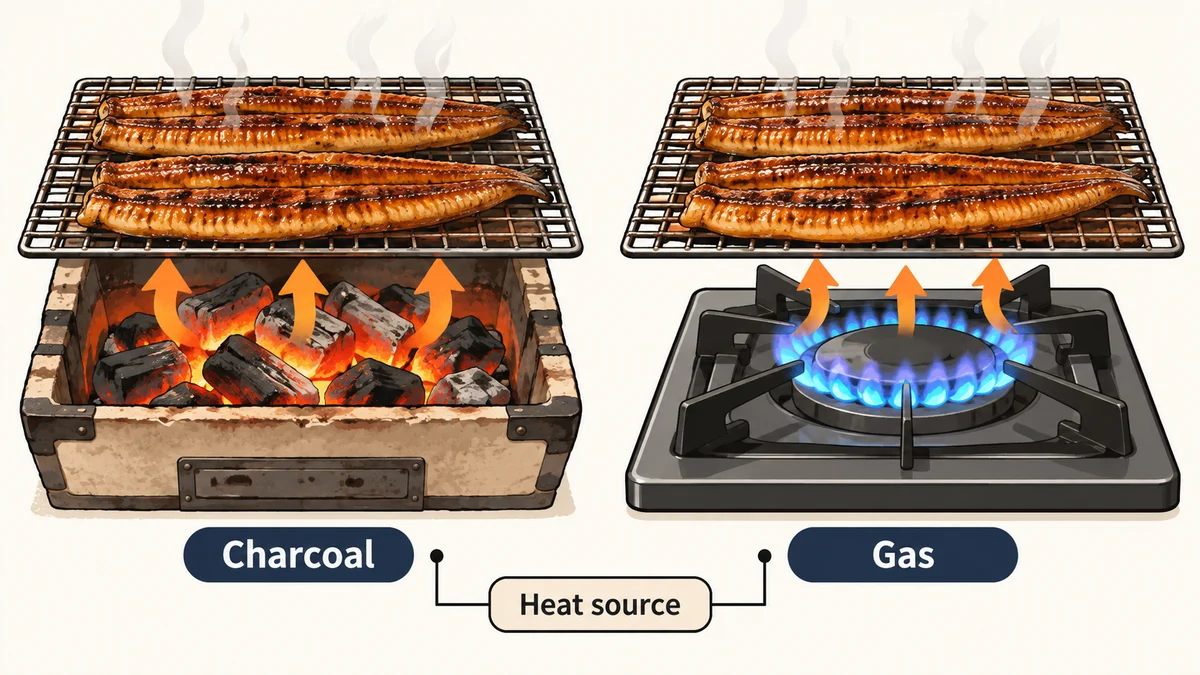
The first clue to understanding charcoal and gas is how heat is transferred. Radiation transfers heat over a distance through electromagnetic waves emitted by hot objects. Convection is heat transfer associated with the movement of a fluid, such as air. In grilling, it helps to distinguish radiation from hot charcoal or heated equipment from convection due to the surrounding hot gases. Conduction also plays a role where the food touches a grate or griddle. Source: U.S. Department of Energy explanation of heat transfer
Even when gas is the fuel, heat reaches food differently depending on whether a flame is used directly or heats a radiating surface. One study compared charcoal, a gas burner, a blackened grill grate heated by gas, and an electric heater. With heat flux matched, the researchers examined the contribution of radiation and the physical properties of the foods. Under these conditions, heat sources with a radiative contribution close to charcoal also produced similar physical characteristics, such as browning and moisture evaporation. However, the samples were hanpen fish cakes, chicken, and salmon. The experiment did not establish which method makes eel taste better. Source: Tatsuguchi et al., 2004
Conditions that change
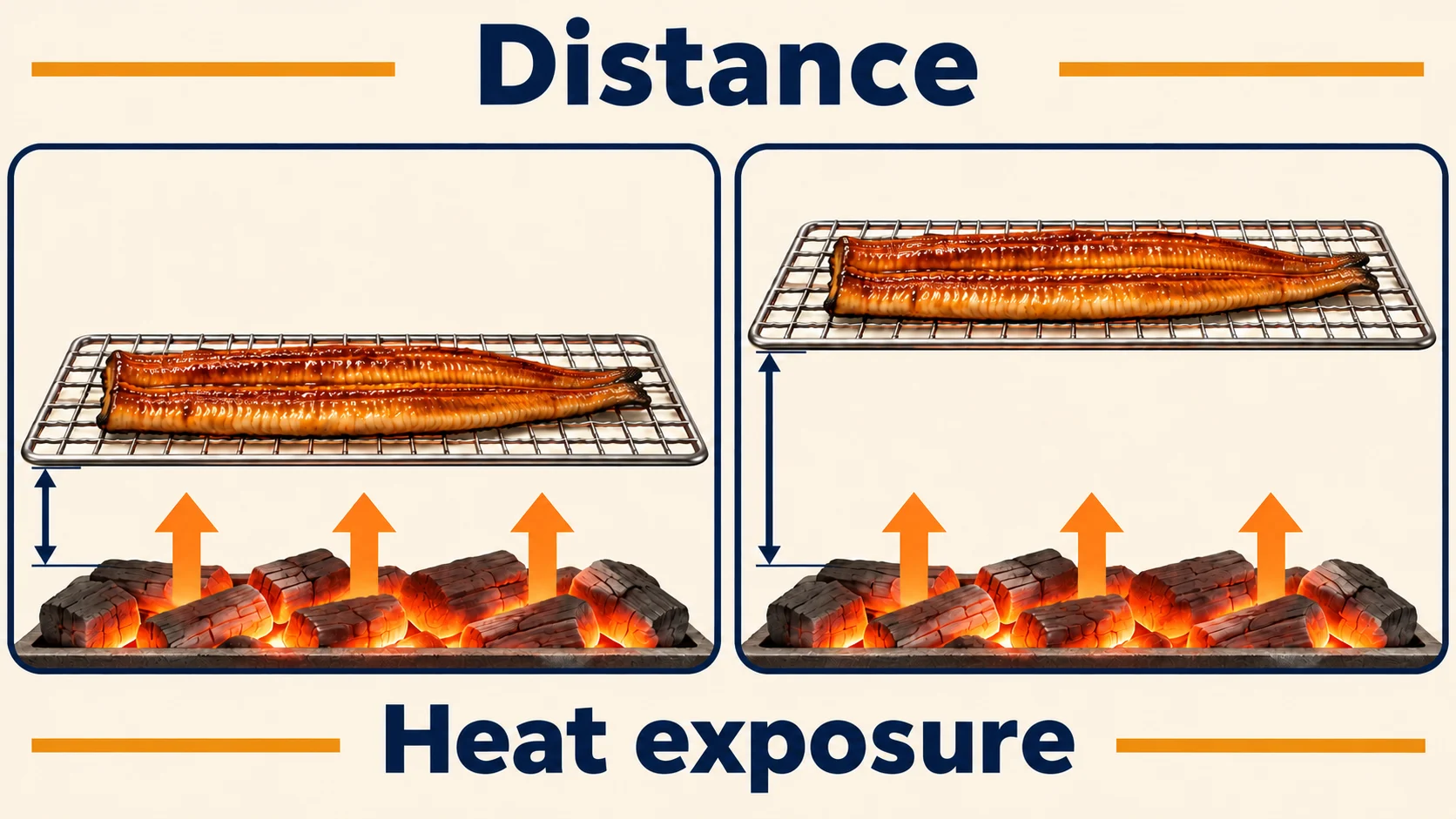
Changing the distance also changes the comparison. The distance from the heat source to the food is a condition worth recording. In a study of radiant heating, heat flux was greater closer to the heater. A conference presentation on charcoal-grilled salmon also reported that distance affected the tendency to scorch and the required grilling time. These findings do not establish one correct distance for every eel or appliance. When changing the distance, check whether heat settings or cooking time have also changed. Source: Sato et al., 1999 · Nakamura et al., 2007 conference abstract
A sauced surface is a different condition from shirayaki, or grilling without sauce. Browning reactions include the Maillard reaction, which involves sugar-derived components and amino compounds; moisture and temperature also matter. Applying sauce changes the ingredients and condition of the surface. The difference in browning between shirayaki and kabayaki, or eel grilled with sauce, therefore cannot simply be read as an effect of the heat source. For a comparison, keep the sauce recipe, amount, number of applications, and timing consistent, and record them. It is also important not to turn darkness of color alone into a score for deliciousness. Source: Hiroshima Prefectural Food Technology Research Center explanation of browning
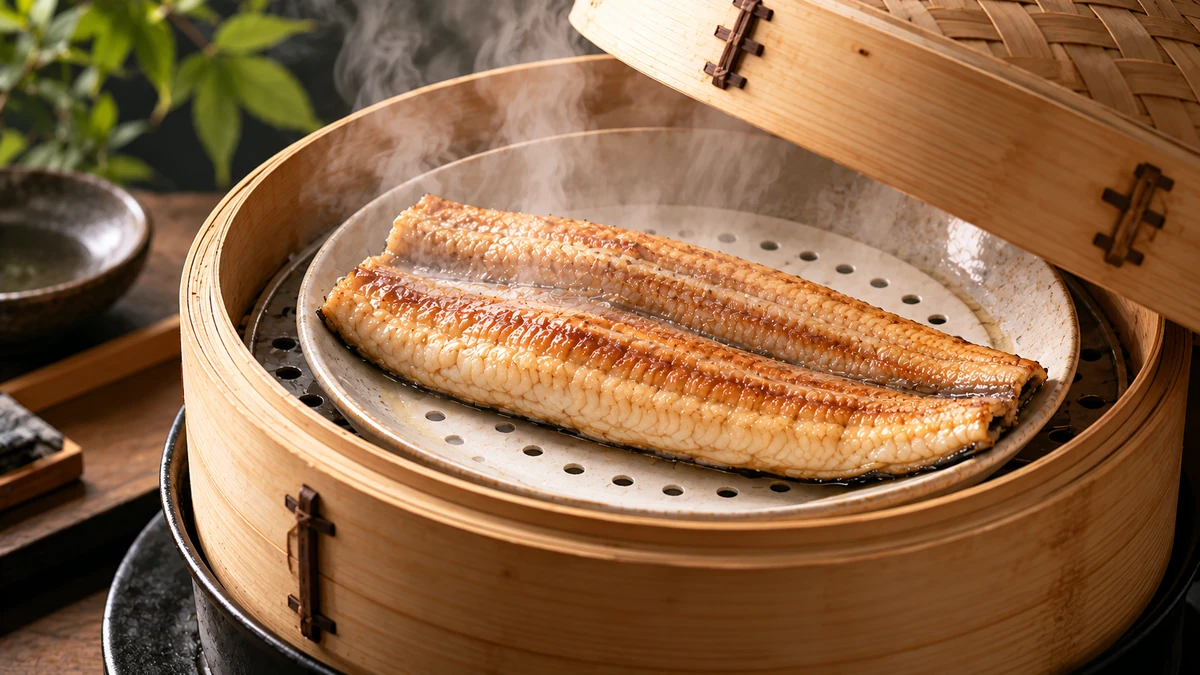
Steaming is a separate step before the final grilling. Japan's Ministry of Agriculture, Forestry and Fisheries describes Edo-style kabayaki as being grilled without sauce, steamed, then coated with sauce and grilled. If two eel dishes are tasted with steaming varied as well, the comparison reveals differences between the entire processes. To examine the effect of the heat source, keep the presence or absence of steaming and its conditions consistent. The sources reviewed here do not allow us to give a magnitude for texture changes or a percentage reduction in fat due to steaming. Source: Ministry of Agriculture, Forestry and Fisheries, “Unagi no kabayaki, Tokyo”
Designing a fair comparison
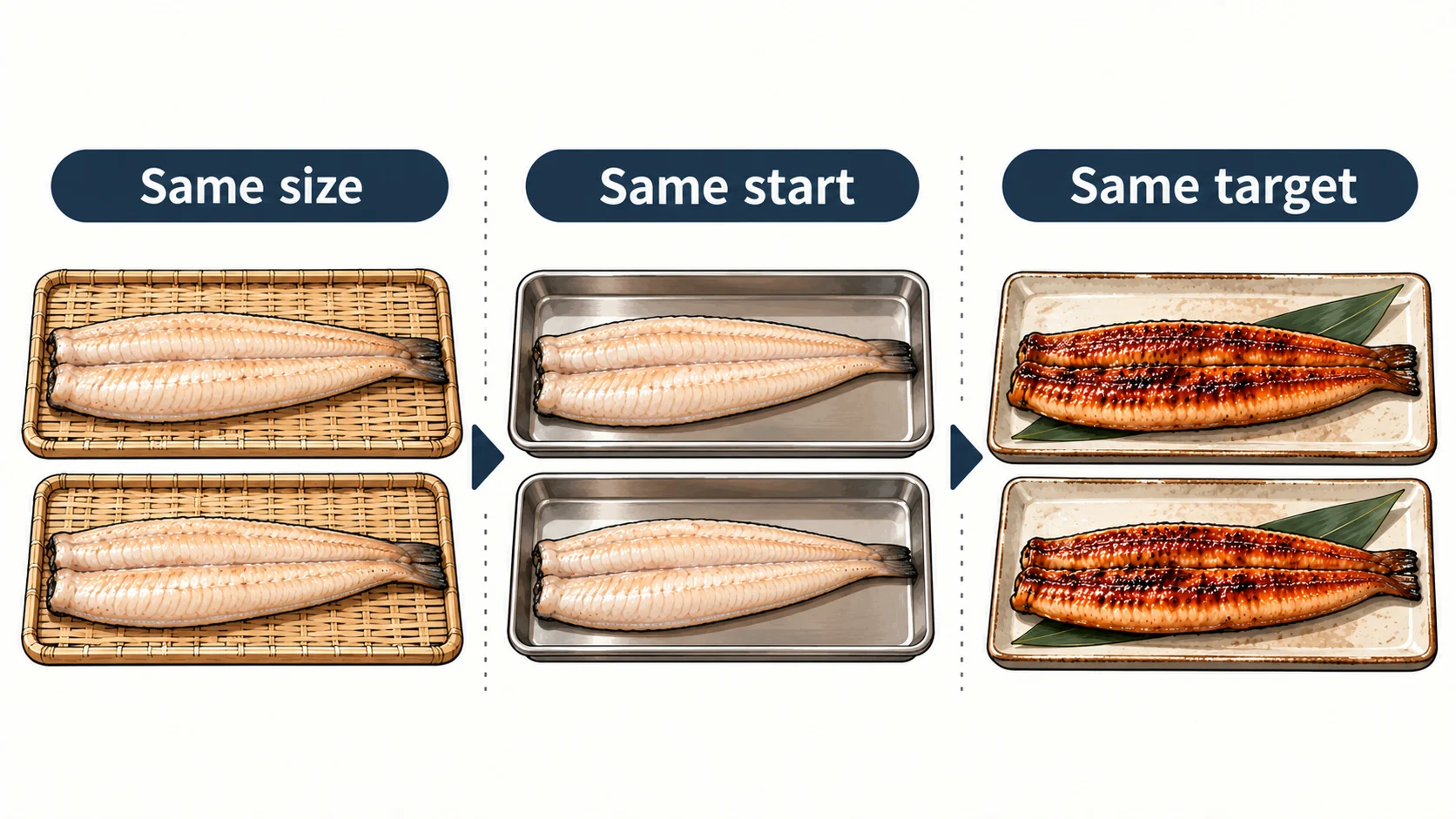
First decide what you want to find out. Asking what happens after the same cooking time is different from asking how to adjust the process to reach the same target result. In the latter case, cooking times may differ, so specify the type of comparison at the outset. Experimental design should fit the objective and factors being investigated, while managing other conditions that could influence the results. Source: NIST introduction to experimental design · Control of conditions and randomization
For an eel comparison, the following records could be useful. This is a comparison design proposed by this article, not a test procedure that has already been carried out or a set of results.
Ingredients: the part of the fillet, thickness, size, temperature before heating, and state of thawing.
Process: whether preliminary grilling without sauce and steaming are used, sauce recipe and application method, and turning procedure.
Equipment: appliance, heat settings or charcoal condition, distance from the heat source, and position on the grill.
Assessment: the cooking time being compared or target result, weight after cooking, surface color, and time before eating.
Even with the same appliance, position and cooking order may introduce differences. Repeating the comparison, changing the order, and recording conditions can help avoid generalizing from a single impression. Use equipment and procedures that allow safe operation, and do not judge whether food is safe to eat by browning alone.
Keep observations separate from explanations too. “The surface became darker under these conditions” is an observation that can be recorded. “Components of charcoal increased umami” is an explanation requiring separate verification. “I liked this aroma” can be recorded as a personal assessment, but it cannot be generalized to everyone's preferences.
In another study using chicken, participants could distinguish the odors of charcoal grilling and gas grilling on a grate, but no statistically significant difference was found in odor preference or overall evaluation. A difference in aroma should be distinguished from a guarantee that one method is preferred. This study did not evaluate eel kabayaki either. Source: Ishiguro et al., 2005
A lack of statistical significance is not proof that the methods are equivalent.
Choosing at home and in restaurants
At home, start by respecting the fuel, intended use, and location specified for your appliance. Do not bring a shichirin charcoal brazier or charcoal grill indoors to try charcoal cooking. The U.S. Consumer Product Safety Commission warns against using charcoal in homes, vehicles, tents, and similar enclosed spaces, and states that charcoal grills should be used outdoors only. Carbon monoxide is colorless and odorless, and burning charcoal produces it. Opening windows or running an exhaust fan does not make indoor charcoal use in a home acceptable. Source: CPSC charcoal safety information · CDC carbon monoxide information
Charcoal installations in restaurants must be considered separately from household appliances. Japan's Ministry of Health, Labour and Welfare has published a poisoning incident in which lit charcoal was stored inside a restaurant while the exhaust system and related equipment were not operating. Installing equipment is not enough: operating procedures and safety training need to cover lighting the charcoal, service, and standby periods. Before installing or changing commercial equipment, consult the manufacturer, a specialist contractor, and the relevant authority when necessary. Source: Ministry of Health, Labour and Welfare occupational accident case
Use a charcoal grill in an open outdoor area, away from doors, windows and vents. Never use it in a garage or carport; carbon monoxide can enter the home. CDC
When cooking raw fish, check the internal temperature with a food thermometer. The US FDA recommends 63°C (145°F) for finfish. Follow preparation and reheating instructions on ready-cooked packaged products; for leftovers, the FDA recommends reheating to 74°C (165°F). Also consult local food-safety guidance. FDA
When choosing a restaurant or product, look beyond “charcoal or gas” to whether the eel is steamed, how sauce is used, and what texture the cook aims for. For cooking or reheating at home, prioritize the product label and appliance instructions. Rather than ranking methods by fuel alone, check the conditions and cooking method, and choose what suits your preferences and equipment you can use safely. That is the practical lesson of this comparison.
Related articles