Japanese eels use estuaries and coastal waters as well as rivers. During growth they use places to hide and tend to be active at night, but behavior varies with water temperature, season and individual. Going beyond the life-cycle outline that they are born at sea, this article explores their habitats, feeding, movements and body functions. Habitat research; tracking studies of yellow eels.
Are Eels Freshwater Fish? Using Rivers, Brackish Water and the Sea
When considering where eels live, look beyond the environment in which they were found to their earlier habitat history. Research reveals lives that cannot be captured by a simple choice between river and sea.
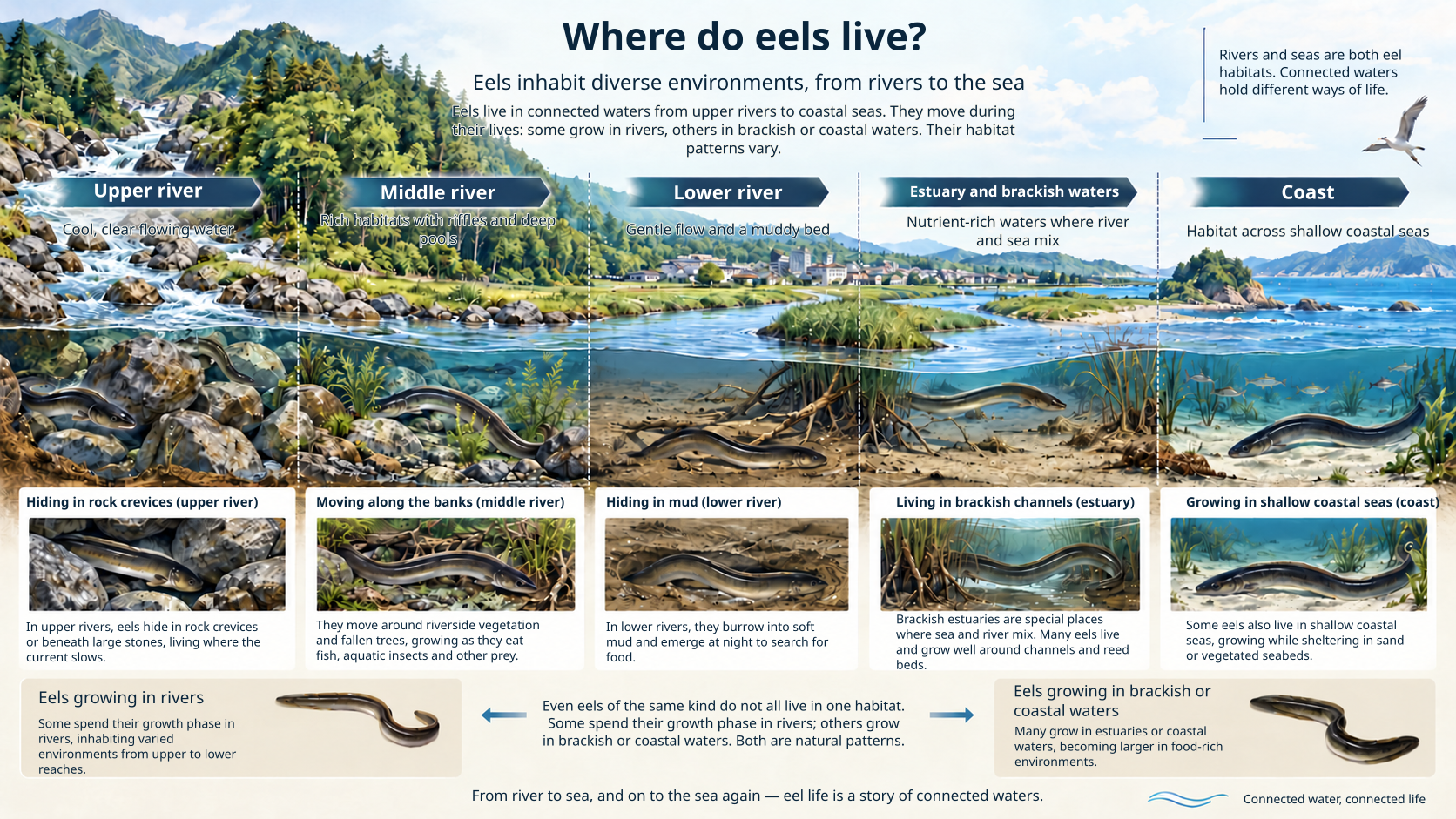
Some Grow in Rivers; Others Remain at Sea
If you think Japanese eels grow only in rivers, you might mistake those found in estuaries or at sea for a different fish. Yet studies of strontium and calcium in otoliths have identified individuals that never entered freshwater. Habitat histories vary, and some eels use environments with different salinities. Otolith research by Tsukamoto and Arai.
The everyday term ‘freshwater fish’ is useful for describing where eels are often seen. It is more accurate, however, not to interpret it as meaning they cannot survive in seawater. Even those seen in Japanese rivers begin life in the open ocean. Sea and river need to be viewed as connected environments. Life history: Fisheries Agency and Japan Fisheries Research and Education Agency.
Even Within One River, Access to Habitat Varies
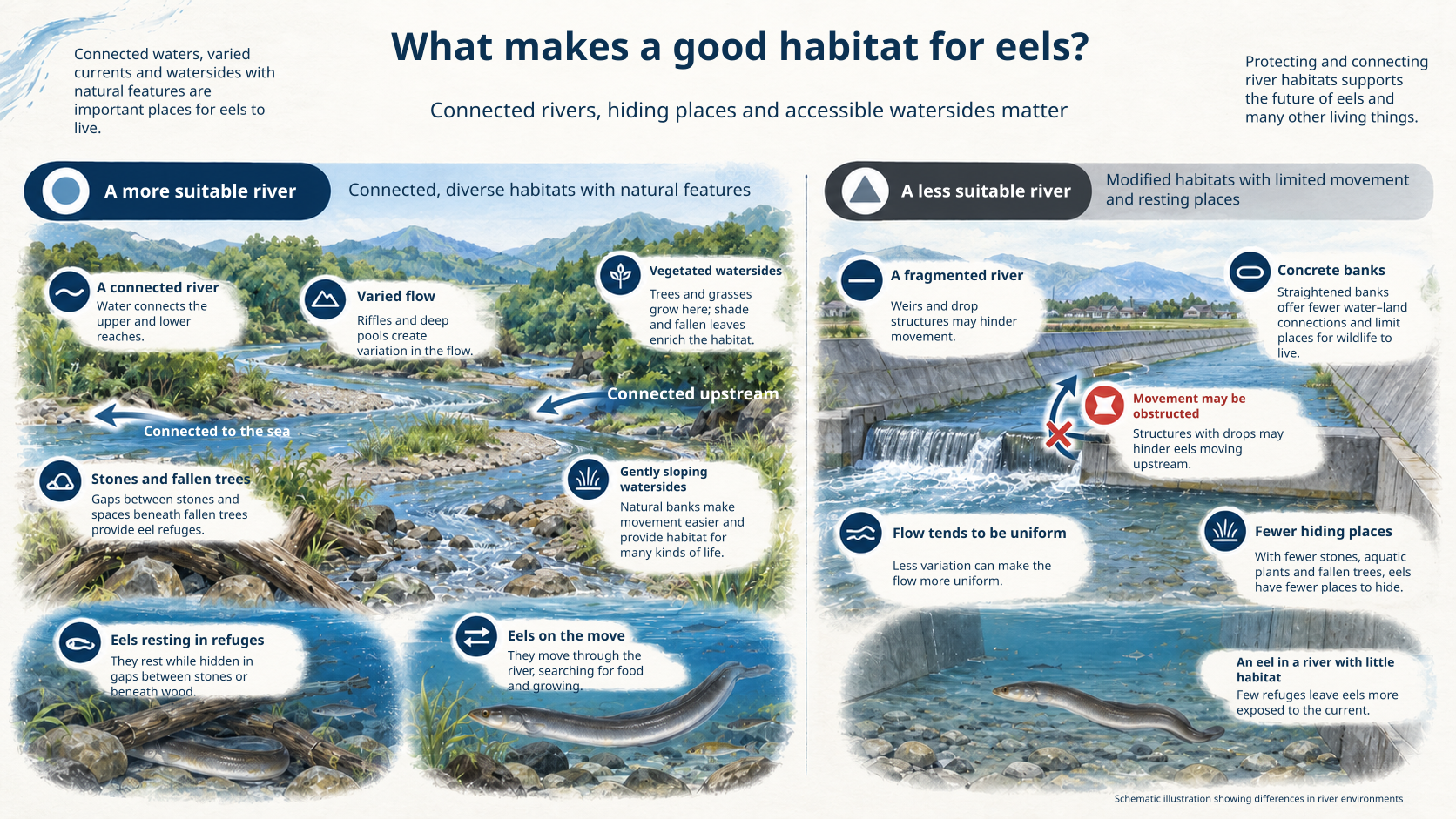
A study of 78 sites in six Japanese rivers found that densities of Japanese and giant mottled eels, and the number of other migratory animal species, were associated with distance from the estuary and the cumulative height of structures spanning the river. Eels need not just water, but a route to reach it from the sea. Itakura et al. (2020).
This does not mean that a single weir makes eel presence upstream impossible. No uniform boundary can be drawn without considering structures’ shape and height, flow and surrounding conditions. Consider habitat sites together with the routes leading to them.
Do They Hide by Day and Move at Night?
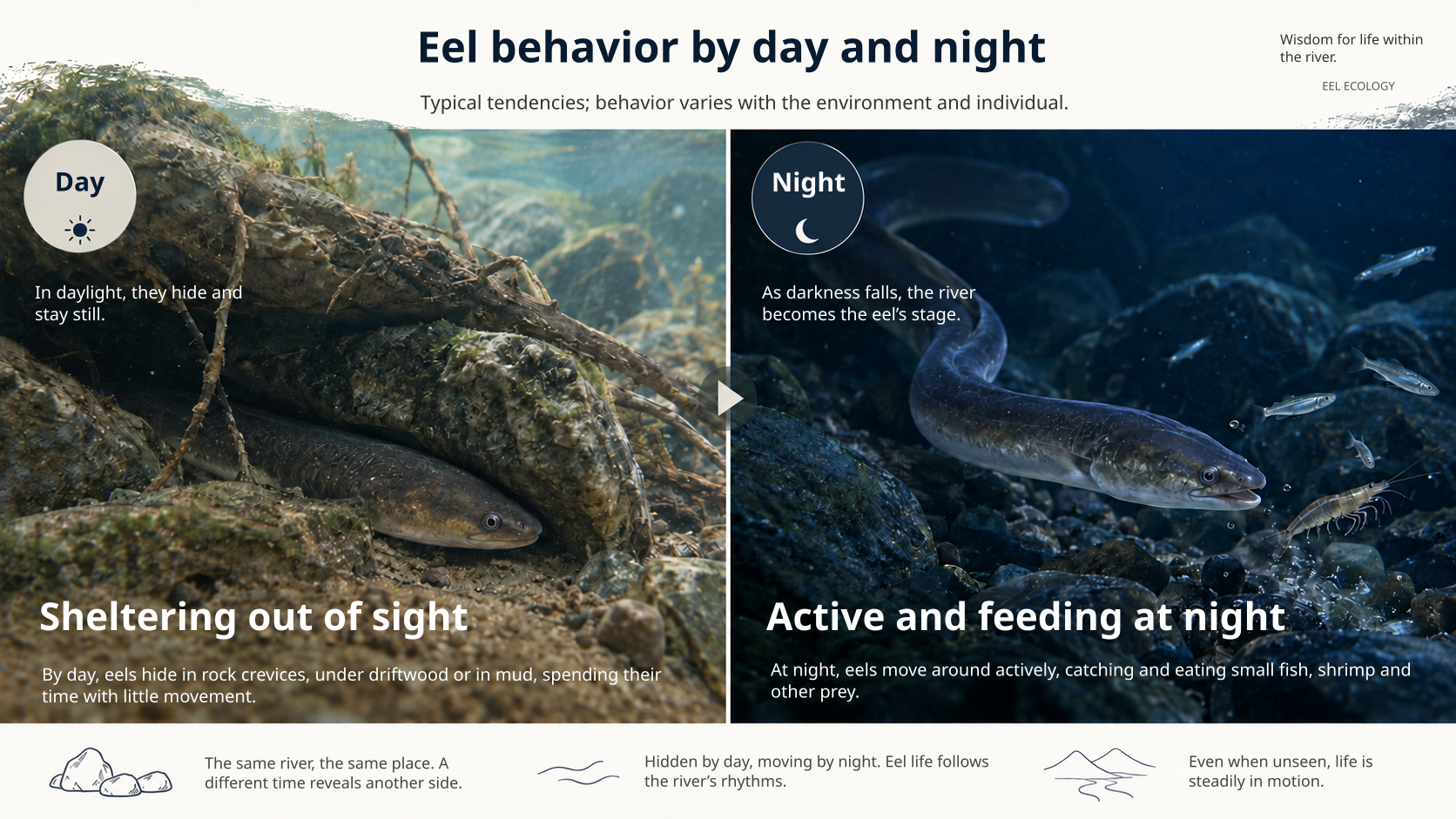
Acoustic tracking of freshwater yellow eels revealed nighttime activity, dormancy, homing and use of limited areas. Finding eels difficult to see in a river by day is not the same as their absence. Itakura et al. (2018).
‘Nocturnal’ describes a tendency, however, rather than a rule that they never move during daylight. A study tagging 19 Japanese eels in Korean rivers also tracked daily activity and movement for each individual. Descriptions of behavior need to identify the observation site, season and individuals studied. Research on river movement and daily activity.
One unsuccessful observation is not proof of absence. Conversely, footage of one active eel cannot establish that its species always behaves that way. Learning about ecology means considering how to preserve the whole habitat, rather than destroying hiding places to search for eels.
What Do They Eat? Diet Changes With Growth Stage
Before reading about food, check whether the subject is larvae in the open ocean or individuals growing in rivers and coastal waters. Linking diet to the stages when body form changes makes the differences clearer.
Larvae Eat Marine Organic Matter, Rather Than Small Fish
Leptocephali drifting in the open ocean are not simply miniature adults. Gut-content and isotope analyses support the idea that they eat marine snow, aggregates of organic matter. Marine snow is not the name of a single plankton species: it consists of particles made up of various materials. Review of larval diet research.
However, the detailed composition of the particles eaten in the wild and the nutritional contribution of each component have not been fully established.
Feeding and digestive organs also change after metamorphosis. A 2023 experiment with artificially reared Japanese glass eels examined individual differences in feeding onset and digestive-organ development after metamorphosis. This cannot be generalized to one feeding-start time for all wild individuals. Eel food cannot be reduced to a single item without considering life stage. Research on feeding after metamorphosis.
Feeding During Growth Is Linked to Habitat
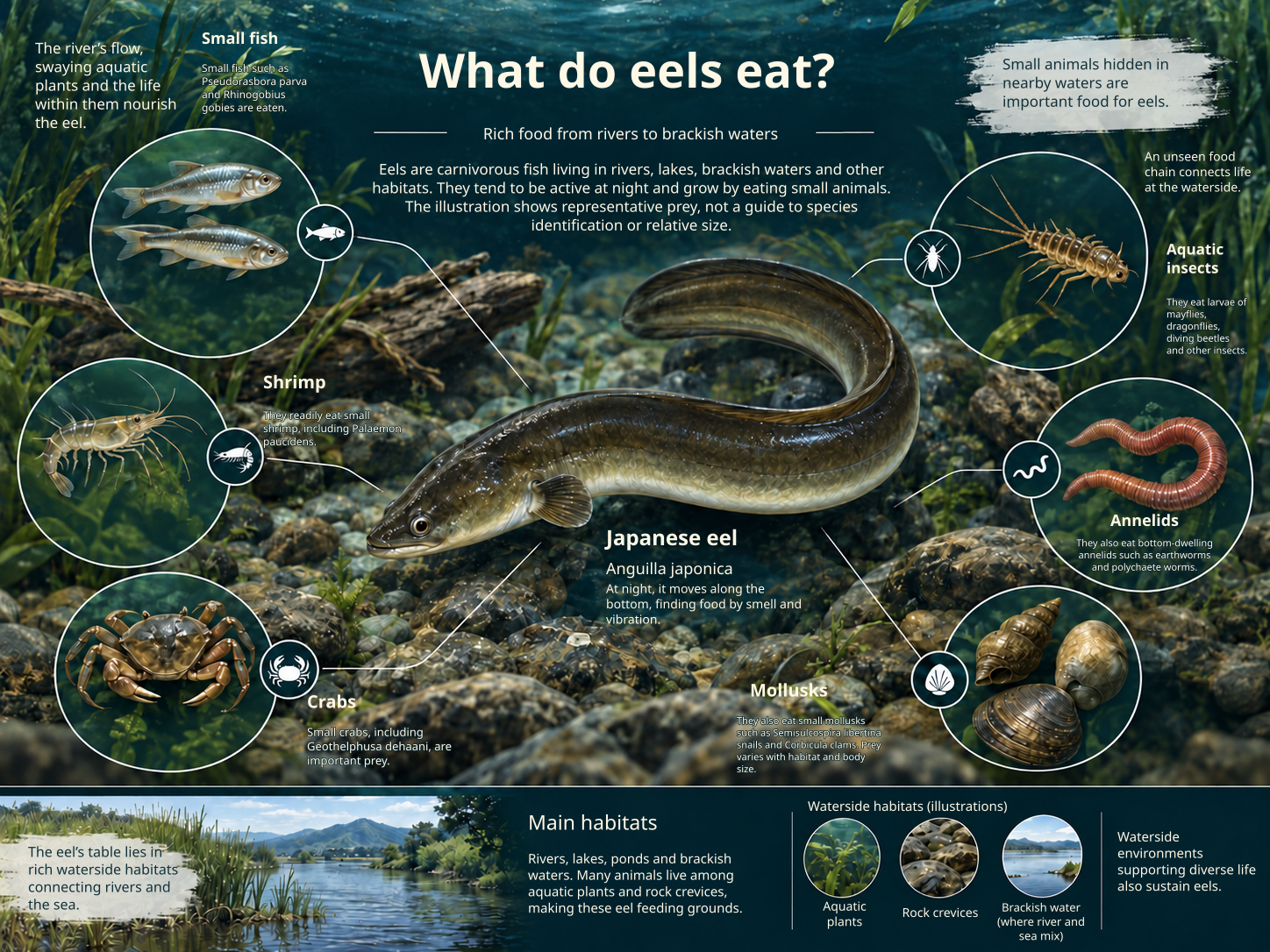
Growing Japanese eels use animal food available where they live. A study comparing 533 yellow eels from freshwater and brackish habitats examined how differences in stomach fullness and feeding over the year related to differences in growth. At least within that study system, the two environments could not be treated as equivalent. Kaifu et al. (2013).
Food diagrams therefore give representative examples, rather than menus for every individual. Considering what prey is present, whether it is small enough to eat and which seasons allow activity connects diet with habitat. Distinguishing formulated aquaculture feed from food found in wild eels’ stomachs also helps avoid confusion.
How Their Bodies Cope With Seawater and Freshwater
In environments with different salinities, eels must maintain a balance of water and salts inside the body. Physiological research examines osmoregulation involving the gills, kidneys and intestine. They do not tolerate any water without doing anything: their bodies adjust to environmental conditions. Review of osmotic adaptation research.
For example, experiments with eel esophagi have examined changes in ion permeability between freshwater acclimation and after seawater acclimation. Organ functions invisible from outside help eels respond to different environments. Research on osmoregulation in the esophagus.
This ability does not mean they can tolerate any deterioration in water quality or abrupt environmental change. Do not directly turn knowledge of habitat use in nature into instructions for water changes or sudden switches between freshwater and seawater in captivity.
Why Head to Sea? Silvering and Spawning Migration
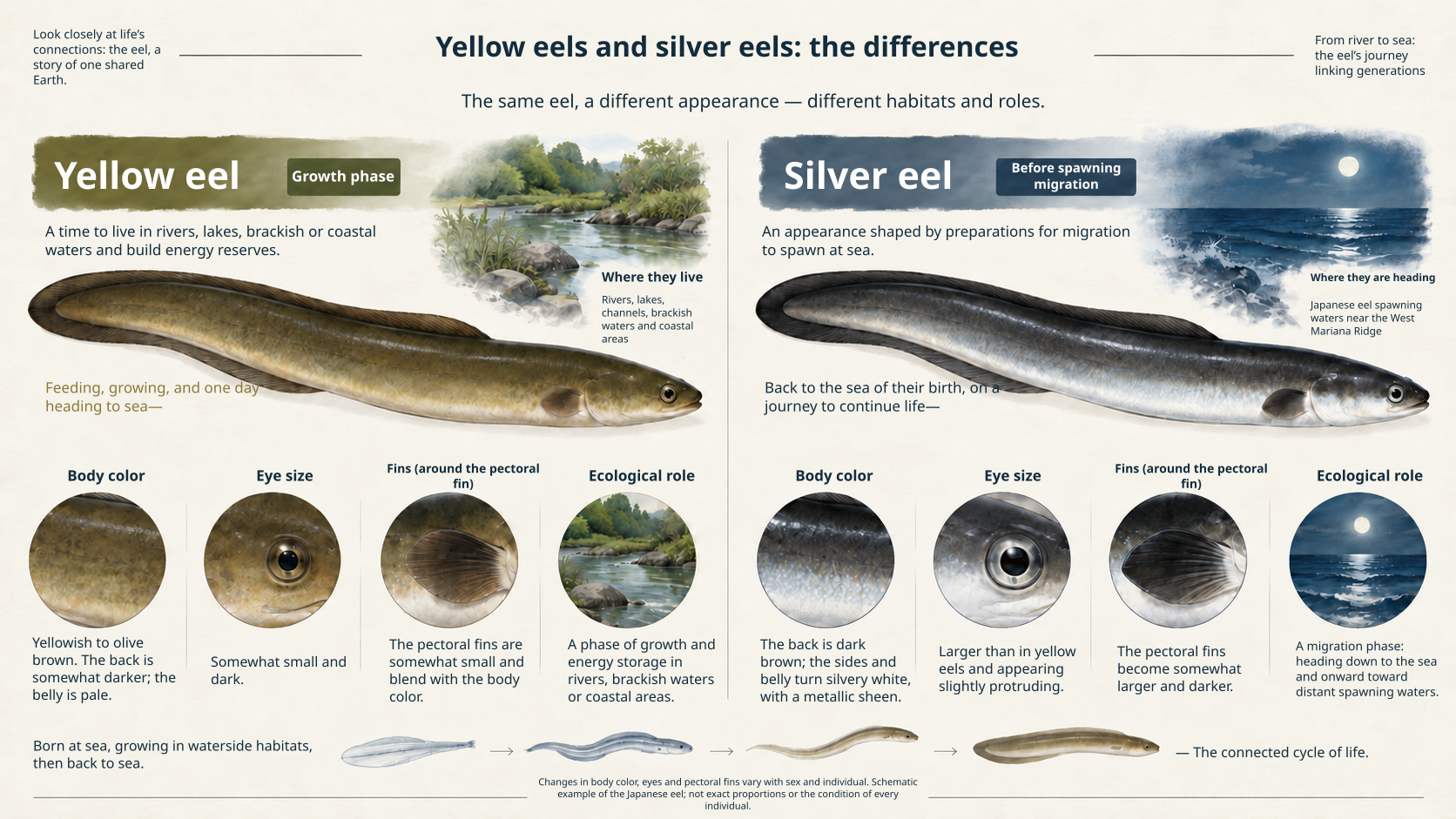
As Japanese eels grow, they undergo silvering in preparation for spawning migration. Changes in body color, pectoral fins and eyes accompany a transition away from the growth phase. Silvering studies examine visible changes alongside gonadal development. Research on silvering and maturation.
Silvering is not the same as completing final maturation and being able to release eggs or sperm.
At sea, eels change depth as well as moving horizontally. A release-and-tracking study along the West Mariana Ridge found daily vertical migration in individuals with continuous records. This is a specific tracking result, not proof that all individuals always swim at the same depths. Tracking research using transmitters.
The sequence of life stages is covered in ‘The Japanese Eel Life Cycle’ (article-12), and evidence for the breeding area in ‘Where Japanese Eels Spawn’ (article-10). Arrows on migration diagrams summarize movement; they are not the path of a wild eel tracked continuously from birth to spawning.
Understanding Ecology Reveals Habitats Worth Protecting
Protecting eels involves more than the fish themselves. Connections between sea and river, hiding places and prey organisms all matter. Research using eels as indicators of freshwater biodiversity also focuses on their broad habitat use and migratory nature. Itakura et al. (2020).
A river’s clean appearance alone cannot establish its suitability as habitat. Water quality, migration routes and the structure of banks and riverbeds need separate examination. Rather than assuming a seemingly hardy fish will be fine, start by considering what each life stage needs.
Frequently asked questions
- Does the Same Ecology Apply to All Eels?
- No. This article mainly covers research on Japanese eels. Distribution, growth and other traits differ between species. Avoid mixing in knowledge of similarly named electric eels or conger eels, which belong to another family. See ‘Types of Eels’ (article-03) for classification.
- Does Seeing a Silver Eel Mean It Is About to Spawn?
- Color alone cannot tell you. Silvering has stages, assessed using external appearance, internal condition and the collection environment together. Finding a silver eel is different from witnessing spawning. Silvering indices for Japanese eels.
Related articles