Kagoshima, Aichi, Miyazaki and Shizuoka are major eel-farming regions in Japan. In 2023, their farming output ranked in that order, and together the four prefectures accounted for about 94% of the national total. These are production figures for a specific year, not a ranking of flavour or a guarantee of the current order. Origin terms such as “produced in Japan” or “from Kagoshima Prefecture” do not identify the fish species. To shop with confidence, distinguish where the eel was raised, where it was processed and which species it is.
Japan’s main producing areas and output
First, compare scale using figures from the same year and in the same unit, then look at each region’s background.
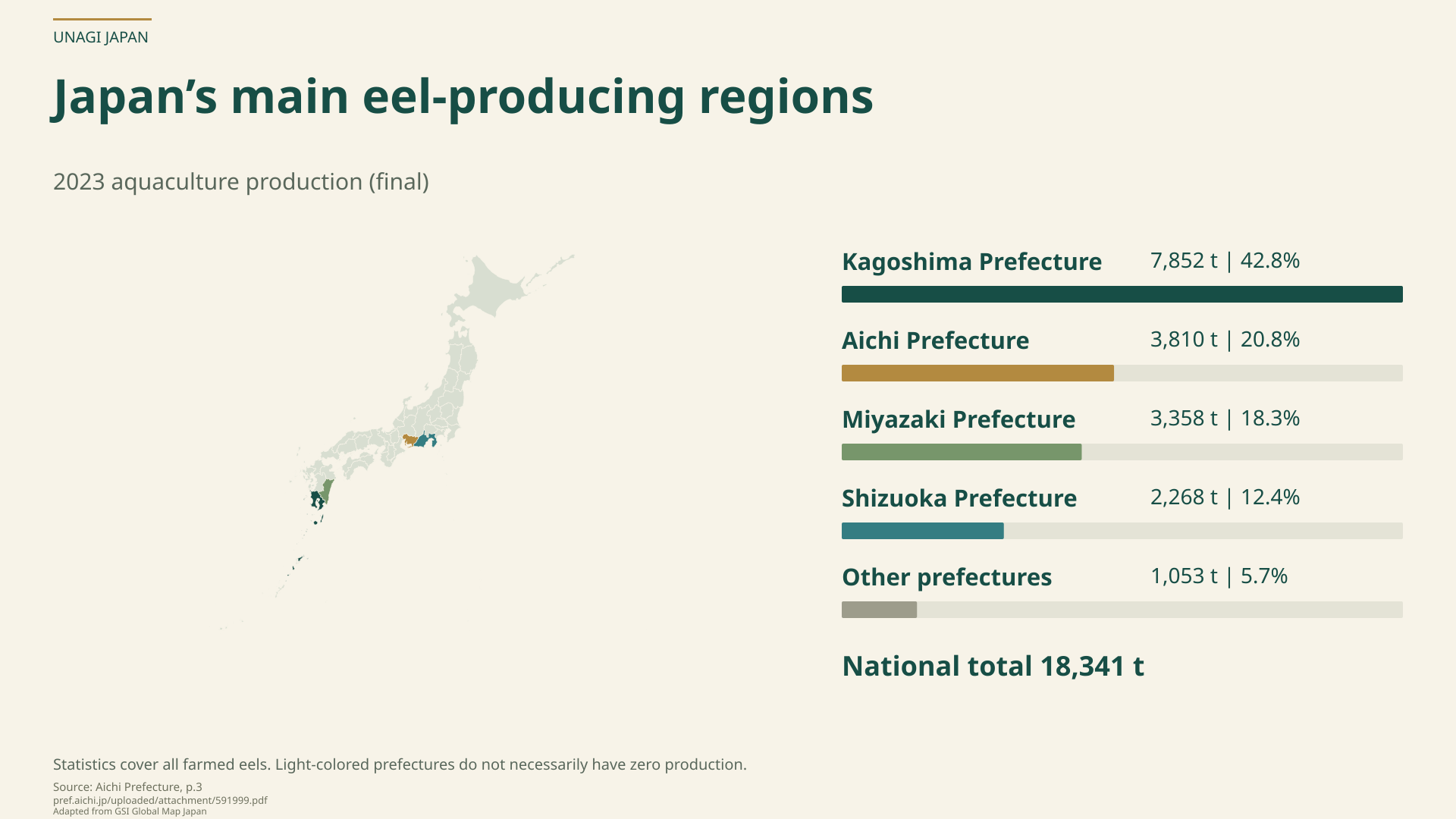
Farmed eel production in 2023
The following 2023 eel-farming figures appear in Aichi Prefecture’s official publication “Trends in Fisheries 2025.” The unit is tonnes; wild eel catches and imports are excluded.
1. Kagoshima Prefecture: 7,852 tonnes 2. Aichi Prefecture: 3,810 tonnes 3. Miyazaki Prefecture: 3,358 tonnes 4. Shizuoka Prefecture: 2,268 tonnes 5. Mie Prefecture: 246 tonnes
Japan’s total was 18,341 tonnes. Dividing the top four prefectures’ combined 17,288 tonnes by the national figure gives about 94.3%. The source draws on the Survey of Inland Water Fishery Production Statistics and other data.
These figures show that domestic farming is concentrated in a few regions. They do not show that all businesses in a prefecture use the same husbandry, ship the same sizes or produce the same flavour. Nor does a prefecture with high output necessarily have more restaurants or higher consumption.
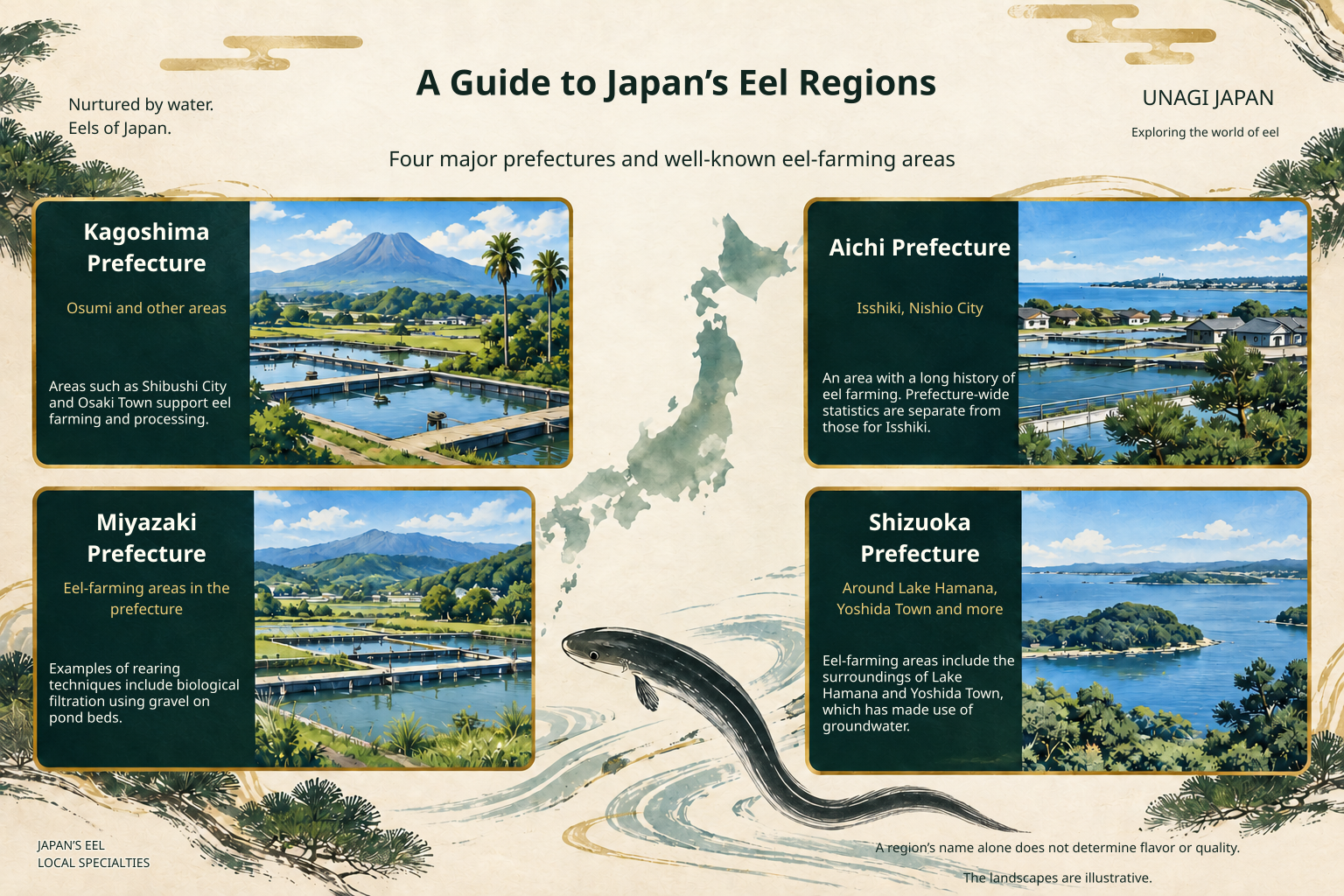
Kagoshima: farming concentrated in areas such as Ōsumi
Kagoshima Prefecture’s materials describe eel farming in an area that includes Shibushi City and Ōsaki Town. Looking beyond the prefecture name to municipalities and producers reveals the communities supporting farming and processing.
Production statistics cannot, however, establish claims such as “Kagoshima eels are always thick-fleshed” or “southern regions produce fattier eels.” If texture matters to you, check product size and processing method as well as origin.
Aichi: a history of eel farming in Isshiki
The Isshiki district of Nishio City, Aichi, has a history of eel farming. Nishio City traces its development from the establishment of a fisheries experimental station and early attempts to raise eels in carp ponds. This background also helps explain the regional name when choosing products today.
“From Aichi Prefecture” and “from Isshiki” do not cover the same area. Do not present statistics for the entire prefecture as though they were output for one particular district.
Miyazaki: regional approaches to pond management
The Miyazaki Fisheries Products Brand Promotion Committee describes the “Miyazaki method,” which uses gravel on the pond bottom to provide biological filtration. When learning about a region, these husbandry practices offer more concrete information than a general claim of good taste.
However, a representative regional method is different from the specifications of the particular product you buy. Do not assume every producer uses the same conditions; consult the product’s producer information if you want details.
Shizuoka: look beyond Lake Hamana to Yoshida
Many people associate Shizuoka eel with Lake Hamana, but there are other eel-farming areas in the prefecture. Shizuoka’s official account describes Yoshida Town’s use of groundwater originating from the Ōi River and its handling of fish before shipment.
The place where you eat eel while travelling is not necessarily where the ingredient was raised. If you are curious at a restaurant, asking where today’s eel comes from helps you appreciate both the local cuisine and its ingredients.
Domestic production and imports are different figures
A ranking of Japanese prefectures measures how much farms in Japan produced. Import statistics measure goods arriving from abroad, so mixing prefectures and countries in the same ranking obscures the meaning.
The Ministry of Agriculture, Forestry and Fisheries’ explanation of imports shows their important role in Japan’s eel supply. However, comparing domestic farming, wild catches and imported processed products requires matching the year, product categories and methods of measuring weight. This article does not add its 2023 prefectural farming figures to imports from a different year to calculate shares.
Imported eels may also be processed in Japan. Therefore, where an eel was imported from and where it became kabayaki are different questions.
Read origin labels by separating farming and processing locations
A product label may contain several place names. Check what each one refers to.
Origin is different from the seller’s address
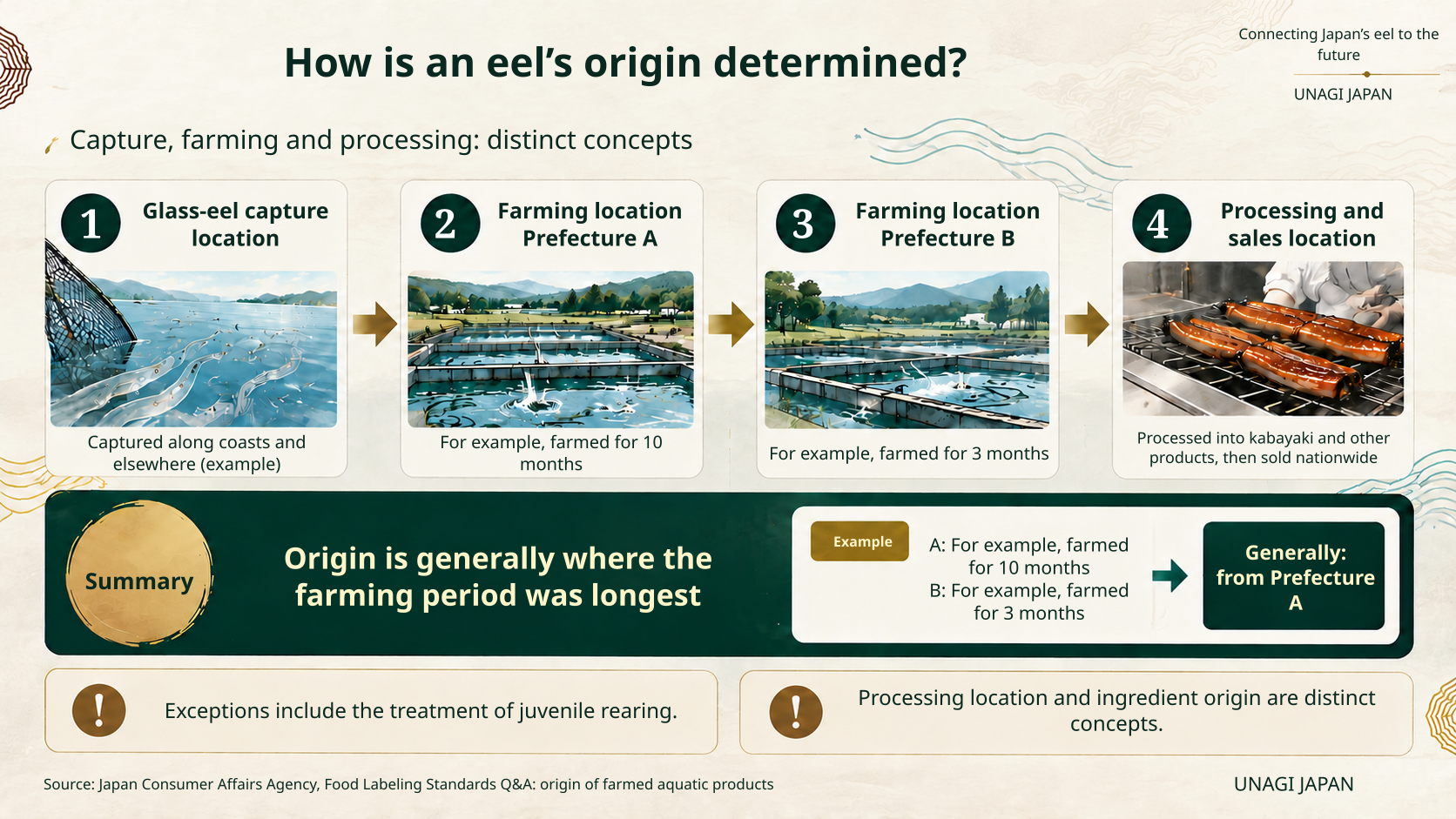
The origin of farmed aquatic products is based on the main farming location. Where several farms were involved, labelling rules take account of matters such as time spent farming. Origin is therefore not determined solely by the last place the fish was kept or the seller’s address.
Consumers cannot easily verify an individual product’s farming history by appearance. A practical approach is to read the label, then ask the seller about anything unclear. An origin name itself is not an official certification of flavour or sustainability.
“Processed in Japan” does not mean “eel raised in Japan”
Even when imported eels are made into kabayaki in Japan, the origin of the eel ingredient and the manufacturing or processing location remain separate. The Consumer Affairs Agency’s food-labelling Q&A gives an example of labelling the eel ingredient’s origin for imported eel heated and prepared as kabayaki in Japan.
Read more than the large text on the front of the package: check the origin alongside eel in the ingredient list and any ingredient-origin declaration. Treat the addresses of the manufacturer, processor and seller as separate information.
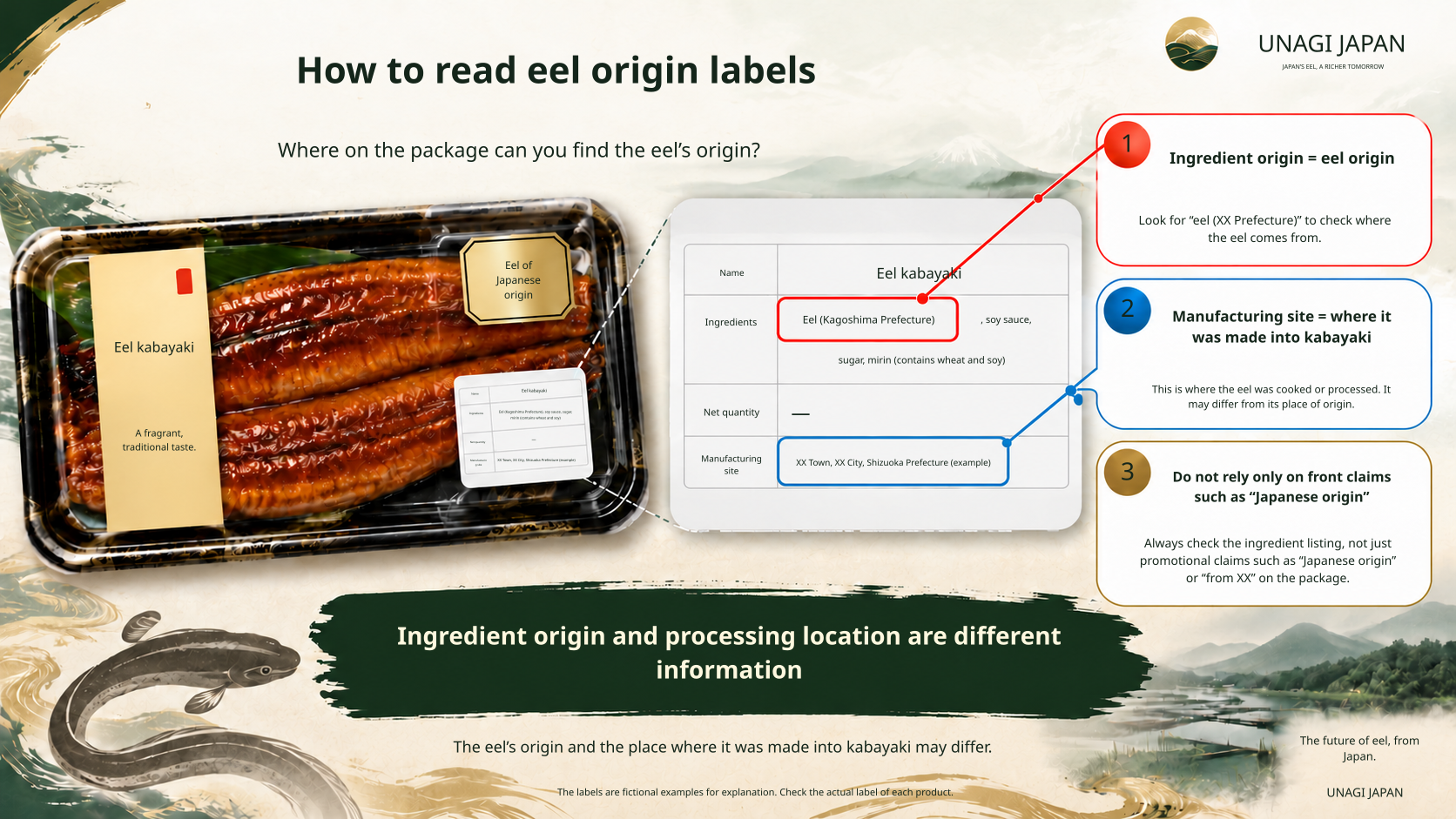
What to check when choosing by origin
First consider why you want a particular origin, such as supporting a region’s producers or recalling a trip. Then compare the following points in order to understand product differences.
- Is the origin of the eel ingredient clearly stated? - Is there an explanation of the producer or farming method that applies to this product? - What is the net quantity per fish or package? - Is it kabayaki or shirayaki, frozen or chilled, and how should it be reheated? - For a gift, can the recipient accommodate its storage and delivery requirements?
Since origin alone does not determine your preferences, cooking method and quantity also matter. Tasting products from different origins under comparable conditions can help you find the finish you enjoy.
Frequently asked questions
- Which prefecture produces the most eel in Japan?
- For the 2023 domestic farming output compared here, Kagoshima Prefecture led with 7,852 tonnes. Distinguish this from a ranking for the latest year.
- Does “produced in Japan” mean Japanese eel?
- “Produced in Japan” is information about origin, while “Japanese eel” is a species name. They do not mean the same thing. To identify the species, consult the product description or seller. The related article “Types of eel” explains species.
- Does a different origin always mean a different taste?
- Origin alone cannot determine flavour. Alongside the producer’s husbandry, compare similar sizes, steaming and grilling processes, sauces and reheating methods.
Related articles