In this context, Māori tuna means eels, principally New Zealand freshwater eels—not the tuna fish named in English. The Department of Conservation (DOC) describes tuna as taonga, something treasured by Māori. DOC DOCT
A fish name, historical food practices, current law and knowledge held by a community are not interchangeable. This guide explains attributable published material; it does not speak for all Māori or claim access to knowledge that has not been shared.
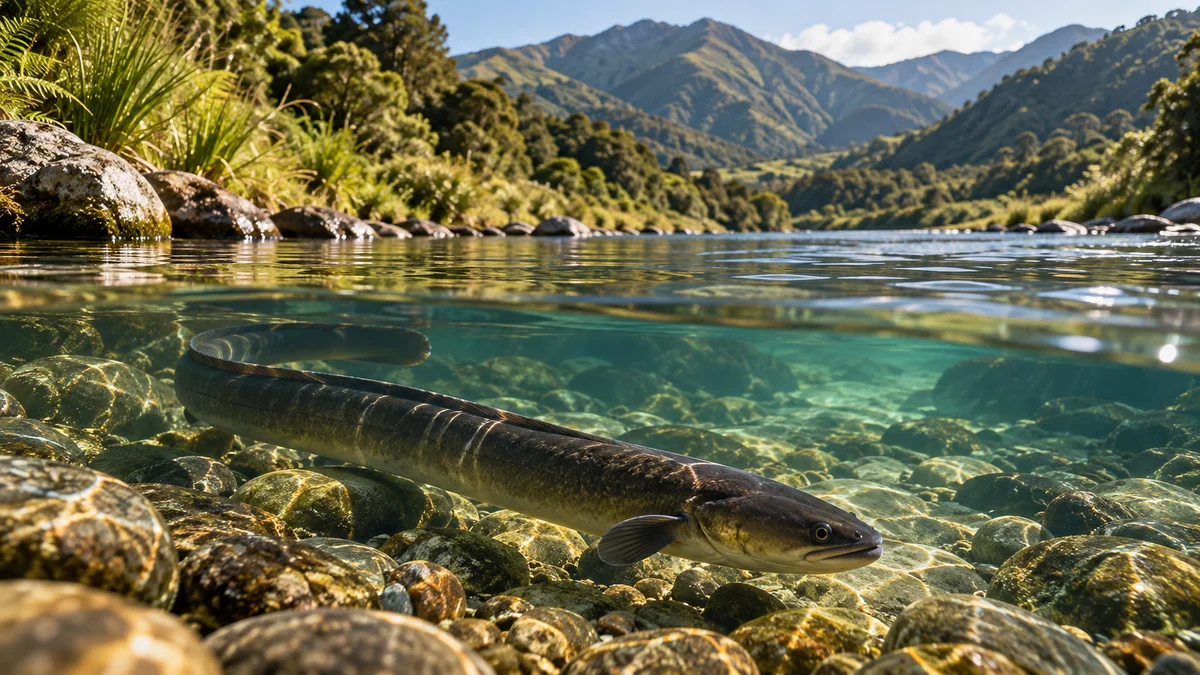
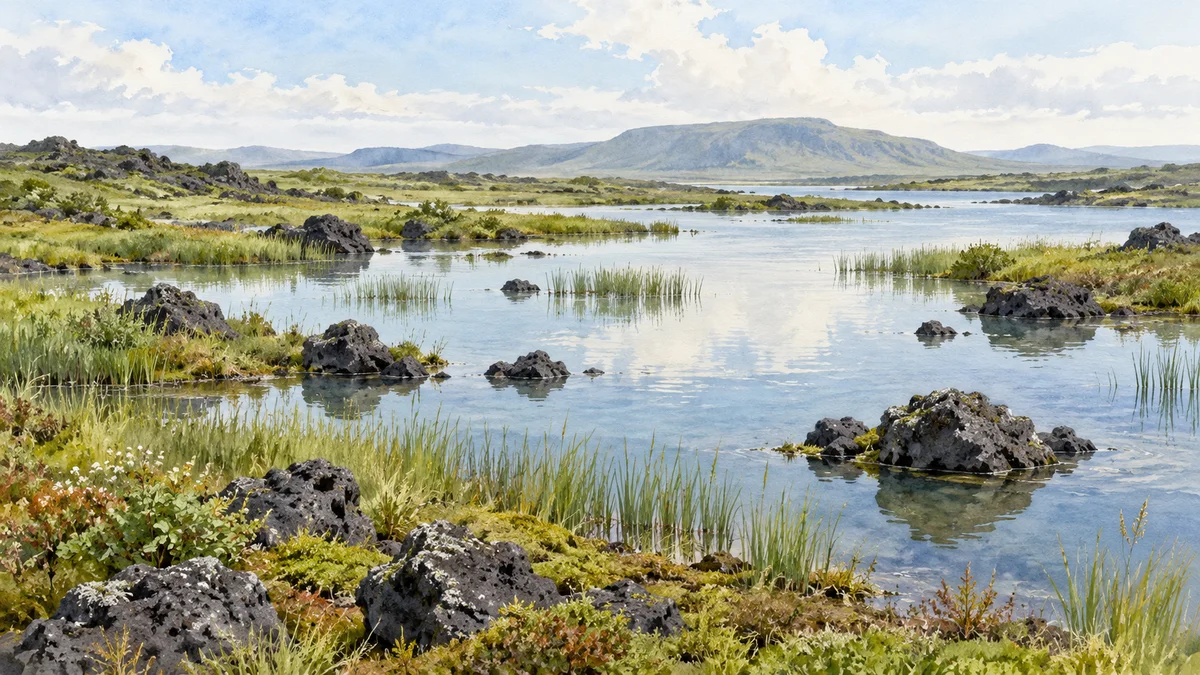
These illustrations are conceptual, not records of a particular place, original source or specific cultural practice.
Words and fish
1. Why tuna does not mean tuna fish here
DOC identifies tuna as the common Māori term for freshwater eels. Basil Keane’s entry in the public encyclopedia Te Ara adds that in some contexts the term can extend to eel-like animals, including conger eels and lampreys. A Māori word therefore cannot always be equated with one scientific species. DOC TEARAT
English tuna normally denotes tuna fish. Despite identical spelling, translate Māori tuna in this context as “eel,” checking the species, speaker and place. Taonga signifies a valued relationship, not merely a commercially valuable fish. DOCT
2. Which freshwater eel species live in New Zealand?
DOC and the aquatic research organisation NIWA identify three species: the endemic longfin eel Anguilla dieffenbachii, the shortfin eel Anguilla australis, also present in Australia and parts of the Pacific, and the relatively uncommon Australian longfin Anguilla reinhardtii. They should not be assigned the same conservation status or cultural meaning by default. DOC NIWAF NIWA merged with GNS Science into Earth Sciences New Zealand on 1 July 2025; source names are retained here.
The distinguishing feature is where the dorsal fin begins relative to the anal fin. In longfins the dorsal fin starts markedly farther forward; in shortfins the difference is small. Colour and preferred habitat are supporting clues, not conclusive identification. The illustration is schematic, not a guarantee for identifying a wild animal. NIWAT DOCT
Lives and places
3. A life connecting rivers, wetlands and estuaries
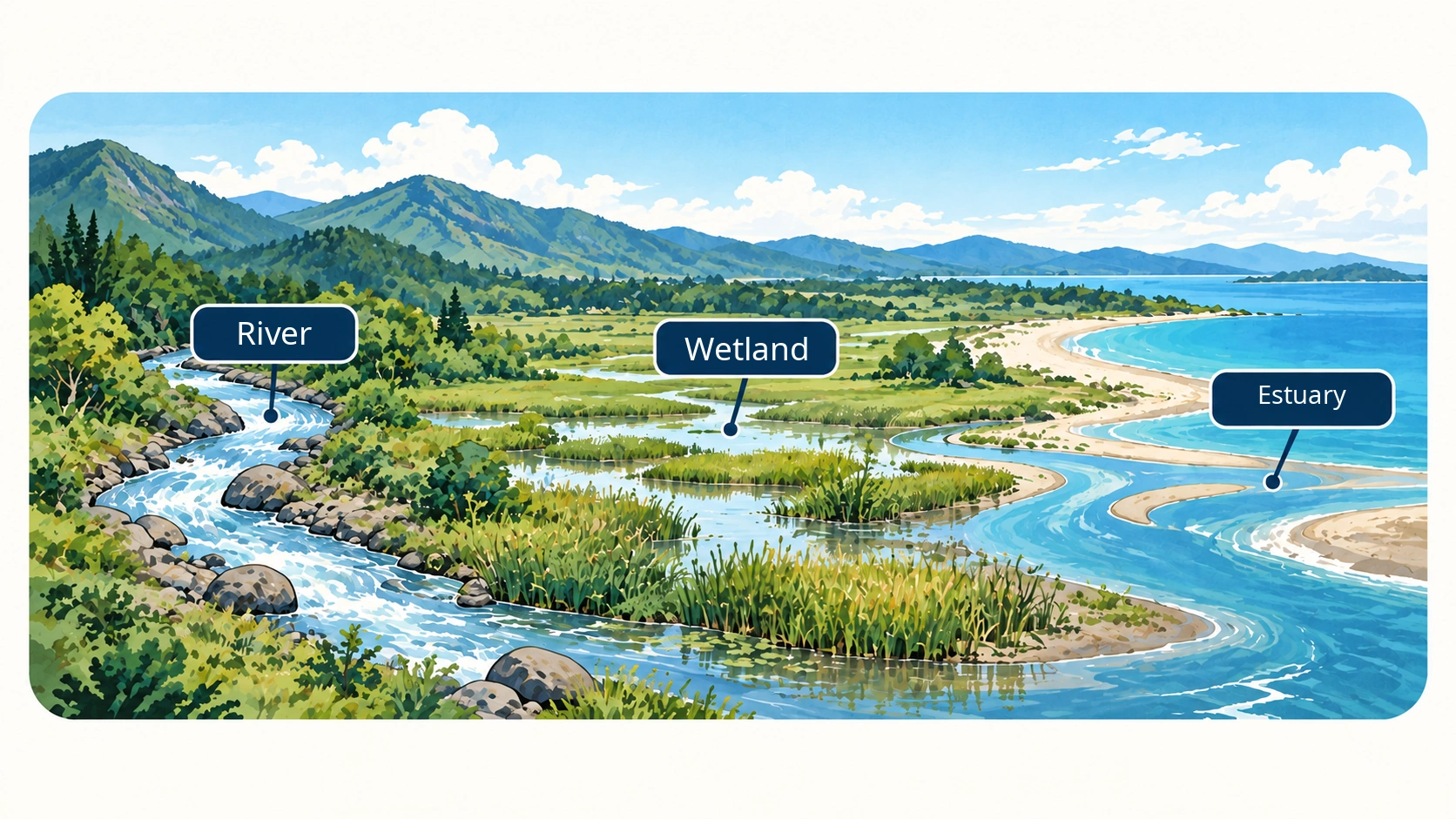
These eels do not spend their entire lives in fresh water. DOC and NIWA describe leaf-shaped larvae born at sea, carried towards New Zealand by currents, transforming into transparent glass eels that enter estuaries and rivers. Adults eventually migrate seaward again. Their exact spawning sites remain unconfirmed, so a precise migration route should not be invented. DOC NIWAT
Rivers, wetlands, lakes and estuaries are connected habitats needed at different life stages. Weirs, dams, culverts, drainage and pollution can interfere with passage and survival. The illustration shows a conceptual connection, not a mapped catchment or survey location. DOC NIWAT
4. Food is only one relationship
Writing for Te Ara, Basil Keane describes the historical importance of eels as food, the use of pā tuna (river weirs) and hīnaki (woven traps), and preservation through drying or partial cooking. This is a historical account, not a claim that everyone follows these methods today or instructions for catching and storing eels. TEARAT
DOC’s bilingual “Tuna – ā tātou taonga” also connects tuna to understanding waterways and passing knowledge between generations. It explicitly credits collaboration with Te Wānanga o Raukawa. Food and taonga are not mutually exclusive labels: the published account shows several intertwined relationships. DOCT
Do not eat freshwater fish raw or undercooked; cook it thoroughly. Use separate utensils for raw fish and cooked food. WHO Beijing
Handling sources
5. Ask whose account you are reading
Identify each source’s voice. DOC publishes a bilingual resource noting collaboration with Te Wānanga o Raukawa. Te Ara’s eeling history was written by Basil Keane. NIWA’s resource compiles published biological science. The publishers, purposes and scopes differ. DOCT TEARAT NIWAF
Reading a community’s published words does not empower an outsider to speak for that entire community. Preserve attribution to a particular locality, iwi (tribal group), hapū (kinship-based group) or named author, and avoid extending one account to unrelated places. NIWAF

6. Published knowledge and knowledge not shared
NIWA expressly says that compiling and publicising the extensive mātauranga Māori—Māori knowledge retained and practised by whānau (families and kin), hapū and iwi—is neither the purpose nor the place of its scientific resource. Absence from a public document is not evidence that such knowledge does not exist. NIWAF
This article cites only what is publicly explained. Do not reconstruct undisclosed places, rituals, oral practices or permissions from clues. Rohe broadly denotes an area or territory, but particular authorities and customs require local primary sources. The box with a padlock is a metaphor for a boundary, not a real archive or permission to share undisclosed knowledge. DOCT NIWAF

Management and conservation
7. Customary practice versus statutory management
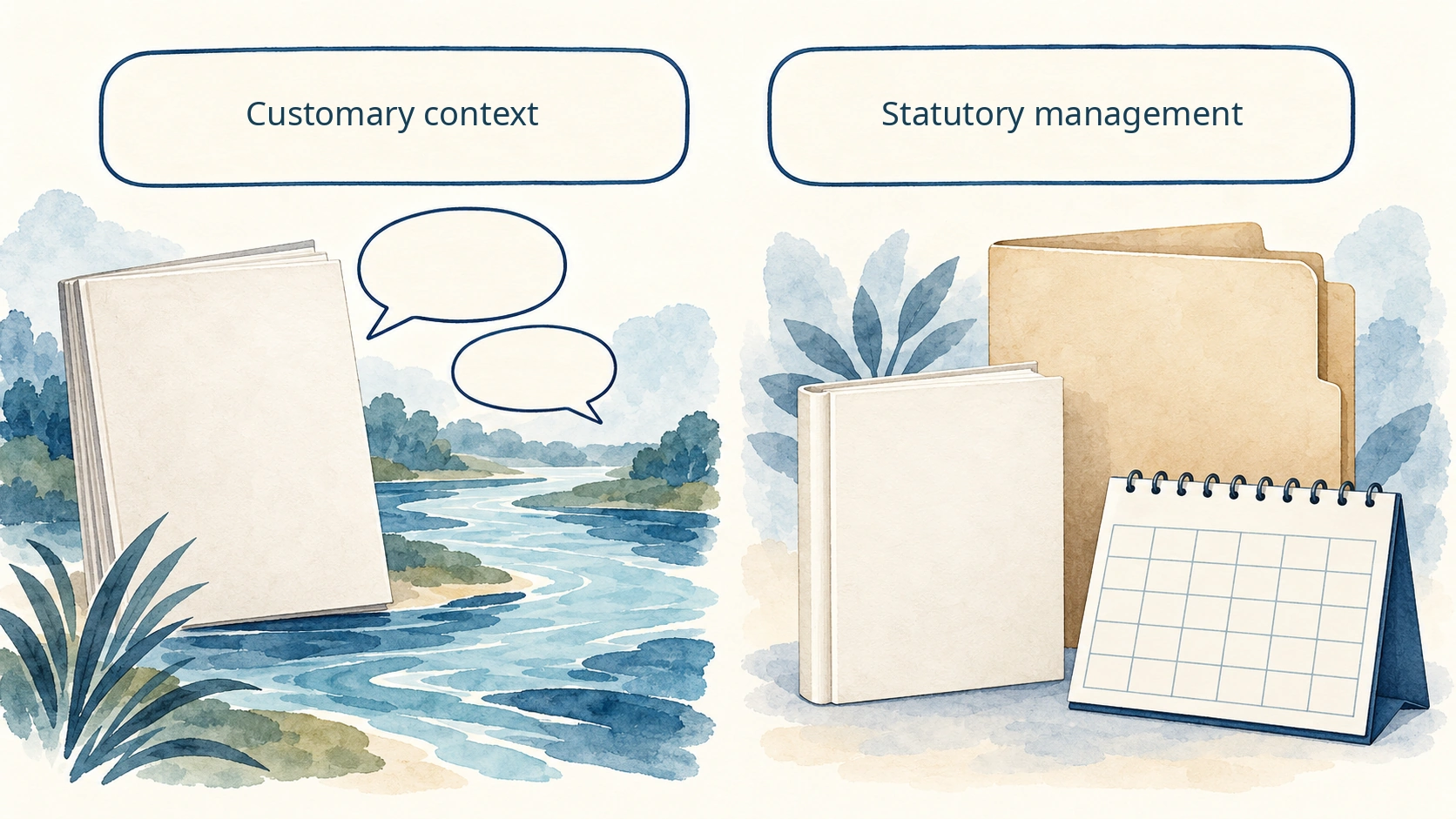
Customary practice and present-day fishing rules require different sources. DOC describes customary harvesting by tangata whenua (people connected to the land) within their rohe, and voluntary restraint by some iwi. The Ministry for Primary Industries (MPI), meanwhile, administers the commercial Quota Management System (QMS). DOCT DOC MPI
Customary management and legal rules are not always separate: statutory frameworks can recognise local customary management, with arrangements varying by area. MPI
The public DOC guidance checked on 2 November 2026 lists a general recreational bag limit of 6 eels per person per day. Protected places, local bylaws and customary management rules may impose additional restrictions: it is not a universal permission to take six. A conservation recommendation is distinct from a binding legal restriction. Check the latest rules for the exact place before acting. DOC MPI MPIB
8. Three coordinates for reading conservation claims
DOC currently classifies New Zealand longfins Anguilla dieffenbachii as At Risk – Declining and shortfins Anguilla australis as Not Threatened in its domestic assessment. This does not establish identical populations in every river, or imply that fishing has no effects. DOC identifies pollution, sediment, barriers, habitat loss and excessive harvest among the threats. DOC
For any conservation claim, record three coordinates together: (1) place—which waterway or rohe; (2) attribution—which speaker or agency; and (3) date—when it was published or the rule applied. Keep observations, scientific recommendations, voluntary industry measures and enforceable law distinct. NIWA emphasises restored passage in both directions and improved water quality. NIWAT MPI

In short: Understanding Māori tuna begins by reading the word as “eel,” not “tuna fish,” then respecting both the ecology and the boundaries of the attributed published account. A government summary cannot settle every cultural meaning, and a historical description is not permission to harvest.
Sources checked: 2 November 2026. Conservation classifications and harvesting rules may change.
The additional MPI customary fisheries management source was checked on 12 November 2026; access may vary by browsing method.
Related articles