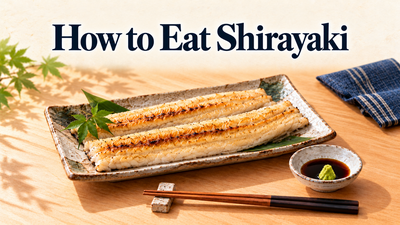
Eating eel on Doyō no Ushi no Hi combines a wish to stay well through hot weather with a food custom passed down since the Edo period. The story that Hiraga Gennai popularized it is famous, but there are several accounts of its origins; one anecdote cannot establish how it began. Separating the period called doyō from the day called an Ox day makes the occasion easier to understand.
What is Doyō no Ushi no Hi? An Ox day within a seasonal period
Rather than treating the phrase as one long name, separate doyō and Ox day. Let’s look first at the period, then at the cycle of days.
Doyō occurs four times a year, not only in summer
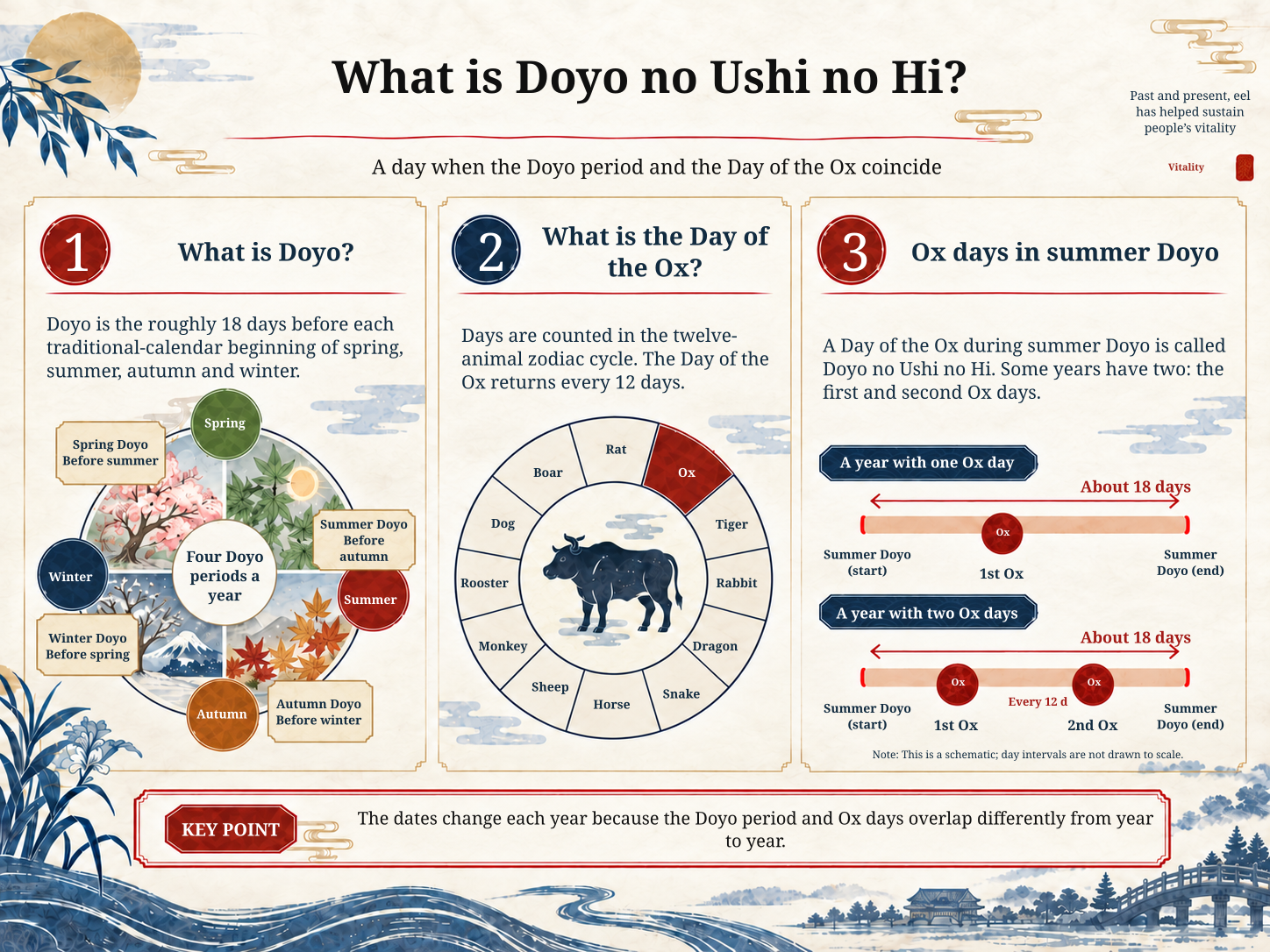
Doyō refers to the roughly 18 days before Risshun, Rikka, Risshū and Rittō, the calendar’s beginnings of spring, summer, autumn and winter. The National Astronomical Observatory of Japan defines it this way too. Summer doyō immediately precedes Risshū. Although doyō often brings summer to mind, it occurs in all four seasons of the calendar.
Despite similar pronunciation, doyō is a different word from doyō meaning Saturday. It does not mean a Saturday for eating eel. Risshū is a seasonal calendar marker, not a statement that the actual heat ends on that date.
Ox days recur every 12 days
The 12 zodiac signs are assigned to days as well as years. Ox days therefore recur on a 12-day cycle; one falling during doyō is Doyō no Ushi no Hi. Japan’s Ministry of Agriculture, Forestry and Fisheries also explains it as the overlap of these two.
A 12-day cycle fits into a roughly 18-day period, so some years have two Ox days in the same doyō. When there are two, the first is ichi no ushi and the second ni no ushi.
Tokyo Customs’ feature on eel also explains this using a year with two Ox days as its example.
Crucially, this is not an anniversary with the same month and day every year. Check the calendar for the year of your meal or reservation rather than reusing last year’s flyer or an old article’s date. Check for a second Ox day too, instead of assuming there is only one that year.
Eel as ceremonial food: a wish for health
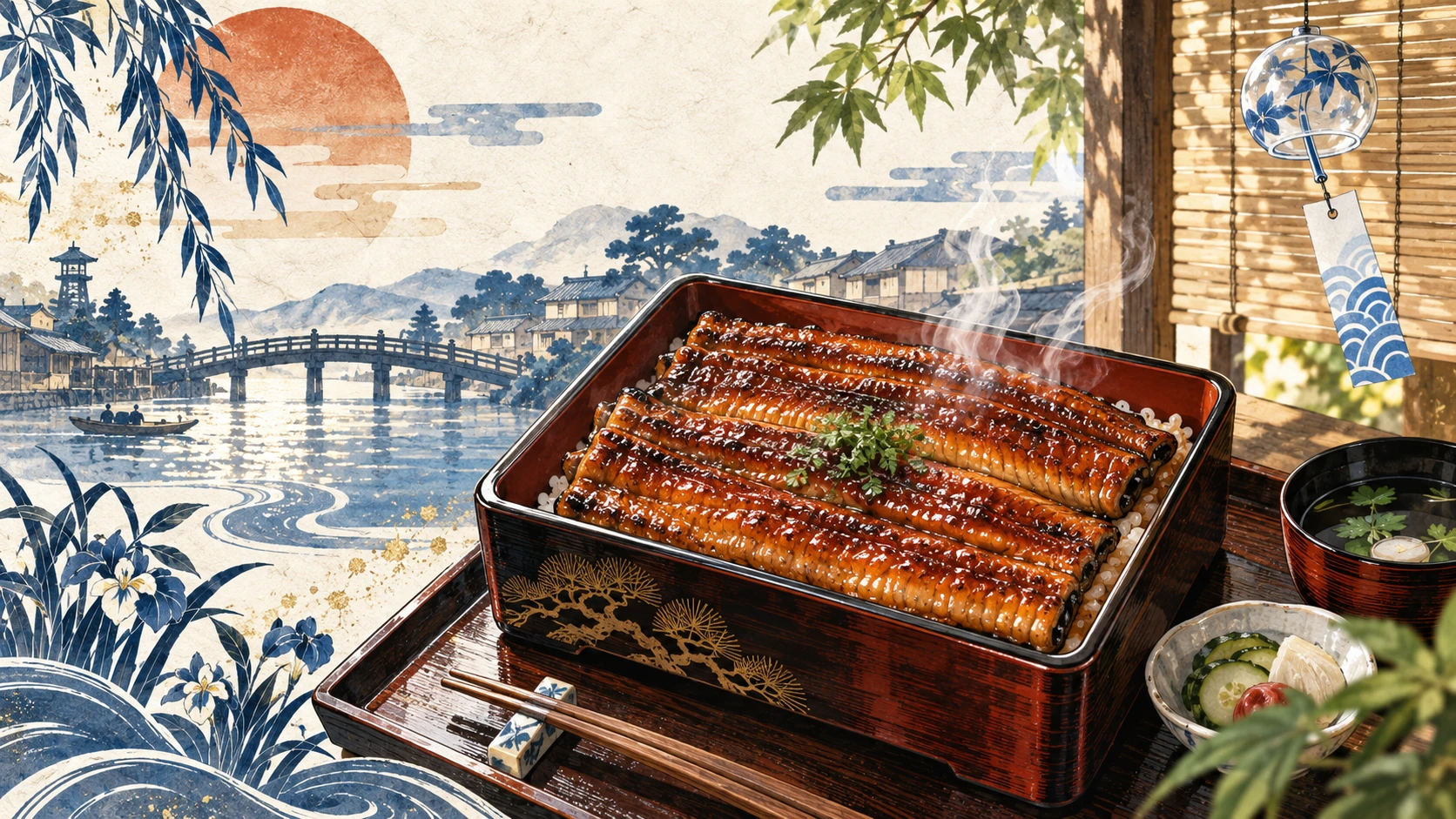
Foods eaten for seasonal occasions are called gyōjishoku, or ceremonial foods. The agriculture ministry explains that they express wishes for family happiness and health, and gives eel on summer’s Doyō no Ushi no Hi as an example.
With that background, the occasion can be more than an eel sale day: it is a chance to experience the season at the table. Sharing a slightly special meal in hot weather or asking as a family what doyō means are also ways to enjoy the culture.
However, a historical wish for health is not a guarantee that a food prevents a particular illness. Understand it as food culture expressing that wish, rather than a promise that eating eel that day prevents summer fatigue. Enjoy it while valuing everyday meals and rest, without relying on one eel meal alone.
Did Hiraga Gennai really start it?
When reading about origins, distinguish a famous story from what sources can establish. Start by looking at how Gennai’s story is presented.
A familiar account says he helped an eel shop’s business
In the famous anecdote, Hiraga Gennai draws on a folk belief about eating foods beginning with “u” on an Ox day and advises an eel shop to display wording announcing Doyō no Ushi no Hi. Japan Search introduces this story, but explicitly notes that there are several accounts of the custom’s origins.
Avoid stating that Gennai invented it alone or that this advertisement is established historical fact. A better account is that it is an Edo-period custom with a famous theory that Gennai popularized it. When sharing the story, saying “it is said” helps distinguish tradition from verifiable fact.
Read old records separately from later stories
Japan Search also notes that Meiwashi describes the custom of eating eel on Doyō no Ushi no Hi. That is a clue to the practice, but the existence of the passage does not substantiate every detail of Gennai’s anecdote.
Keep three points distinct: contemporary documents show a food custom; someone is said to have started it; and the custom continues today. Rather than explaining everything through one person’s inspiration, consider how existing seasonal practices, trade and food culture overlapped.
Summer and eel also appear together in the Man’yōshū
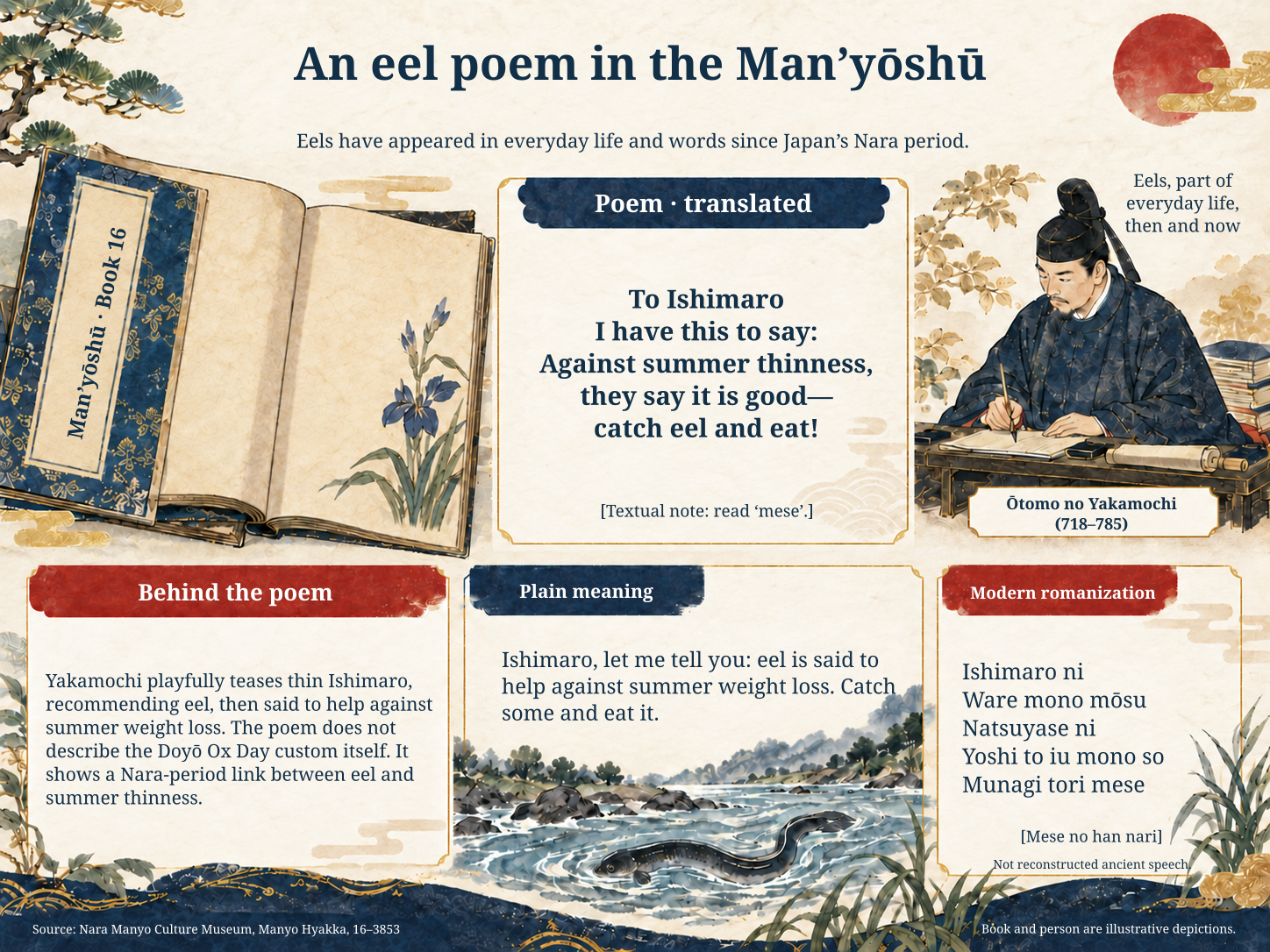
The idea of eating eel in summer is not confined to Edo-period anecdotes. Japan Search introduces a Man’yōshū poem by Ōtomo no Yakamochi mentioning summer weight loss and eel. But that poem does not establish that the same Doyō no Ushi no Hi observance existed then.
Again, distinguish recommending eel in summer from eating it on a specific calendar day. An old poem offers insight into what people hoped for from eel; it is not evidence proving modern health benefits.
At the table, explain that the link between summer and eel appears in old poetry, but is a separate matter from the origins of Doyō no Ushi no Hi. That keeps episodes from different periods distinct.
Eel need not be the only way to mark the occasion
To enjoy eel as ceremonial food, choose to suit your taste and budget: kabayaki with rice, for instance, or small portions of shirayaki. When sharing, first decide how many people will eat and whether it is the main dish or one addition; that makes quantities easier to plan.
You need not concentrate the meal on the exact day. For dining out, check opening days and reservations; for takeaway, pickup times; for online orders, expected arrival and storage instructions. Enjoying the calendar can fit around everyday life.
Even people who dislike or do not eat eel can use the occasion to notice the changing season. Knowing a tradition and always eating the same dish are different things. Discuss its origins and adapt the occasion to your own table.
Frequently asked questions
- Is Doyō no Ushi no Hi on the same July date every year?
- No. It depends on the combination of the doyō period and zodiac days, so the month and day are not fixed each year. Check the calendar for the relevant year.
- Must I eat eel on the second Ox day too?
- There is no requirement. Ni no ushi is simply the second Ox day within the same doyō period. Enjoy the occasion according to your plans and tastes.
- Is eel eaten in summer because that is the only season it tastes good?
- The link to Doyō no Ushi no Hi explained here concerns calendars and food culture. It alone cannot determine when eel has its best taste or quality. When buying, consider the product or restaurant’s description as well as the occasion’s date.
Related articles