Full-cycle breeding of Japanese eel succeeded in research in 2010, and trial sales of kabayaki were announced in 2026. This does not mean it has widely replaced conventional farming or is always available at an affordable price. Breeding success, stable mass production and retail availability are different milestones.
Separate research success, trial sales and widespread supply
Completing a breeding cycle differs from reliably supplying the quantities a market needs. The May 2026 FRA and Yamada Suisan announcement describes trial sales bringing research to consumers. It does not establish ongoing availability or stock across Japan.
Conventional farming, hatchery seed and full-cycle breeding
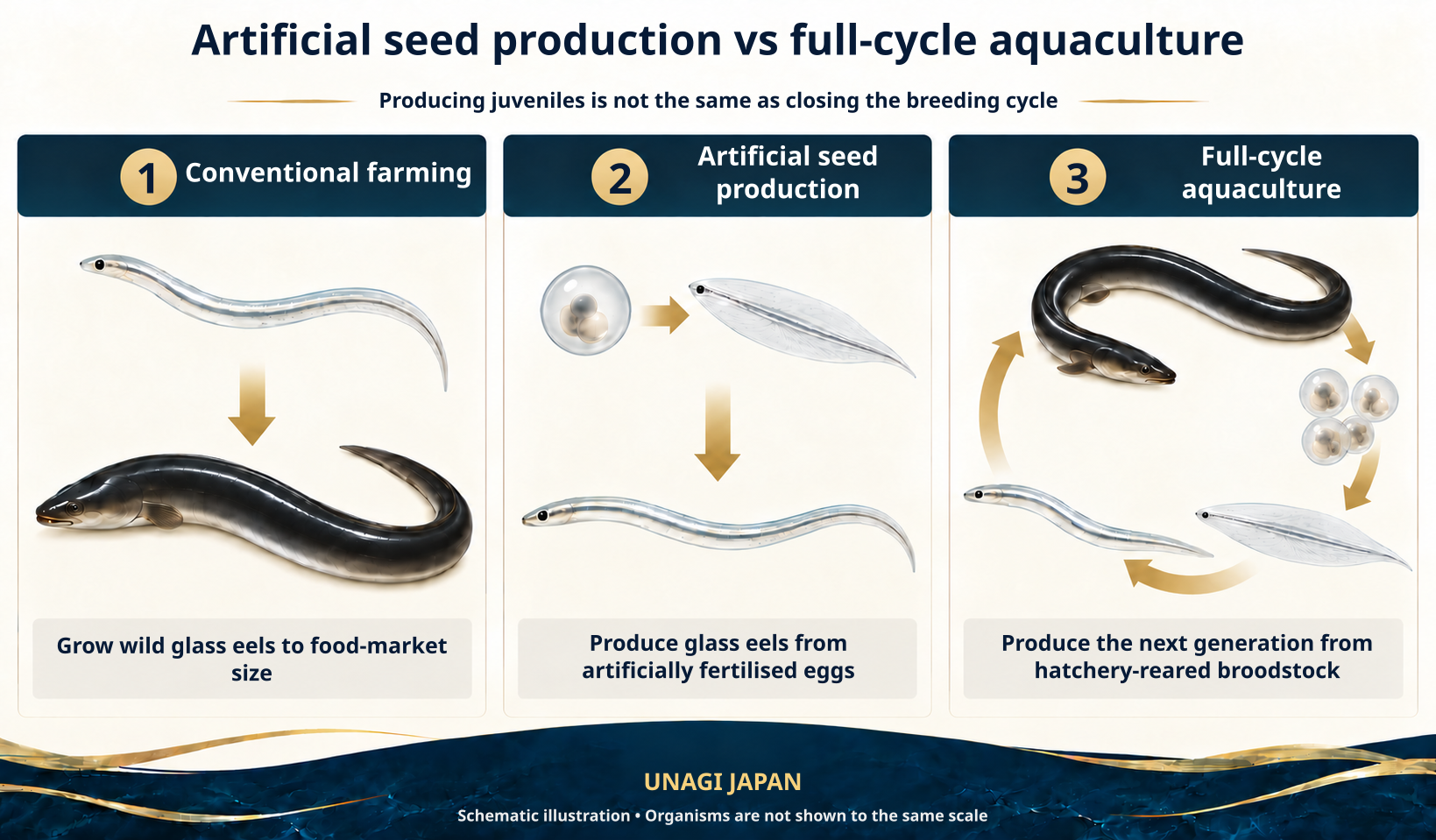
Conventional farming raises wild-caught glass eels to eating size. Hatchery seed production obtains eggs from broodstock and raises hatched larvae to glass eels. Full-cycle breeding raises hatchery-born eels into parents and obtains the next generation, closing the reproductive cycle. Simply growing eel in a pond is different.
From eggs to parents and another generation
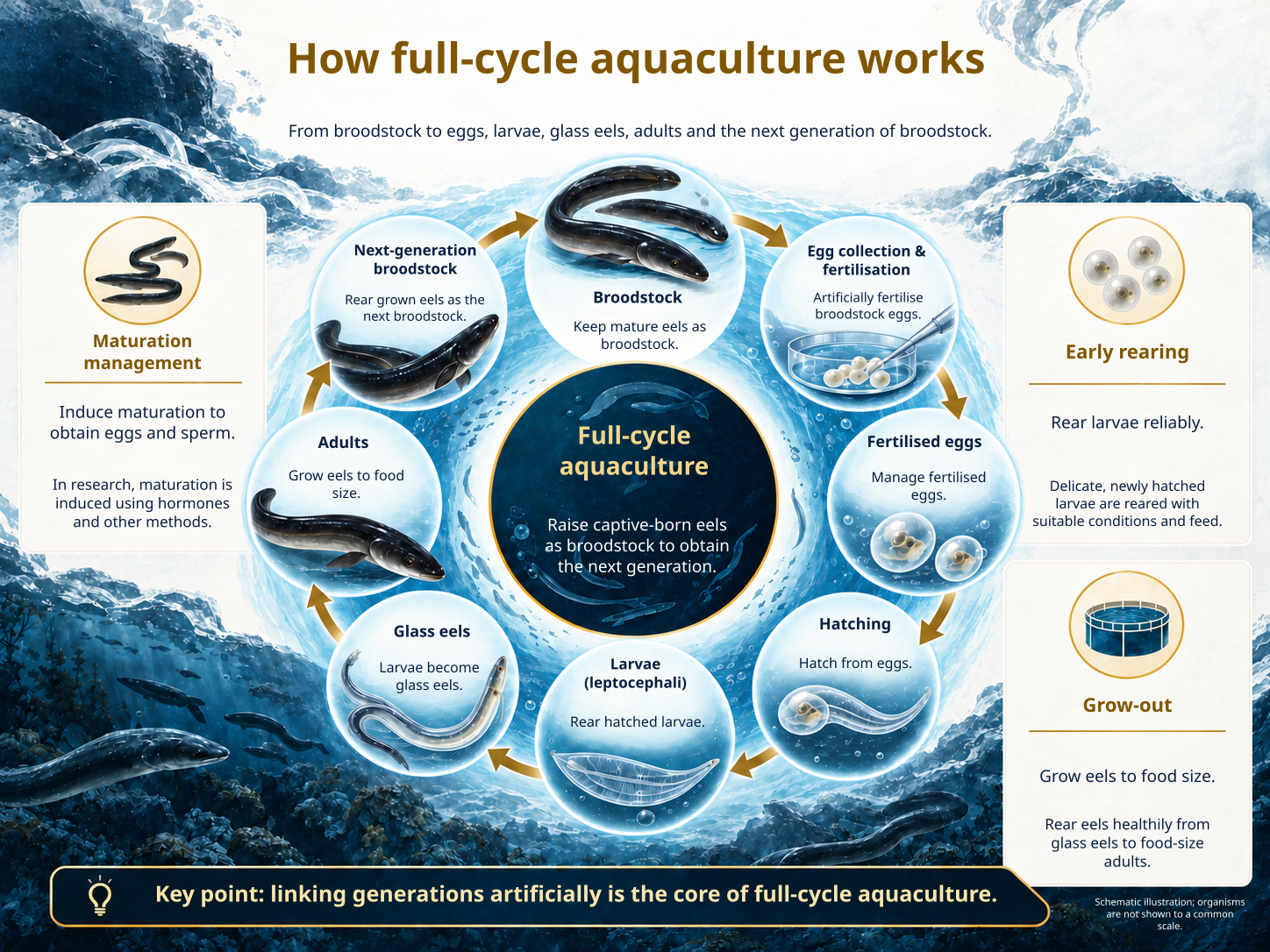
The process manages broodstock maturation, egg collection and artificial fertilization, hatching, larval rearing, metamorphosis into glass eels and growth into adults. Using those animals as parents to obtain another generation closes the loop. Ocean-like backgrounds in the diagram do not locate the work or reproduce an actual facility.
Newly hatched larvae are not yet leaf-shaped leptocephali
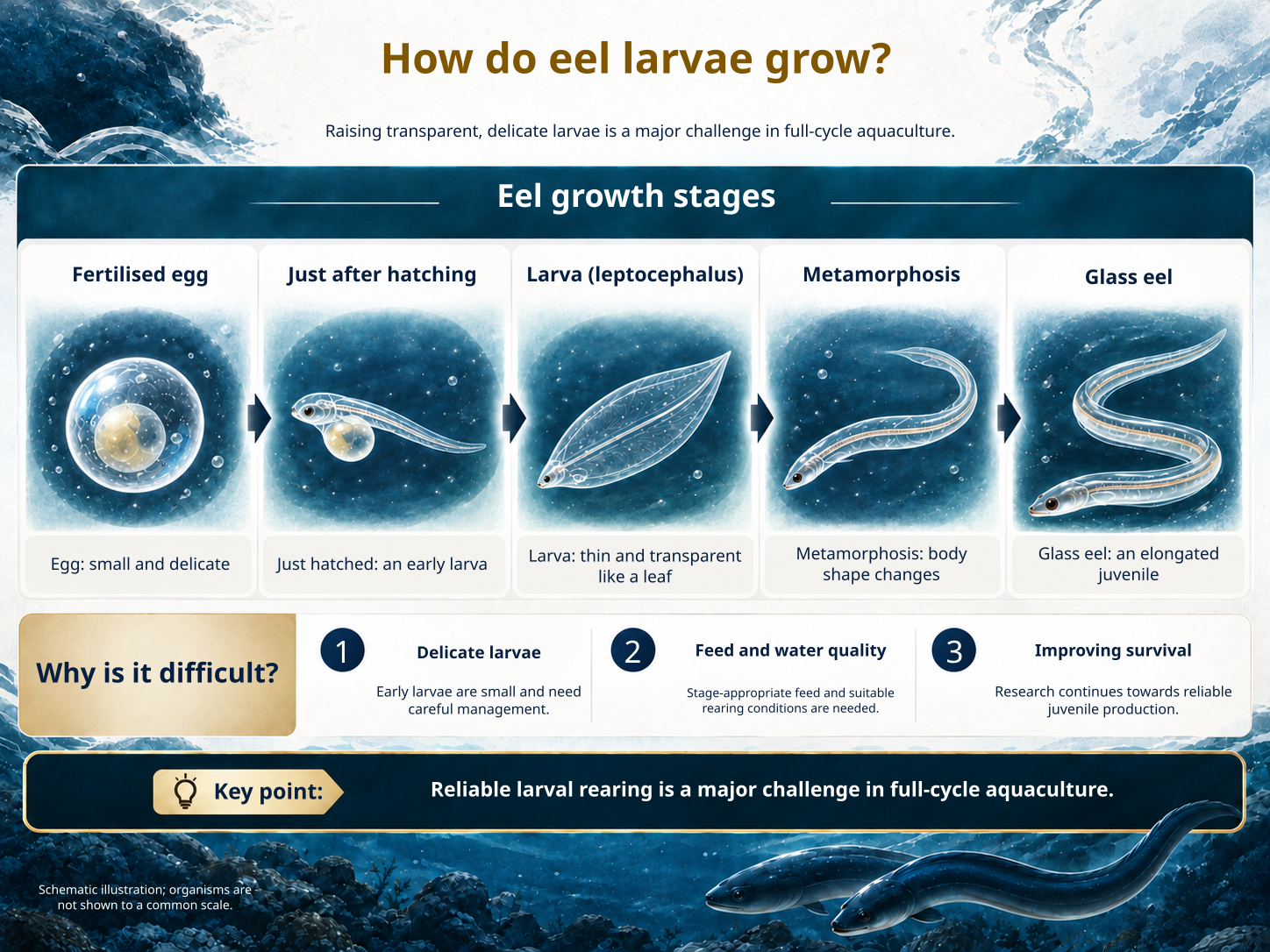
An eel does not hatch as a large leaf-shaped larva. The later leaf-shaped stage is called a leptocephalus and metamorphoses into an elongated glass eel. The organisms in the diagram are schematic and not to a common scale. Appropriate feed and environmental control, including water quality, are essential.
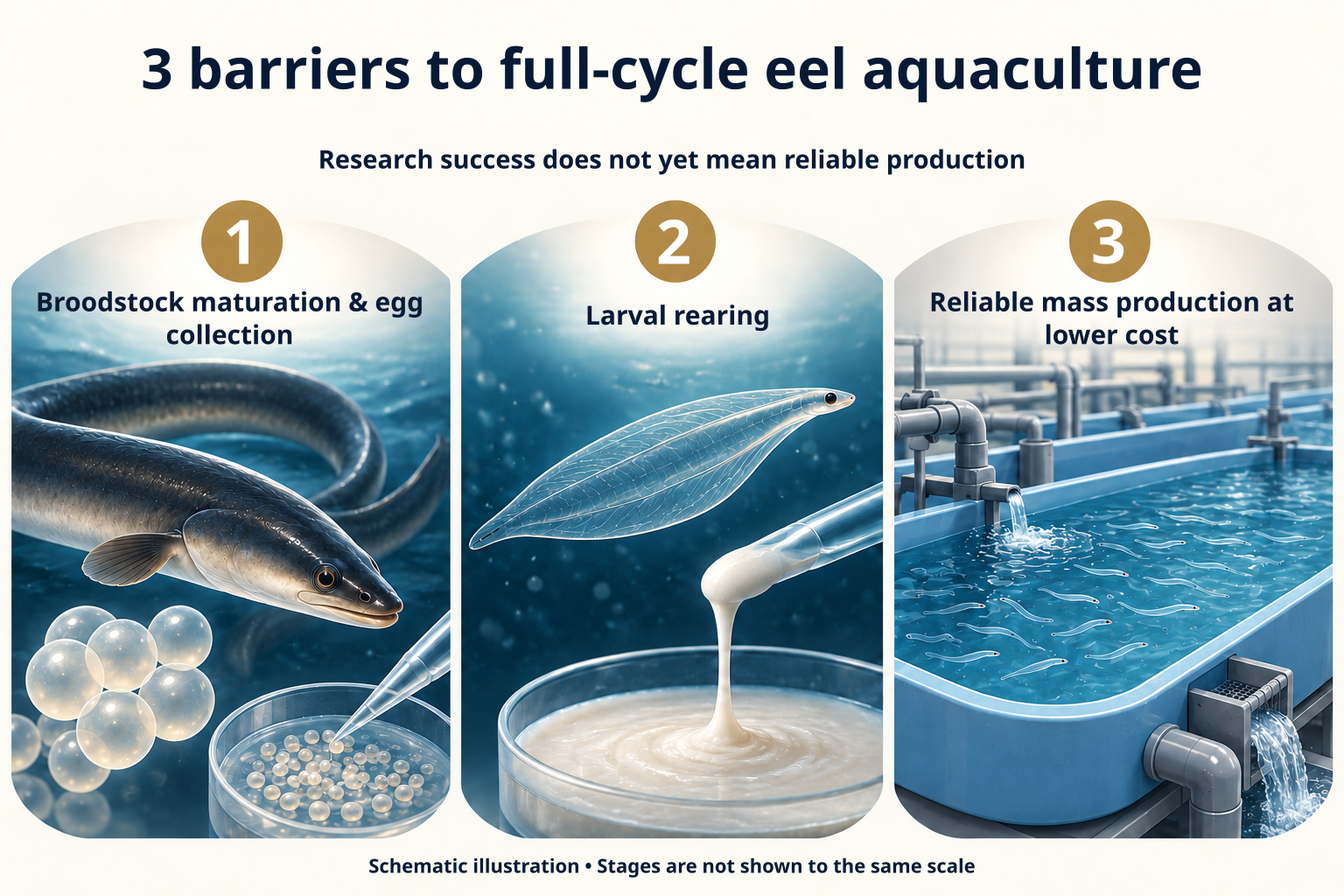
Maturation, larval survival and stable scale remain difficult
Key challenges are obtaining good eggs consistently, providing feed and conditions that delicate larvae can survive, and improving equipment, labour efficiency and cost at scale. Growing adult eel alone completes neither the reproductive loop nor dependable commercial supply.
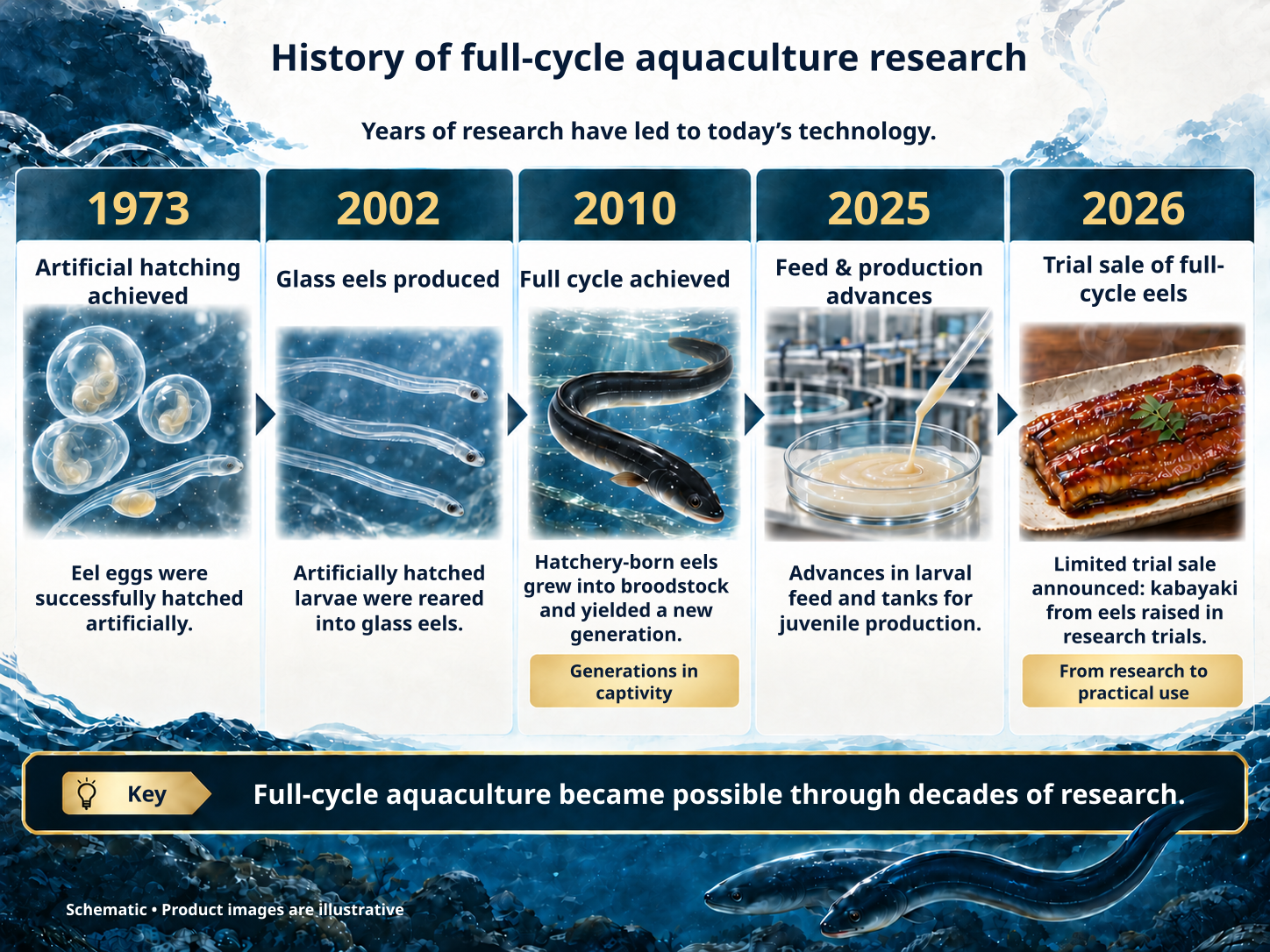
From hatching in 1973 to full-cycle success in 2010
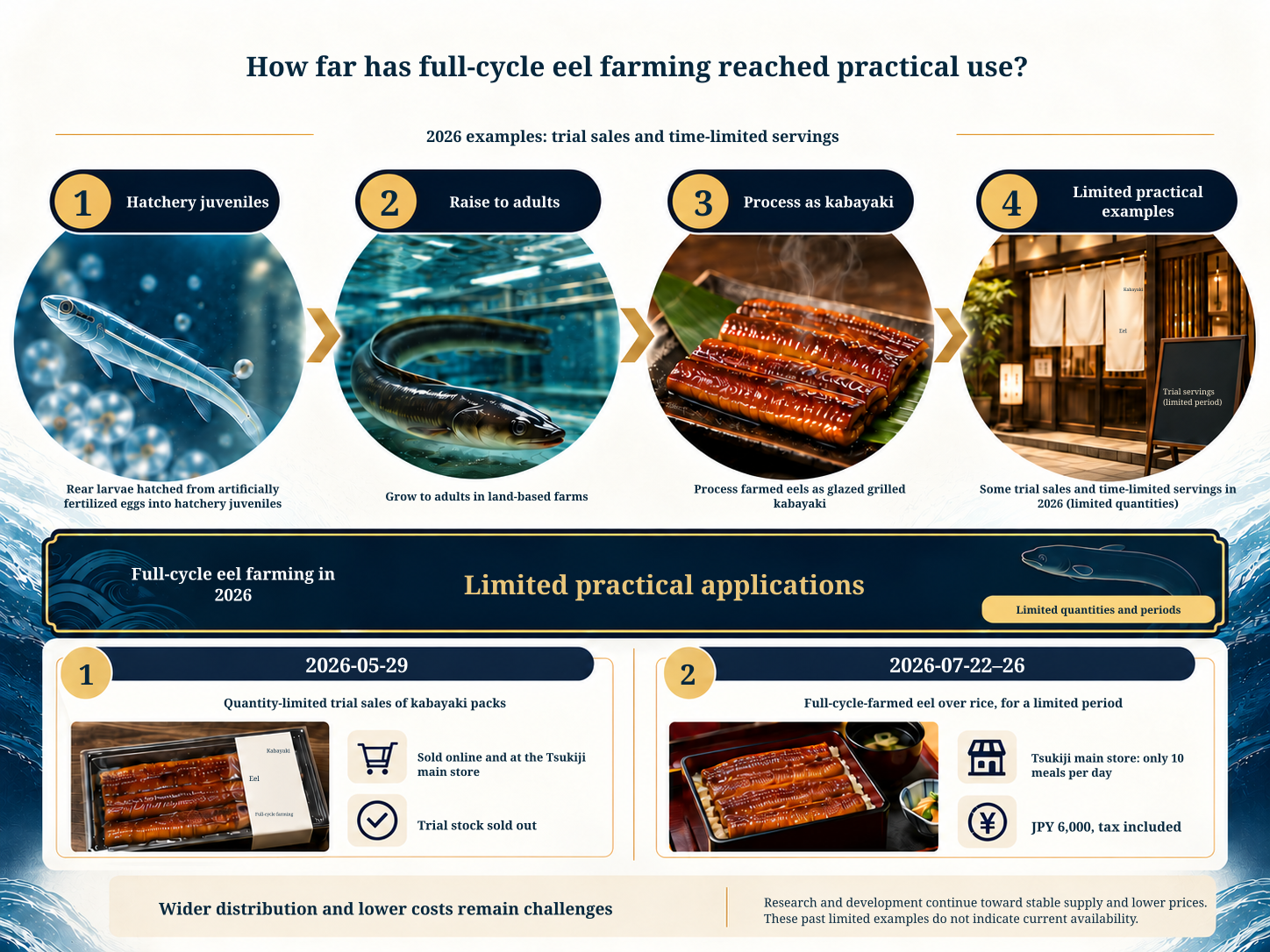
Artificial hatching was achieved in 1973, rearing from eggs to glass eels in 2002, and FRA full-cycle breeding in 2010. Kindai University's 2023 achievement was university success, not a replacement for the first 2010 result. Feed and tank advances followed in 2025, with trial sales announced in 2026.
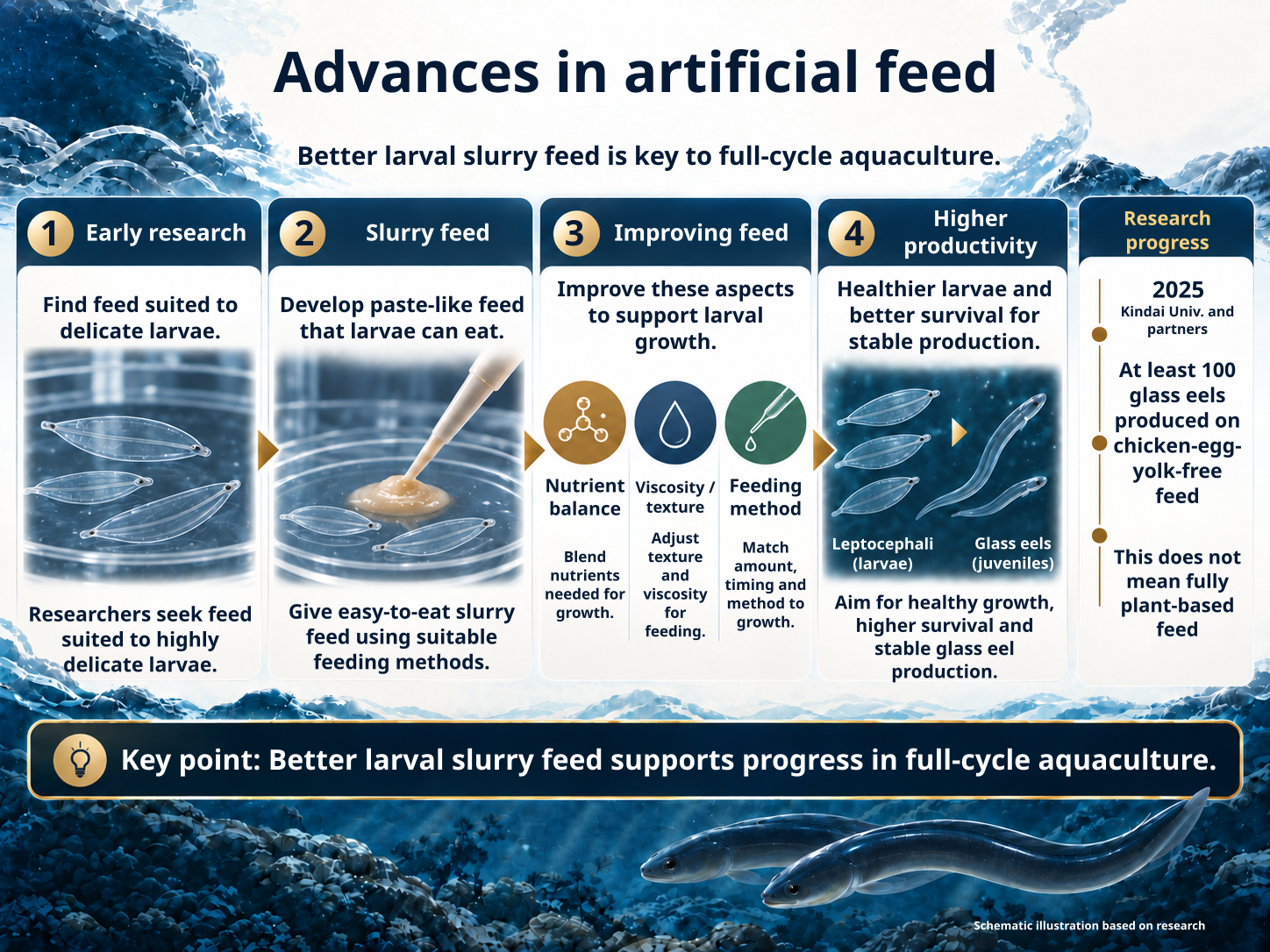
Larval feed: egg-yolk-free does not mean wholly plant-based
Slurry feed depends on nutrients, viscosity, physical properties and delivery. In July 2025, Kindai University and San-Ei Gen F.F.I. reported producing at least 100 glass eels by the end of May using feed without chicken egg yolk. Removing yolk does not mean removing all animal ingredients or completing commercial mass production. Other approaches, including dry-feed research, also exist.
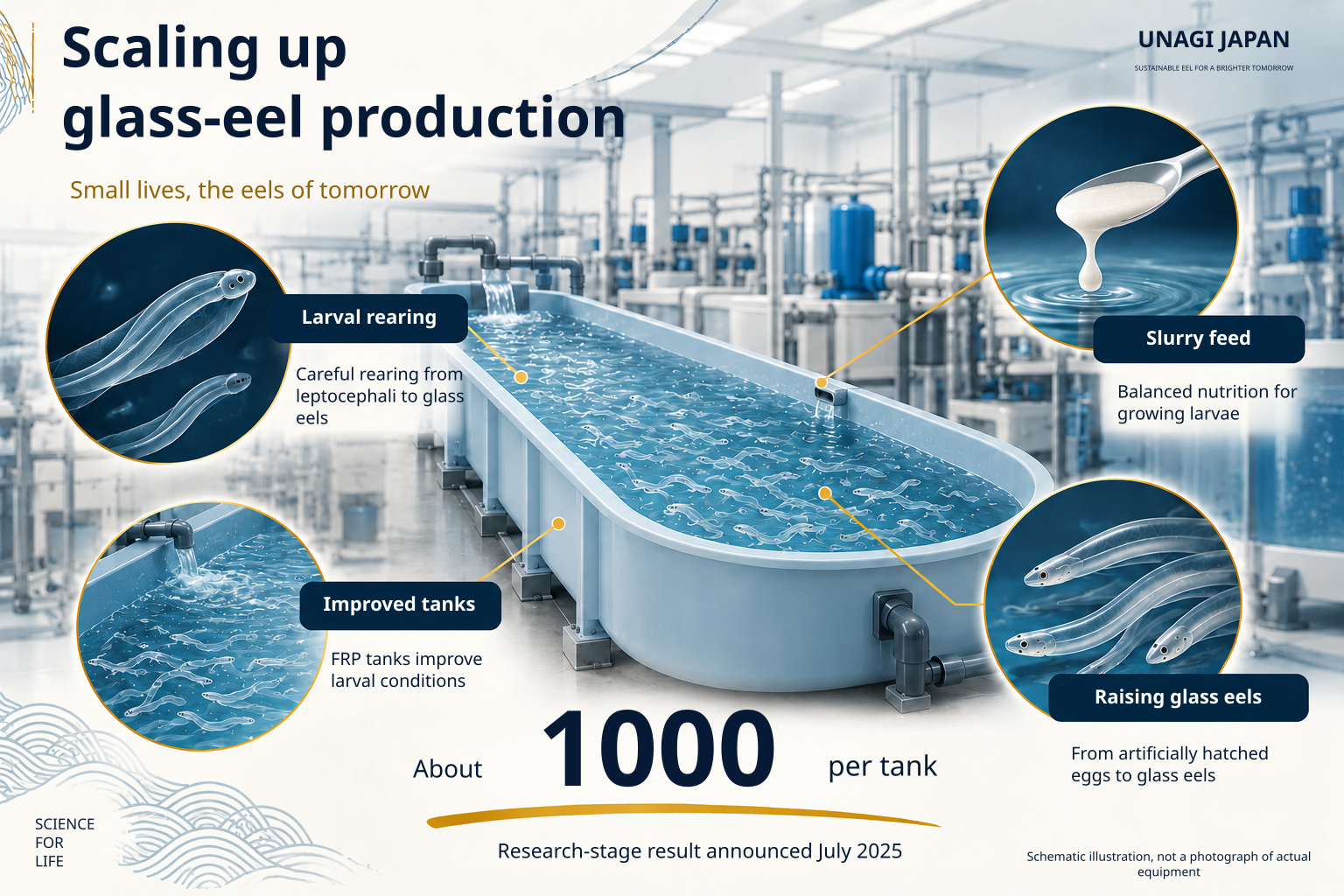
About 1,000 glass eels per tank, with further work needed
In July 2025, FRA, Yanmar and Marino-Forum 21 reported about 1,000 glass eels per new FRP tank. Work includes refining the horizontal, U-section tank and improving survival, cleaning, feeding and labour efficiency. The illustration is a schematic, not a photograph of the actual apparatus.
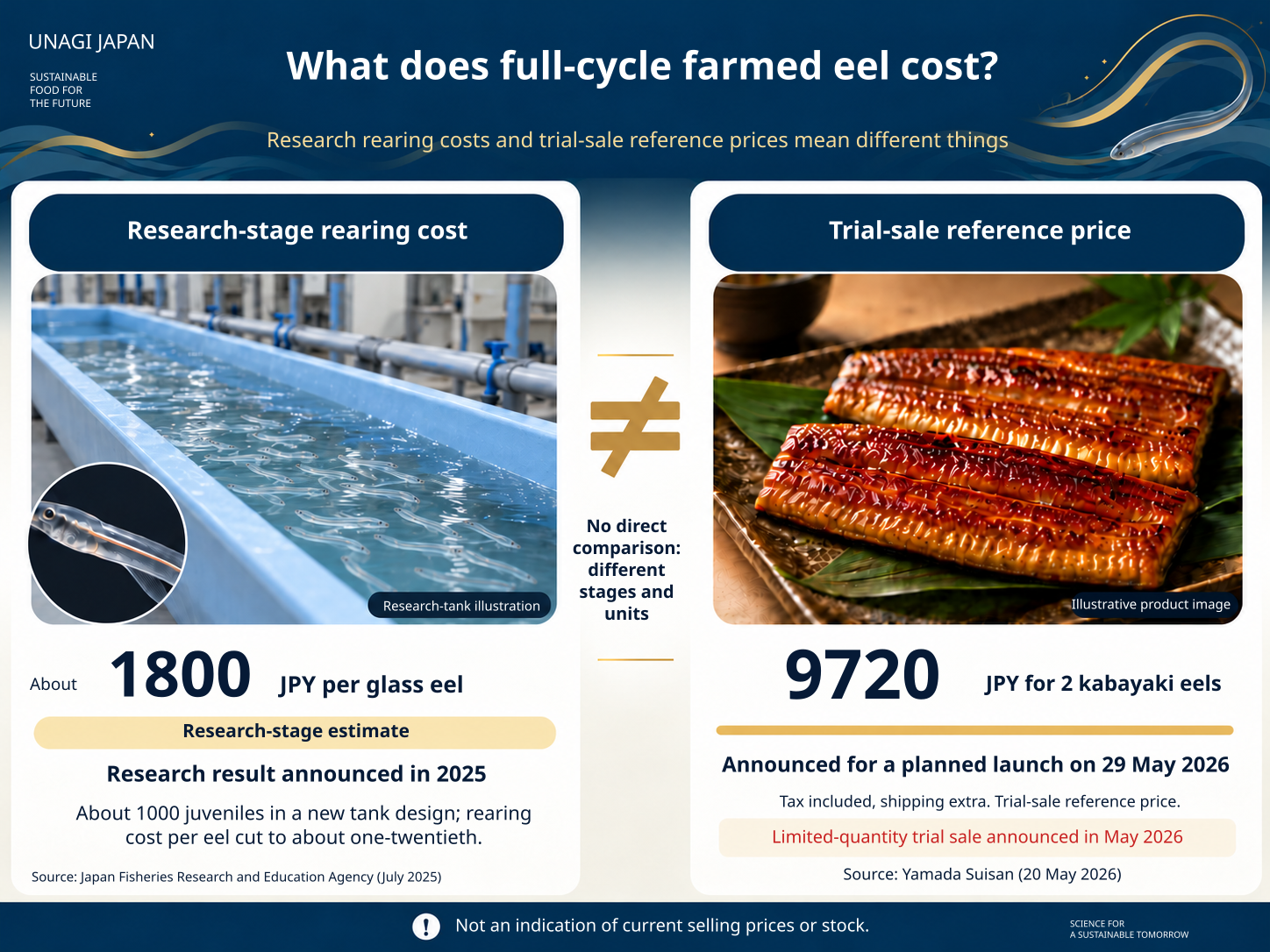
¥1,800 rearing cost and a ¥9,720 sale refer to different units
About ¥1,800 was a 2025 research estimate for rearing one glass eel, around one twentieth of the cost using earlier large tanks. It is neither the wild-seed market price nor the retail price of an adult or kabayaki. A May 20, 2026 release listed a two-eel kabayaki set at a reference ¥9,720 including tax, plus shipping. Stages and units differ, so these amounts cannot be directly compared. The latter is a historical announcement, not current price or stock.
Check the seller's latest notice before buying
After limited sales on May 29, 2026, Yamada Suisan announced the sale had ended. It also advertised a Tsukiji menu for July 22–26 at ten servings daily and ¥6,000 including tax. This was a past service announcement; we have not independently verified every date or serving.
Check the product's full-cycle claim, sales period, quantity, current stock and delivery terms with the official seller. One company's closure notice does not establish unavailability from every supplier or channel. Do not confuse farmed eel raised from wild seed with a full-cycle product.
Institutes, universities and companies handle different stages
FRA's breeding and scale-up work, tank development with Yanmar and Marino-Forum 21, Yamada's production and trial sales, and Kindai–San-Ei Gen feed research have different roles. The 2026 joint release reports at least 10,000 full-cycle glass eels annually for two consecutive years from 2024 at Yamada. Nissui and Shin Nippon Biomedical Laboratories have also announced joint research; future plans do not establish a retail launch.
Wild-eel conservation still matters
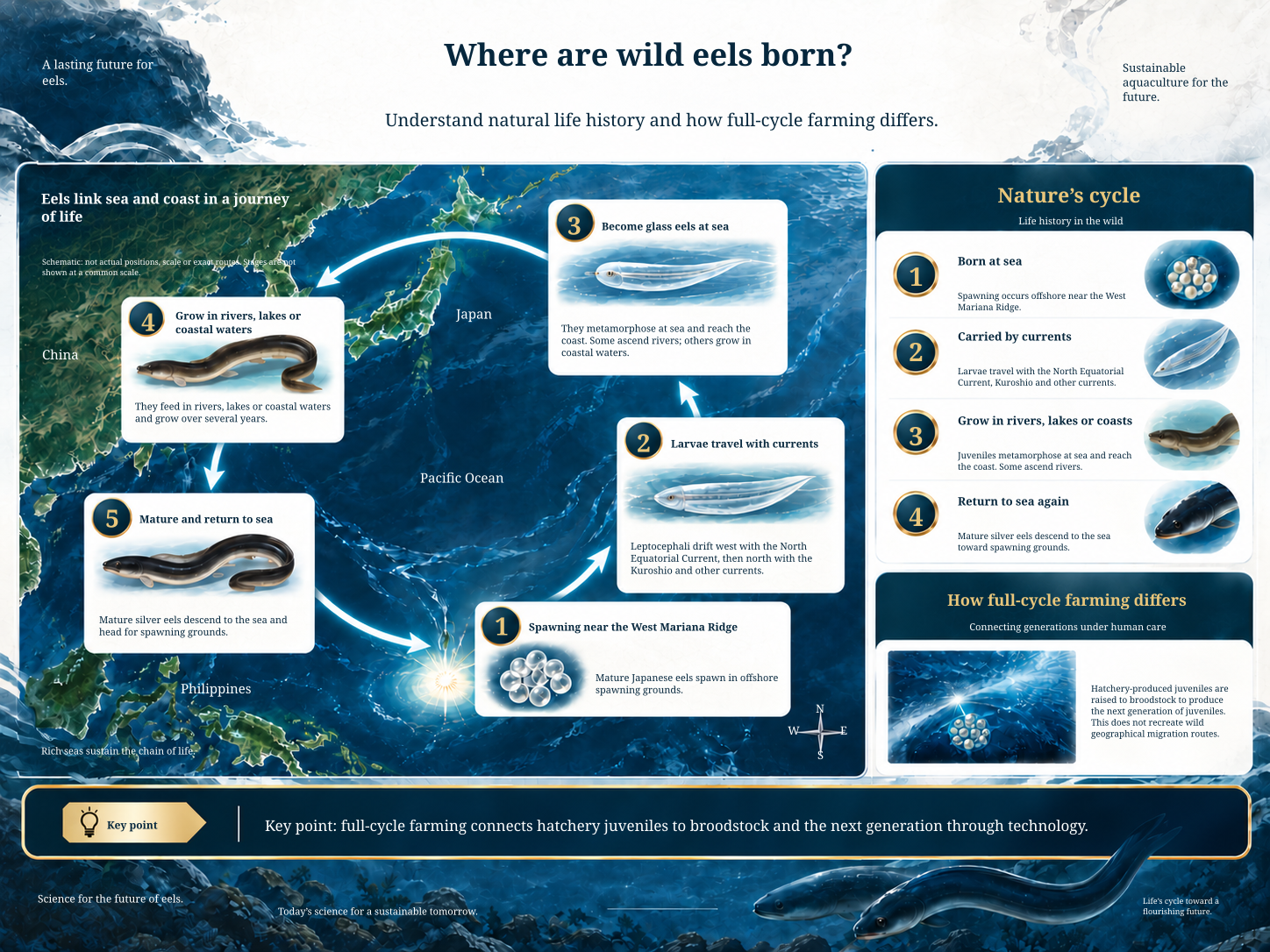
Wild Japanese eel spawn west of the Mariana Islands; larvae reach East Asia via currents including the North Equatorial Current and Kuroshio. The dashed adult route is schematic and estimated, not a fully established exact route. Geography uses public-domain Natural Earth data. Full-cycle farming may reduce reliance on wild fry, but cannot by itself resolve habitat, fishing and ocean-environment pressures.
Check the unit, first-success claim and sales period
Reading the sources as saying kabayaki costs ¥1,800, Kindai was the world's first success, or the 2026 trial sale continues today goes beyond their evidence. Check the production stage and unit, institution and year, and the seller's stated period together.
2050 is a policy target, not a price or availability guarantee
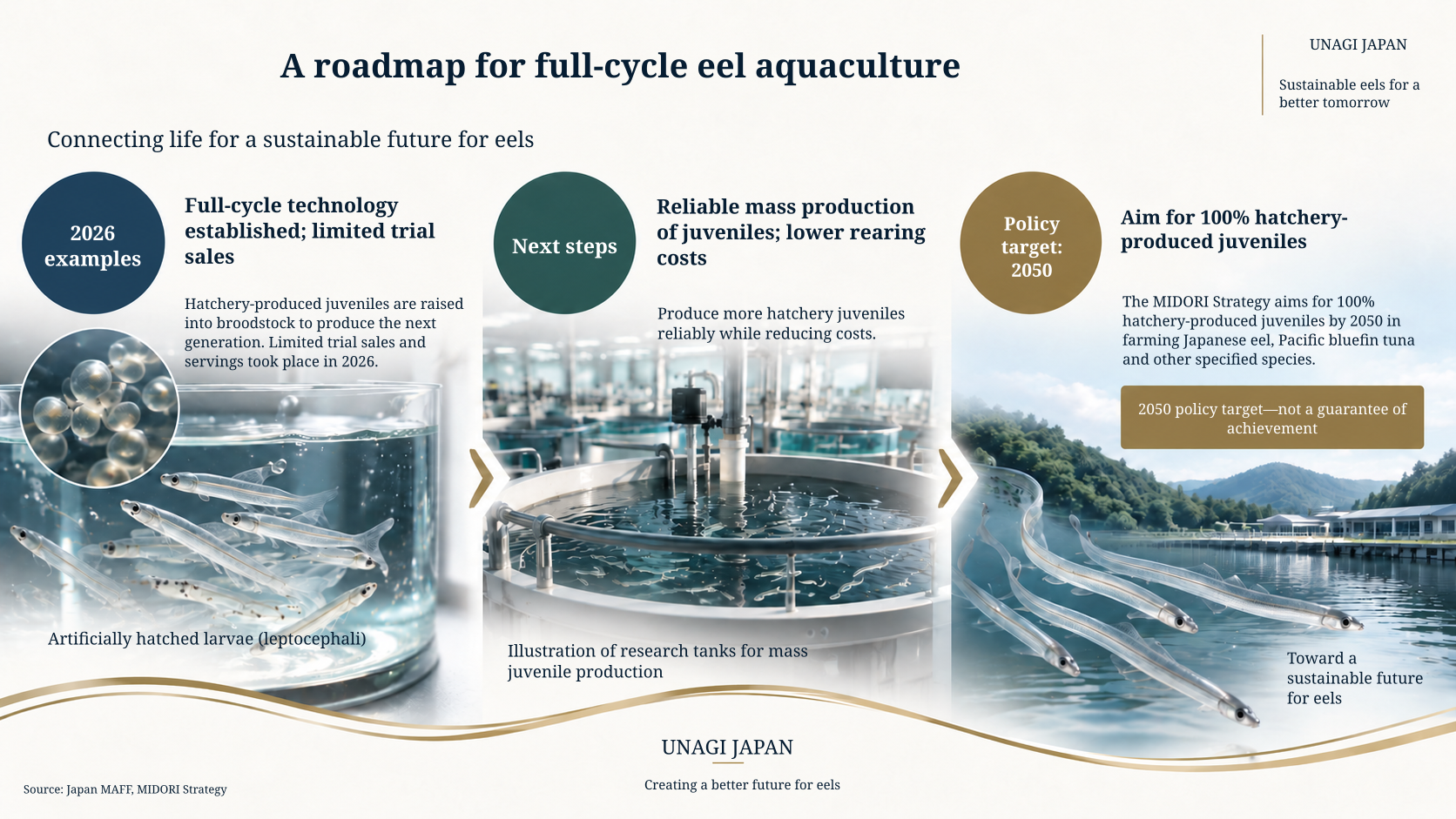
Japan's Fisheries Agency sets a 2050 target of 100% hatchery seed in farming species including Japanese eel and Pacific bluefin tuna. This is neither an achieved result nor a forecast of when inexpensive full-cycle eel will be routinely sold. Larval survival, feed, equipment, costs and resource conservation still require parallel progress.
Related articles