Unagi and anago both have long bodies and belong to the order Anguilliformes, but they are not different names for the same fish. The familiar Japanese eel belongs to Anguillidae, while whitespotted conger belongs to Congridae. Jaw projection, tail shape and white spots along the sides offer clues. However, a fillet or kabayaki dish cannot be assigned a species from appearance alone. This article mainly compares Japanese eel and whitespotted conger, familiar species in Japan. Not every fish covered by the broad terms unagi and anago has exactly the same characteristics.
Three differences to know first
- Classification: Japanese eel and whitespotted conger belong to different families within the same order, Anguilliformes. - Appearance: a projecting lower jaw and rounded tail are clues for Japanese eel; a projecting upper jaw and pointed tail are clues for whitespotted conger. - Life: Japanese eels have varied lifestyles using rivers, brackish waters and coastal areas; whitespotted congers live in the sea. Japanese eels are also born at sea, so calling them freshwater fish throughout life is inaccurate.
The official explanations cited above describe classification and appearance; materials from the Fisheries Agency and Japan Fisheries Research and Education Agency cover life history.
For live fish, examine the face, sides and tail together
When observing fish in an aquarium or similar setting, compare the visible parts in turn rather than relying on just one feature.
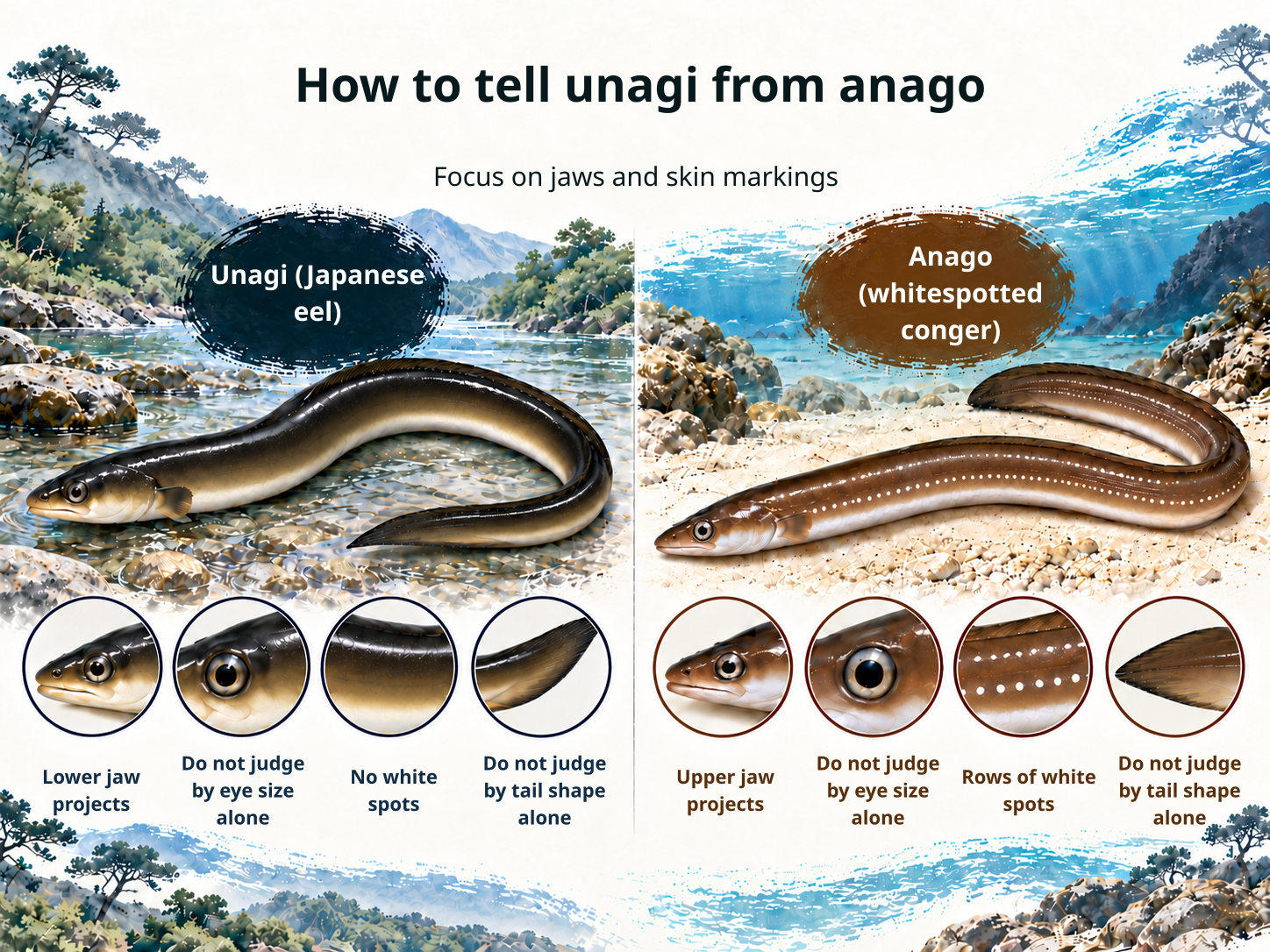
Jaw and tail shape provide useful clues
Tokyo Sea Life Park's keepers explain that the Japanese eel's lower jaw projects, while the whitespotted conger's upper jaw projects, and that their tail tips differ. If one body part leaves you unsure, compare both face and tail.
Tank lighting and the fish's orientation can obscure outlines. Rather than deciding from a fleeting glimpse of color, check several features under comparable lighting and viewing angles.
The conger's white spots also explain the name hakarime
Whitespotted congers have rows of white spots along their sides. A fisheries research institution explains that the regularly spaced white spots at lateral-line pores led to the regional name hakarime. Knowing that this name at fishmongers or restaurants comes from the body pattern connects the dish with the living fish.
White spots alone cannot classify all congers. This article compares typical differences between whitespotted conger and Japanese eel specifically.
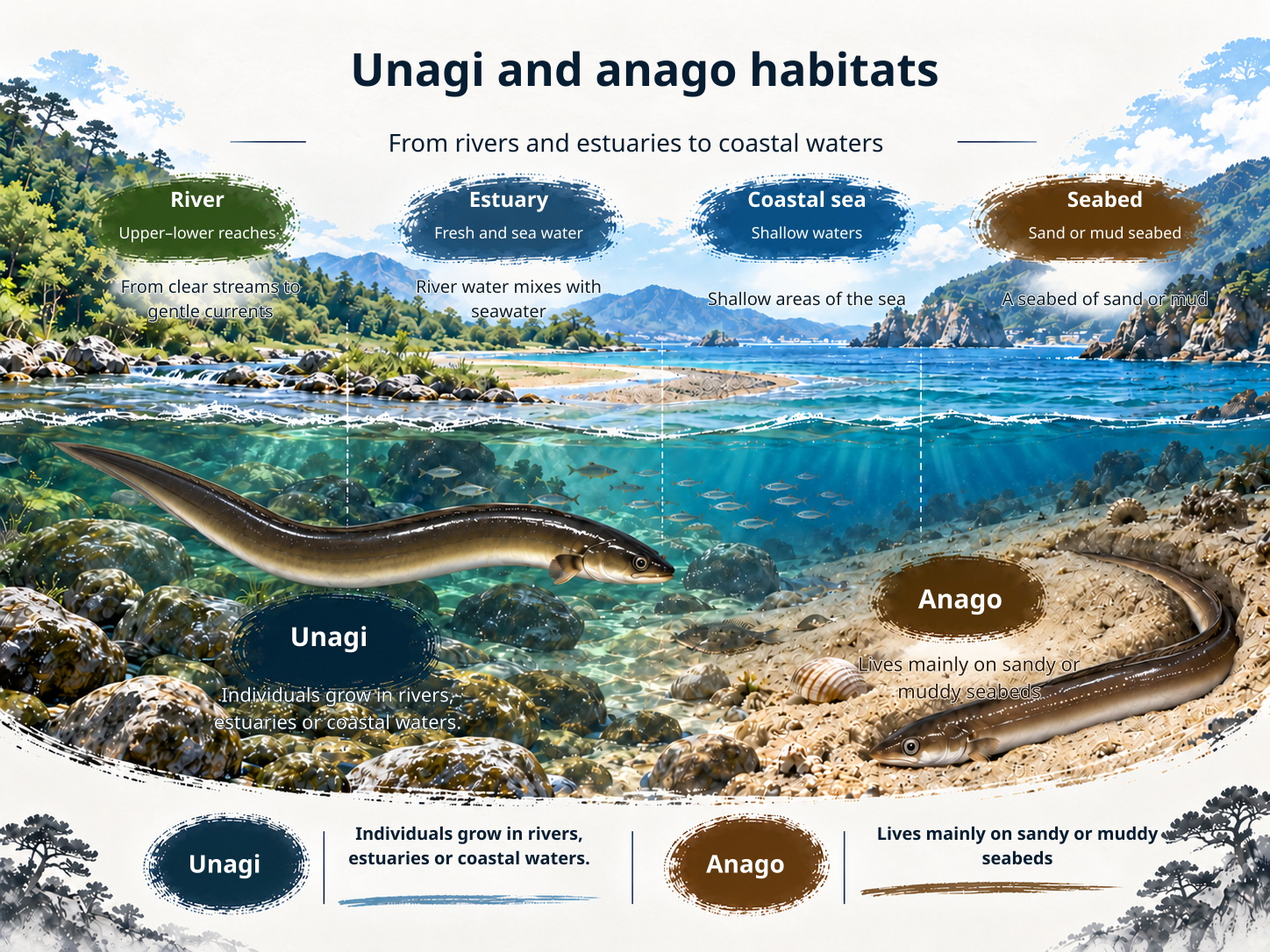
Eels in rivers, congers at sea is not the whole story
Separating where fish grow from where they are born and reproduce makes their lifestyles easier to understand.
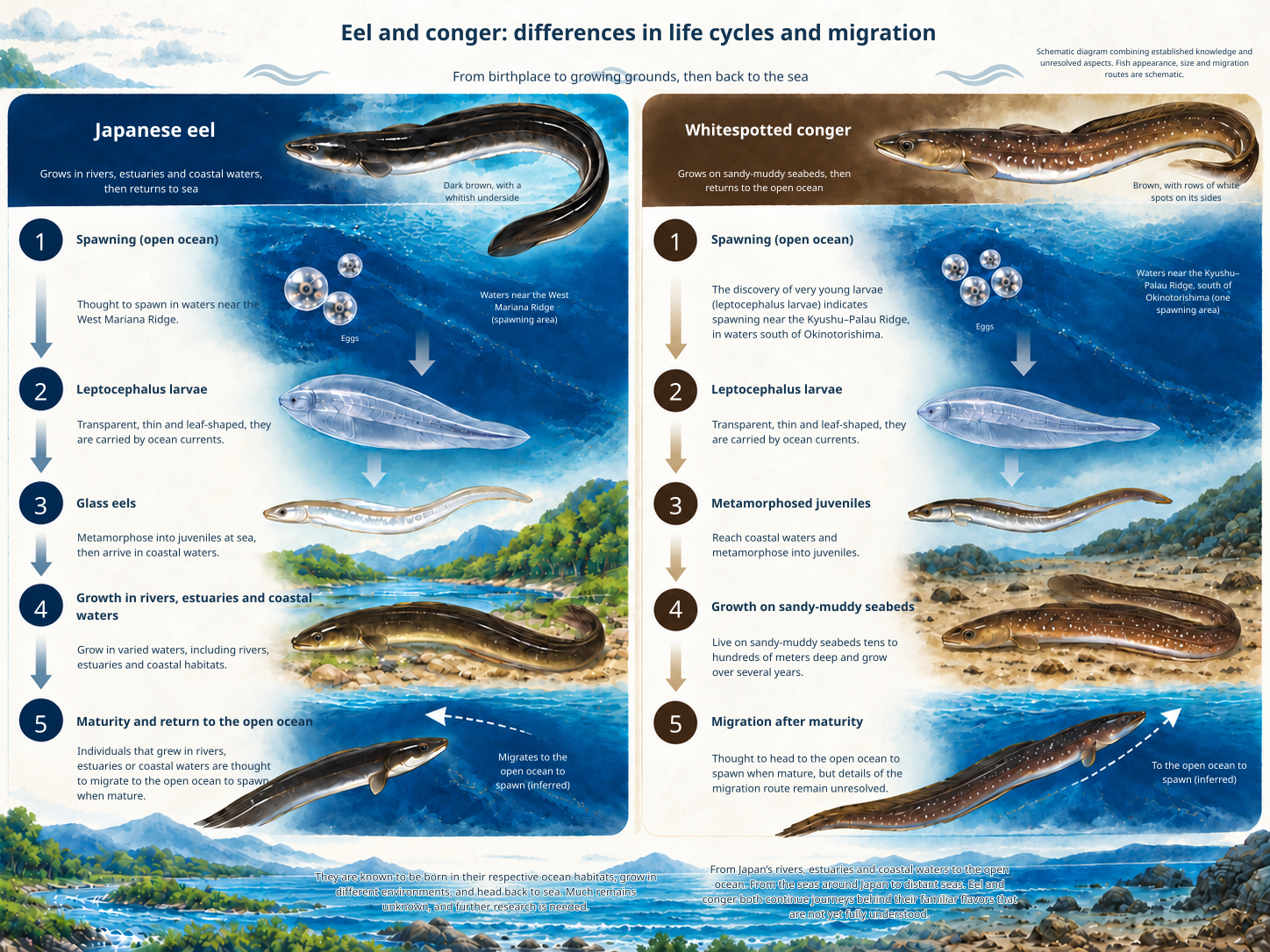
Japanese eels are born at sea
The Japanese eel begins life at a distant ocean spawning ground. After its larval period, it is carried toward the coast, and after growing it migrates through the sea to reproduce. Looking only at eels in rivers misses this ocean connection.
Not every individual necessarily ascends a river. Research evaluation materials from the Japan Fisheries Research and Education Agency also discuss Japanese eels living in coastal seas without entering rivers. A long fish found at sea is therefore not automatically a conger.
Whitespotted congers also move through the ocean
Living at sea does not mean remaining beside the same shore throughout life. Fisheries research institutions describe findings on spawning grounds based on larvae collected in southern waters. The coastal place where fish are caught for food should not be assumed to be their birthplace.
Beyond their similar adult shapes, eels and congers share leaf-shaped larvae. This form is called a leptocephalus. It is a shared feature that is hard to imagine from photographs of adult fish alone.
How do the dishes differ?
At the table, differences between fish overlap with differences in preparation. Try separating the two when reading menus.
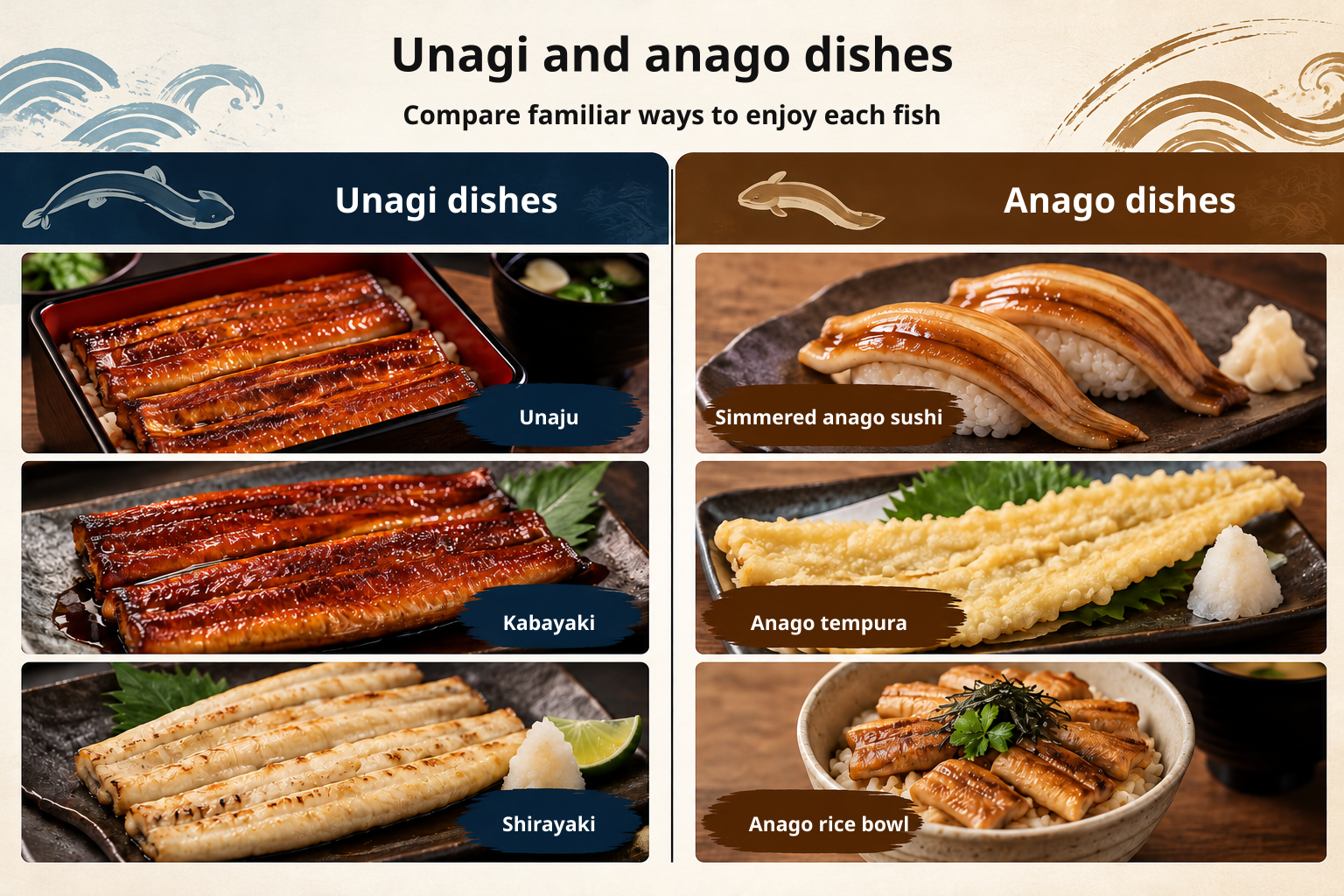
Kabayaki does not always mean unagi, and tempura does not always mean anago
Unagi is often served as kabayaki or shirayaki; anago as simmered conger, tempura or grilled conger. But cooking methods do not correspond one-to-one with species. Conger is also eaten as kabayaki and sushi toppings.
Do not identify a long, sauce-covered fillet as unagi from its color alone. If a dish name omits the fish, check the menu or ingredient label. Kabayaki, for example, describes a preparation method, not proof of a species.
For a tasting comparison, match the preparation as well as the fish
A fisheries cooperative on Tsushima describes whitespotted conger as having a delicate flavor compared with eel. This is a description of taste, not a guarantee that every product tastes the same.
Differences between strongly sauced kabayaki and tempura eaten with salt also include seasoning, batter and cooking technique. To explore the fish themselves, try small portions prepared in similar ways. When simply choosing a meal, you can also focus on the roasted aroma, simmering sauce or batter texture you want, without dwelling on classification.
Do not compare nutrition or price from dish names alone
Fish names alone cannot establish which is healthier. Nutrient comparisons require matching raw edible portions, kabayaki or tempura, as well as the weight compared. This article does not rank fat or calories by placing differently prepared dishes side by side.
Price needs similar care. The price of one plate does not equalize fish quantity, rice, side dishes or processing work. Rather than treating anago as a cheap substitute for unagi, consider it a different fish dish and examine portion size and preparation.
Frequently asked questions
- Does anago become unagi as it grows?
- No. Japanese eel and whitespotted conger are different fish, not names that replace each other during growth.
- Is an eel that grows in the sea anago?
- No. Some Japanese eels grow using marine habitats. Habitat alone does not determine species.
- Can you distinguish skinless fillets?
- Clues such as the face and side markings are lost, so avoid certainty from appearance alone. When shopping or ordering, check labels or ask the shop for its description.
- Do they have the same season?
- A single nationwide calendar cannot easily cover this. Views vary with region, target catch, farmed or wild status, and the qualities valued in a dish. To find out what is enjoyable on your visit, ask the restaurant about that day's origin and arrivals.
Related articles