Japanese eels spawn near the West Mariana Ridge in the western North Pacific, rather than in Japan's rivers. Collections of wild eggs, newly hatched larvae and mature adults support this finding. Identifying the spawning area, however, is different from witnessing the entire release of eggs and sperm in the natural ocean. Tsukamoto et al. (2011)
Japanese eels spawn in the open ocean far from Japan
To understand the location, separate its position on a map from its depth underwater. Rather than picturing the bottom of a trench from the name Mariana alone, examine the ridge and the collection depths in turn.
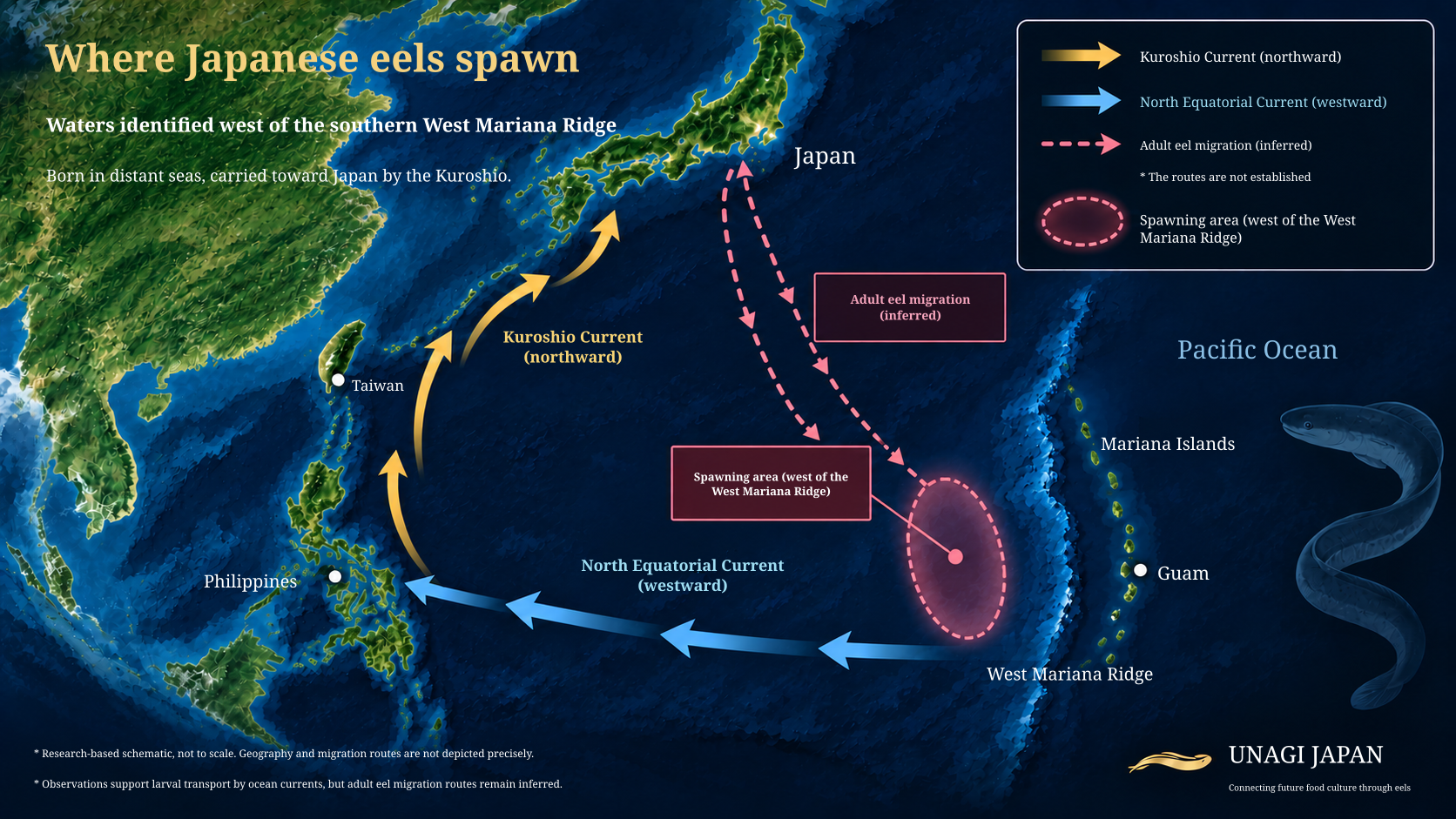
The landmark is the West Mariana Ridge, rather than the trench floor
The West Mariana Ridge is an underwater elevation extending north–south west of the Mariana Islands. Japanese eel eggs have been collected in waters near its southern part. This does not mean eggs are attached to riverbeds in Japan or to the floor of the Mariana Trench, among the world's deepest trenches. The University of Tokyo explains that the eggs collected in 2009 were found in the open ocean at depths of 150–200 metres. University of Tokyo: discovery of the spawning area
Distinguish three things: the height of seabed features, depth below the sea surface and where the eggs were collected. The ridge helps narrow the search area; collection depth gives a position in the water. The phrase near the ridge should not suggest eggs being laid on a rock surface.
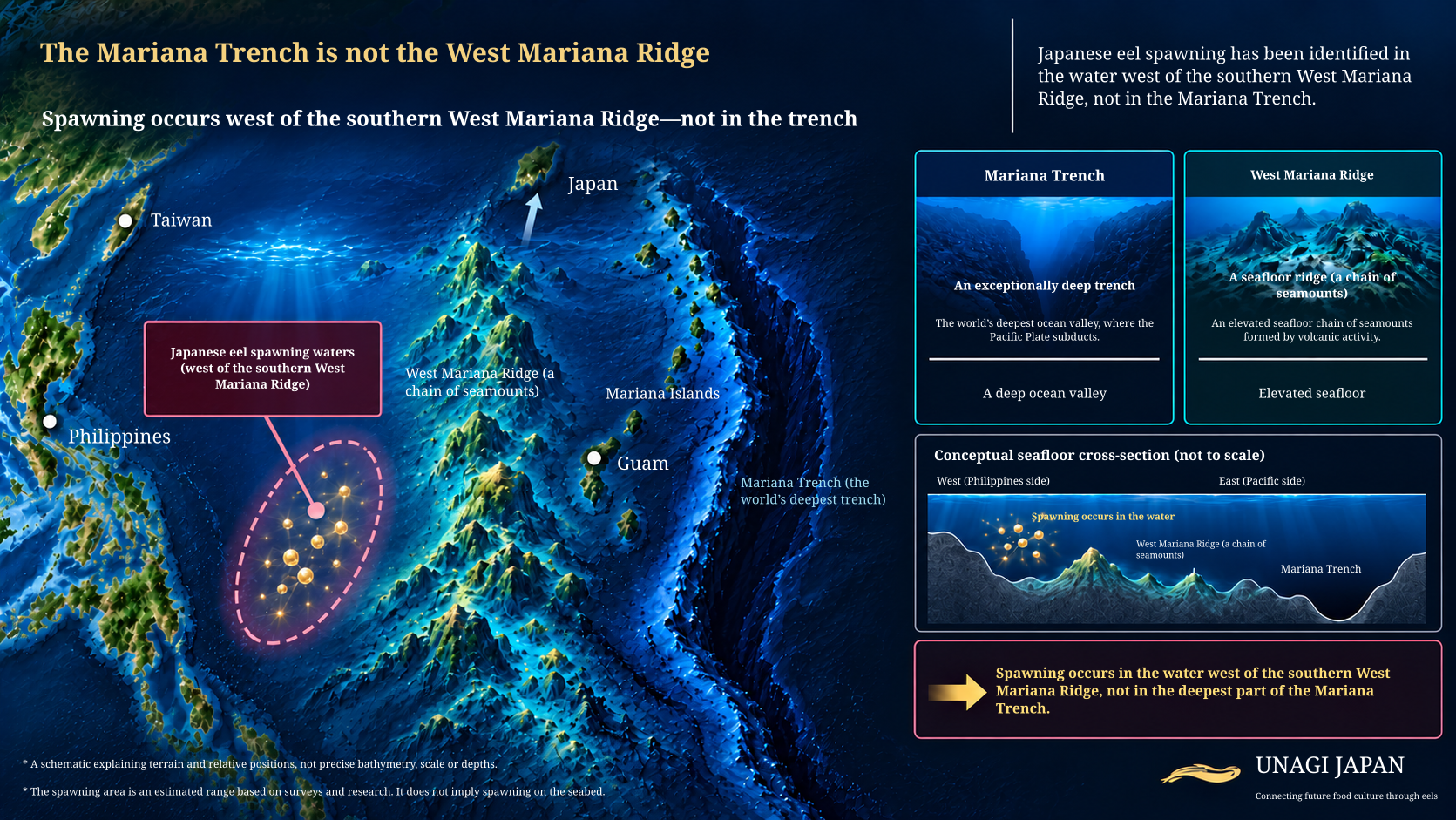
A dot on a map is not a spawning site fixed forever
Aoyama and colleagues' study of the 2011 and 2012 surveys examined how egg and newly hatched larval collection sites related to surface salinity structure. The location of low-salinity water and its boundary was associated with spawning latitude. Because ocean conditions change, a single coordinate cannot appropriately be declared the destination shared by every generation. Aoyama et al. (2014)
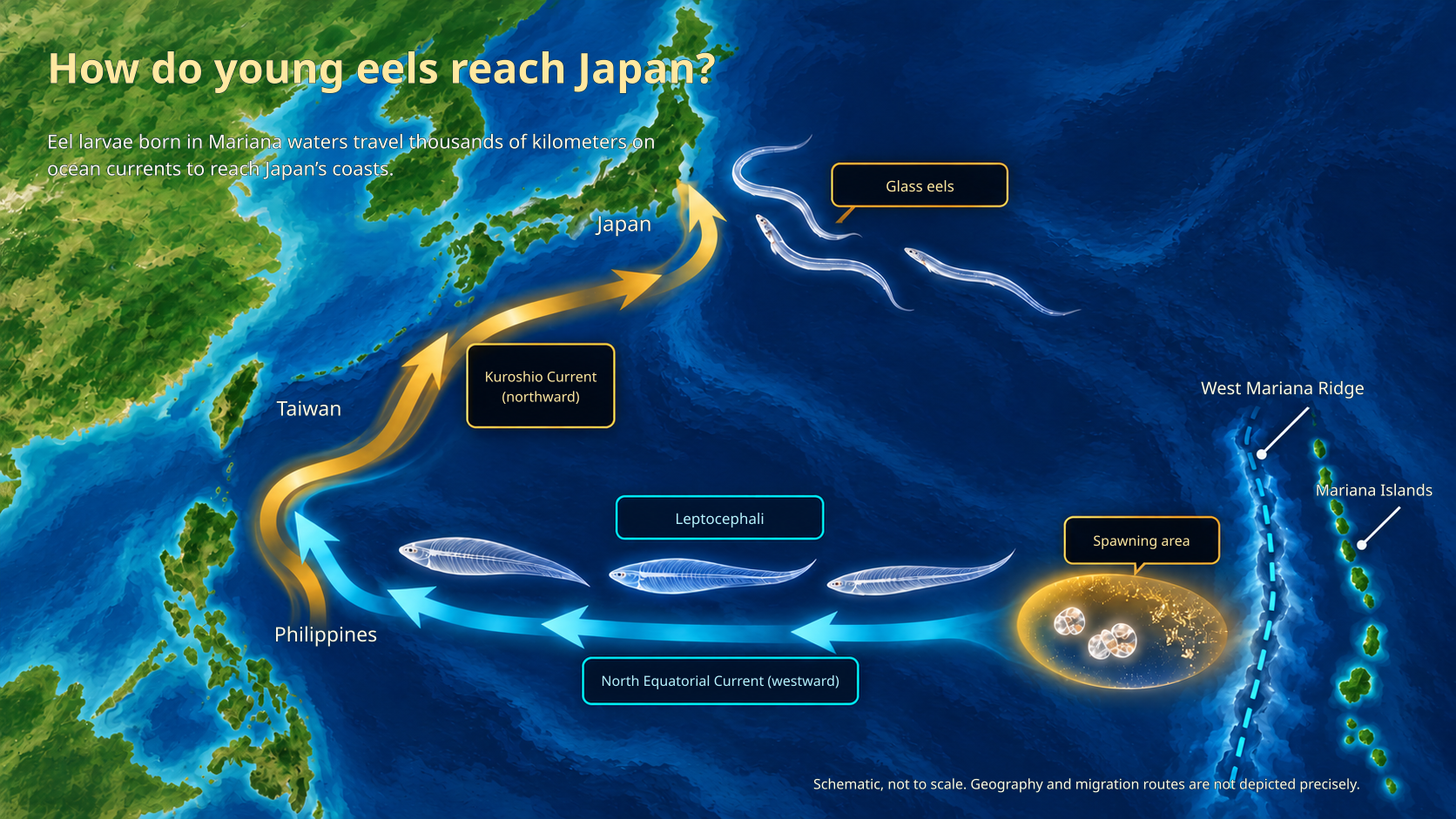
The area and migration diagrams here are schematics showing spatial relationships. They do not reproduce actual collection points, survey vessels' net tracks or individual tracking records. For precise survey locations, consult the maps and methods in the original papers.
How was the spawning area identified?
The key is what was collected, where, and how its species was confirmed. Following the discovery of young larvae separately from the collection of wild eggs shows how the evidence became stronger.
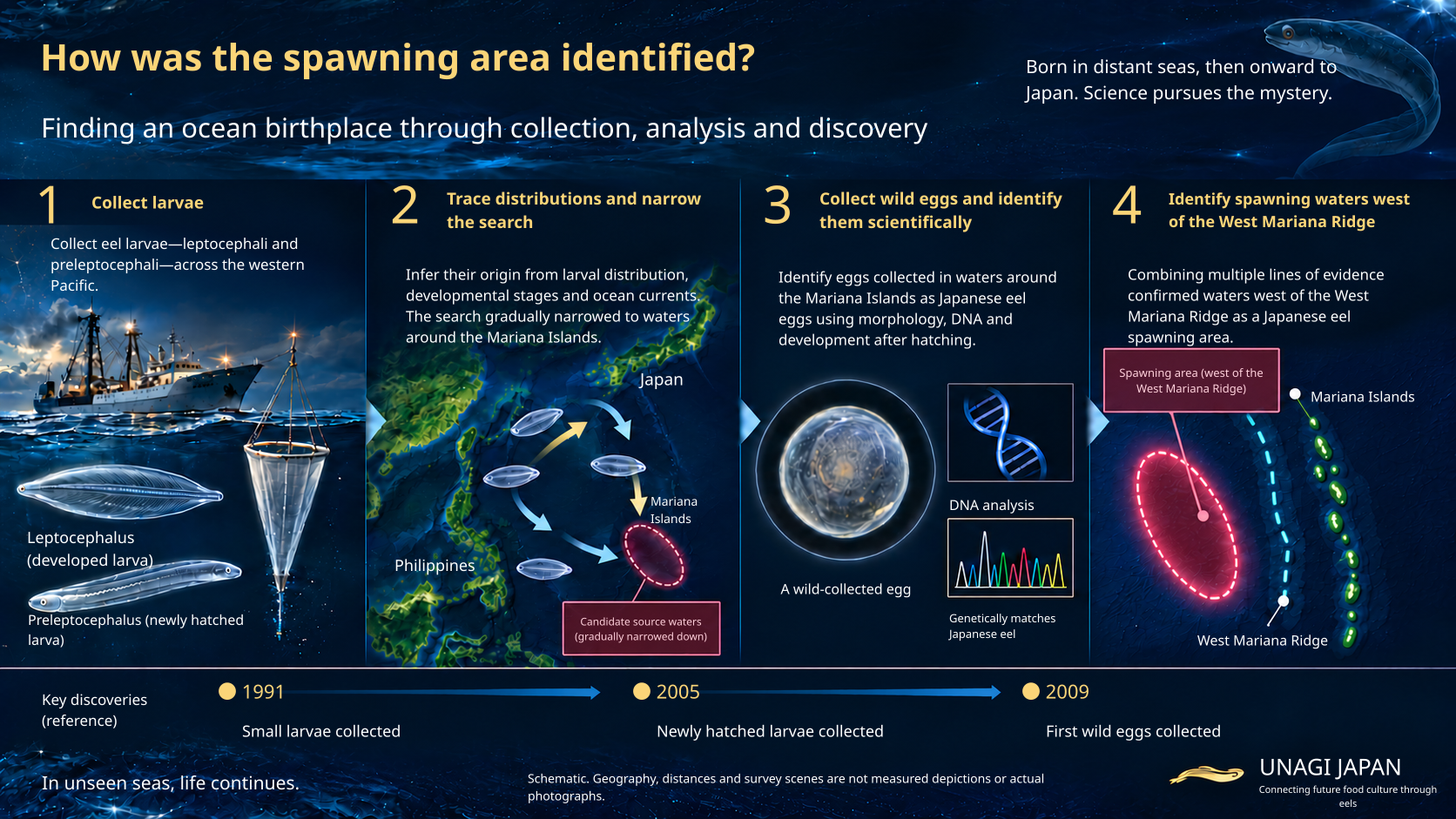
From larvae to evidence closer to the place of birth
Collecting drifting larvae and examining their size and development helps narrow the spawning area. In a 2006 paper, Tsukamoto reported genetic confirmation that newly hatched larvae collected in 2005 were Japanese eels. Finding this stage, younger than leaf-shaped larvae, was important for approaching the place just after spawning. Tsukamoto (2006)
Researchers did not conclude from appearance alone that finding a small fish proved the area. Other fish have eel-like larvae, so species identification was combined with assessment of developmental stage. The discovery accumulated evidence by interpreting individual specimens.
Wild eggs collected in 2009 provided strong evidence
Tsukamoto et al. (2011) reported collecting 31 Japanese eel eggs at three sites in five net tows in May 2009. Morphological examination and genetic testing aboard the research vessel Hakuho Maru identified them as this species. These eggs, together with adults and newly hatched larvae collected nearby, support the spawning area's identification. Collection methods and results: Tsukamoto et al. (2011)
When viewing egg photographs, check whether the eggs were collected in the wild or artificially fertilised, and which species they represent. A photograph's impression is different from a specimen's scientific information.
How do the new moon and salinity boundary relate?
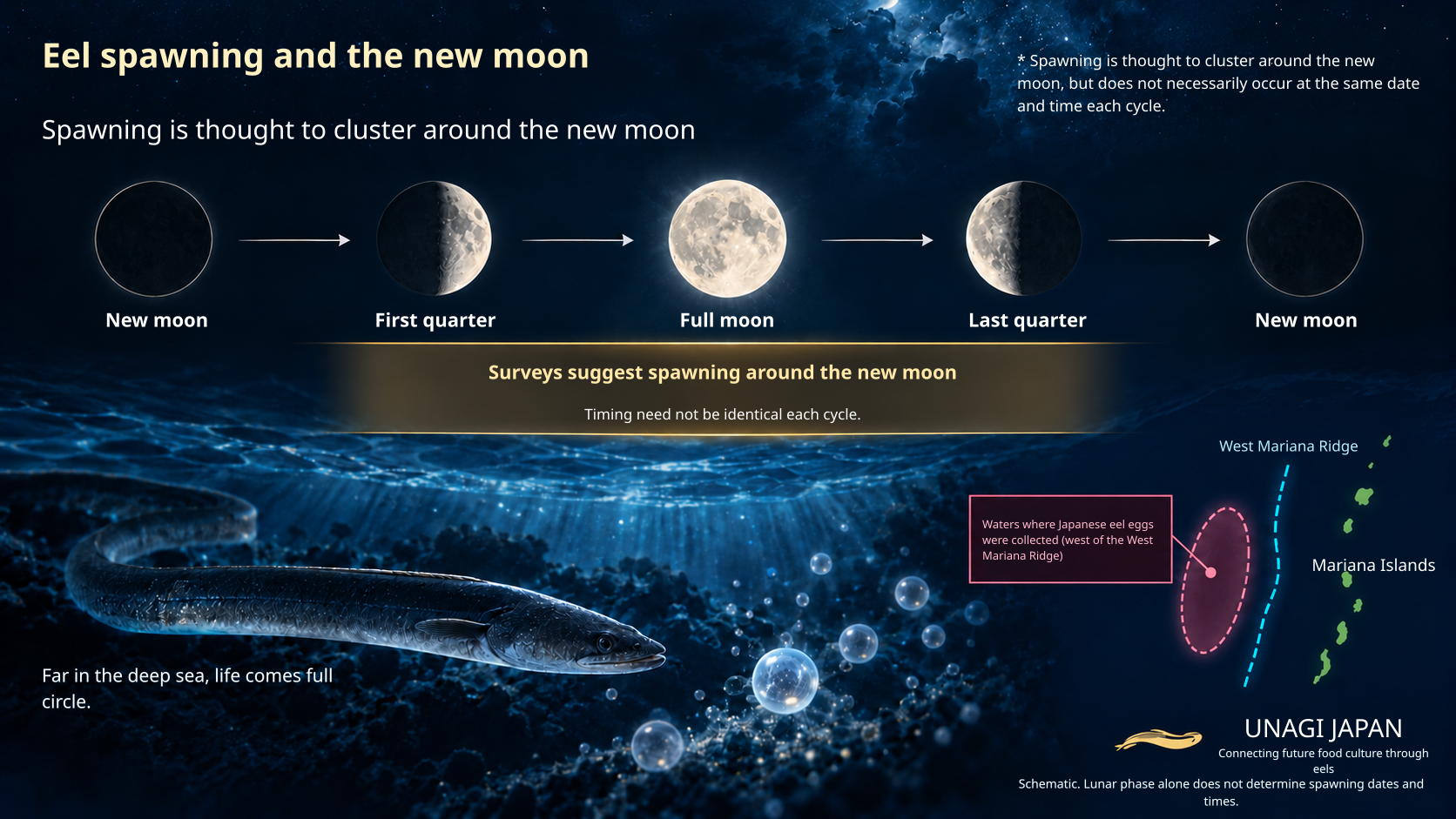
Collection dates for eggs and very young larvae were associated with the lunar cycle around the new moon. The University of Tokyo explains how three clues—the ridge, new moon and salinity front—narrowed the surveys. These are temporal and spatial reproductive patterns derived from research, rather than a forecast guaranteeing sightings anywhere along the ridge on a new moon. University of Tokyo research explanation
Higuchi et al. (2020) also estimated spawning time by combining wild egg development, experimentally measured egg ascent speeds, water temperature and other factors. The indicated time window results from calculations under several assumptions. It was not obtained by filming egg release underwater and reading a clock. Higuchi et al. (2020)
How do the larvae reach Japan?
The North Equatorial Current and Kuroshio are central to the connection between the West Mariana Ridge area and East Asia. Currents are not conveyor belts delivering every larva to the same river. The relationship between spawning location and current branching is considered important for transporting larvae that recruit to East Asia. Aoyama et al. (2014)
A single arrow in a diagram summarises that connection. Distinguishing the adults' migration route from the route along which larvae are transported makes it easier to read. The sequence from eggs through glass, yellow and silver eels is explained in the related article Japanese eel life cycle (article-12).
What is established, and what still needs checking?
Strong evidence already supports open-ocean spawning by Japanese eels, the waters where eggs were collected, and relationships with collection timing and ocean conditions. Egg collections alone do not directly reveal how wild eels find mates, gather, or behave in detail while releasing eggs and sperm. The 2020 spawning-time study also identifies the difficulty of directly observing spawning behaviour in the wild. Higuchi et al. (2020)
Calling everything a mystery overlooks years of discoveries. Claiming spawning is fully understood turns estimates into observed facts. Separating egg collection facts, deductions from them and behaviour still requiring verification helps readers appreciate eel research.
Frequently asked questions
- Do all eels spawn at the West Mariana Ridge?
- No. This article focuses on the Japanese eel. The Sargasso Sea in the Atlantic is known in relation to European and American eel reproduction. The spawning grounds of the entire genus Anguilla cannot be reduced to one place. Tsukamoto (2006)
- Is egg collection depth the same as spawning depth?
- Not necessarily. Eggs move through the water, so collection depth cannot simply be called the depth of egg release. Estimates must consider egg ascent, development and water temperature. Higuchi et al. (2020)
Related articles