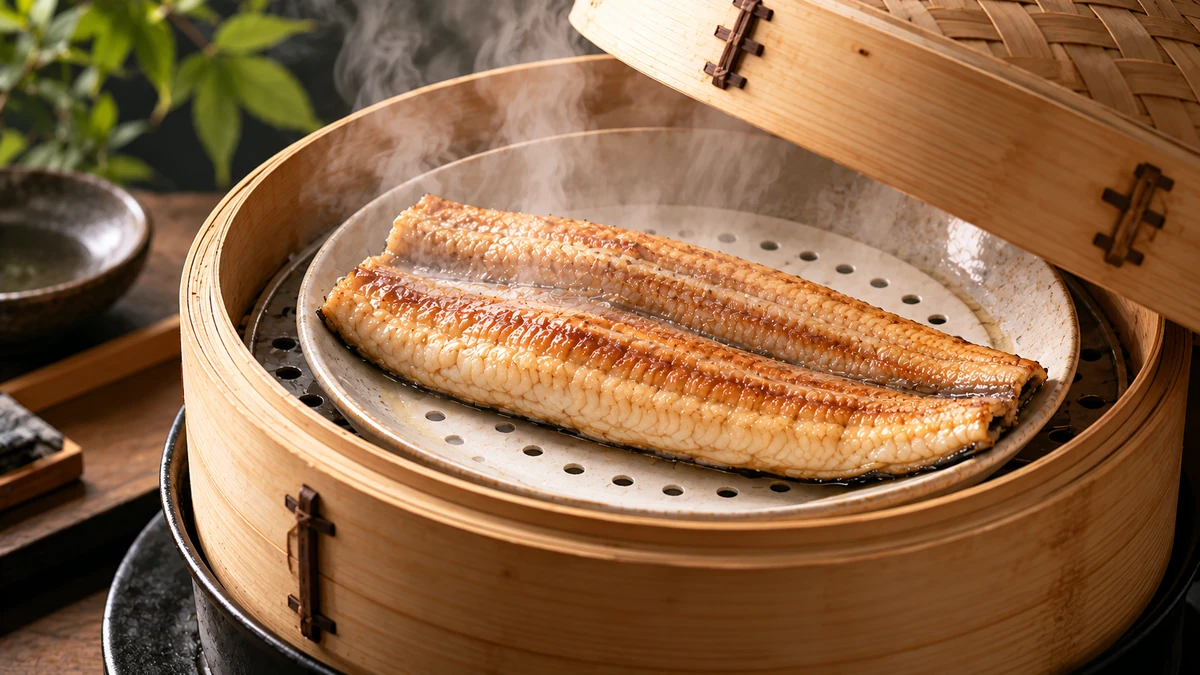
There is no universal answer to “How many minutes should I steam eel?” First identify what you have: a raw split fillet, shirayaki (eel grilled without sauce), or ready-cooked kabayaki (glazed grilled eel). Cooking raw fish and warming an already cooked product are different operations; their heating times are not interchangeable.
This guide separates the purpose of steaming, equipment setup, heating conditions and finishing checks. It draws on the Japanese agriculture ministry's description of a Kanto-style process MAFF, Kikkoman's named recipes Kikkoman Kikkoman, and Japan's health ministry food-safety advice Japan’s health ministry. The illustrations are editorial schematics, not cooking experiments or instructions for any specific product.
Identify What You Are Steaming
1. Raw, simply grilled and fully cooked eel are not the same
The word “eel” covers several states of preparation. Kikkoman's ingredient guide confirms that both shirayaki and kabayaki are sold. Shirayaki describes an unsauced grilling preparation; the name alone does not certify the cooking status or storage requirements of every item on sale. Check the individual product information. Kikkoman
Treat a raw split fillet as uncooked fish: do not eat it raw or assume a brief steaming is enough. If you cannot establish whether a product is already cooked, ask the seller or follow the product's explicit instructions rather than guessing.
2. Cooking and reheating serve different purposes
The Ministry of Agriculture, Forestry and Fisheries (MAFF) records one Kanto-style sequence: split and skewer the eel, grill it without sauce, steam it, and then grill it again with sauce. Kikkoman's hitsumabushi-style rice recipe instead tells readers to warm ready-cooked kabayaki by grilling, steaming or microwave before cutting it. The latter is reheating, not a validated shortcut for a raw fillet. MAFF Kikkoman
Steam and Equipment
3. Let steam circulate around the food
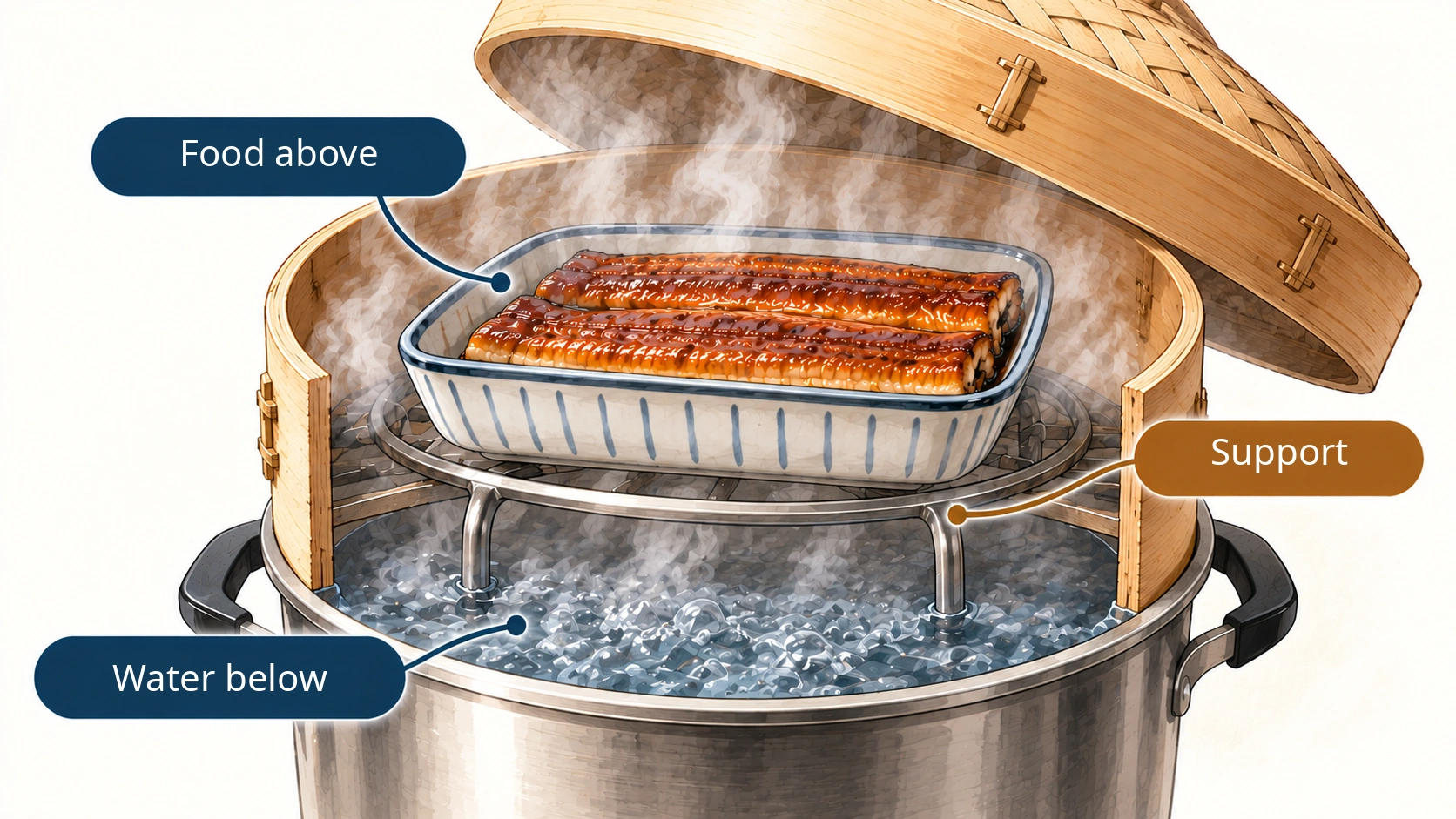
A basic setup has a pot producing steam, a rack or steamer basket that holds the food clear of water, a heatproof dish and a lid. Use a dish suitable for the equipment and leave space for steam to circulate. The time until steam first appears is not the time needed to heat the centre of the fish. Water level, heat output, lid fit, dish and initial food temperature all change the result.
4. Keep the dish above boiling water
Steaming does not require submerging the dish or eel in boiling water. Raise the dish on a suitable support, and maintain enough water to prevent the pot from boiling dry. If water must be added, take care around hot steam and follow the steamer manufacturer's instructions. Immersing the food in water would be a different cooking method.
Beware of burns from boiling water and steam. NHS
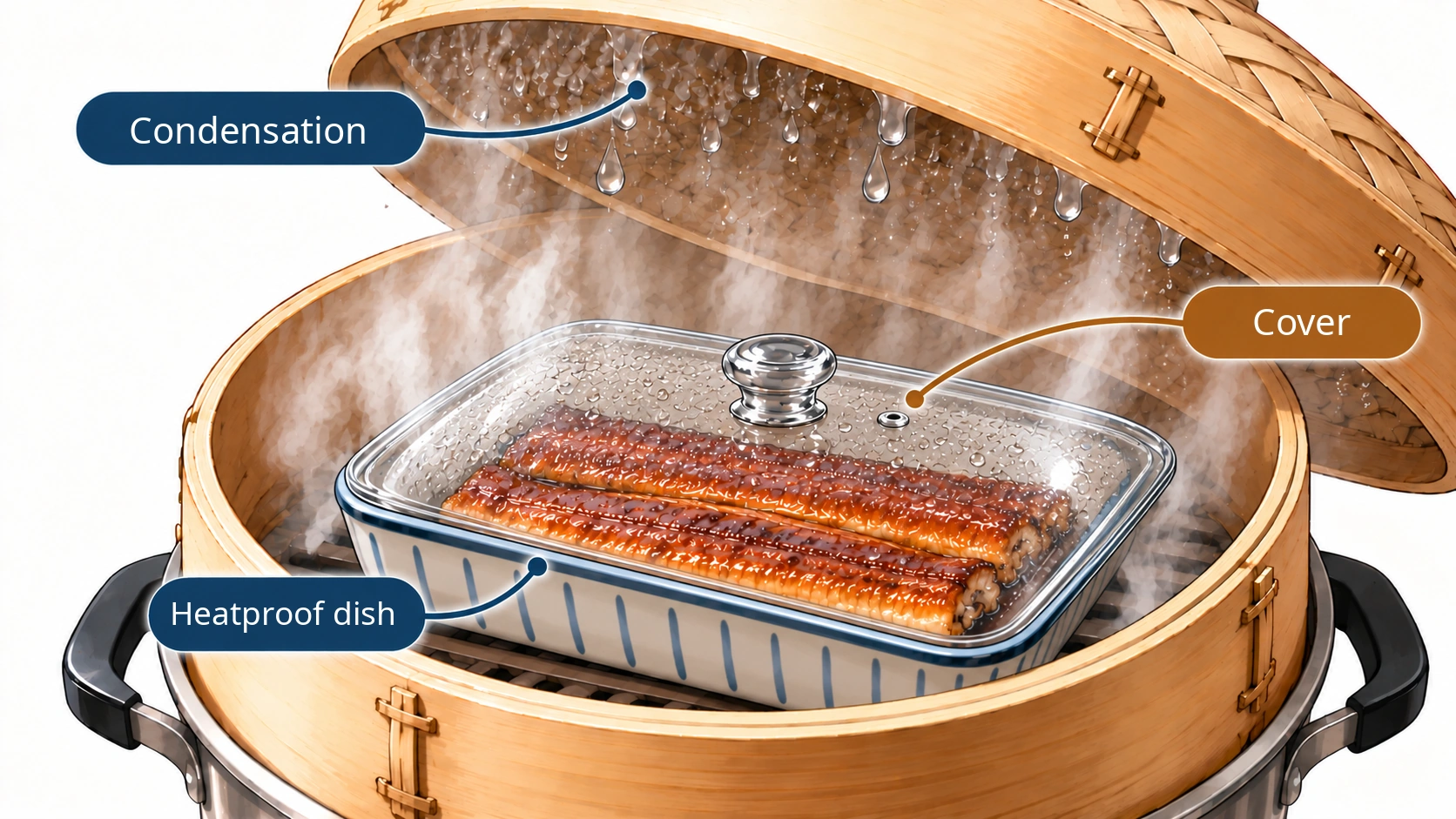
5. Prevent condensation from dripping onto the eel
Droplets collect under a lid and may fall onto the food, diluting sauce or altering the surface finish. Where appropriate, protect the dish with a food-safe, heat-resistant cover without blocking steam circulation. Only use cloth or paper as permitted by the equipment instructions: prevent contact with flames or heating elements, slippage and steam burns. The drawing illustrates the principle, not a universal covering technique.
Control the Conditions
6. Thickness changes the heating requirement
Thin and thick fillets, small and large batches, refrigerated and frozen products do not heat to the centre at the same rate. Read any stated minutes together with the ingredient's processing state, quantity, equipment and the point at which timing begins. Visible steam is not proof that the centre is adequately heated.
The original recipe first warms and cuts the kabayaki; the times below concern later stages. For a concrete comparison, Kikkoman's steamed turnip dish serves 2 people, using 1 skewer of cooked kabayaki, 2 shrimp and 150 g of turnip. Its method steams the eel and shrimp for 2–3 minutes, then adds the turnip mixture and steams for another 7–8 minutes. The published 60-minute preparation time covers the dish as a whole; it does not mean steam eel alone for 60 minutes. These figures are not a standard for raw eel. Kikkoman
Check allergen information for fish, shrimp, egg and, where present, wheat and soy in each product. The cited recipe uses sake in the shrimp marinade. If avoiding alcohol, check the recipe and product ingredients; cooking does not guarantee its complete removal, and the residual amount in this dish has not been measured. USDA
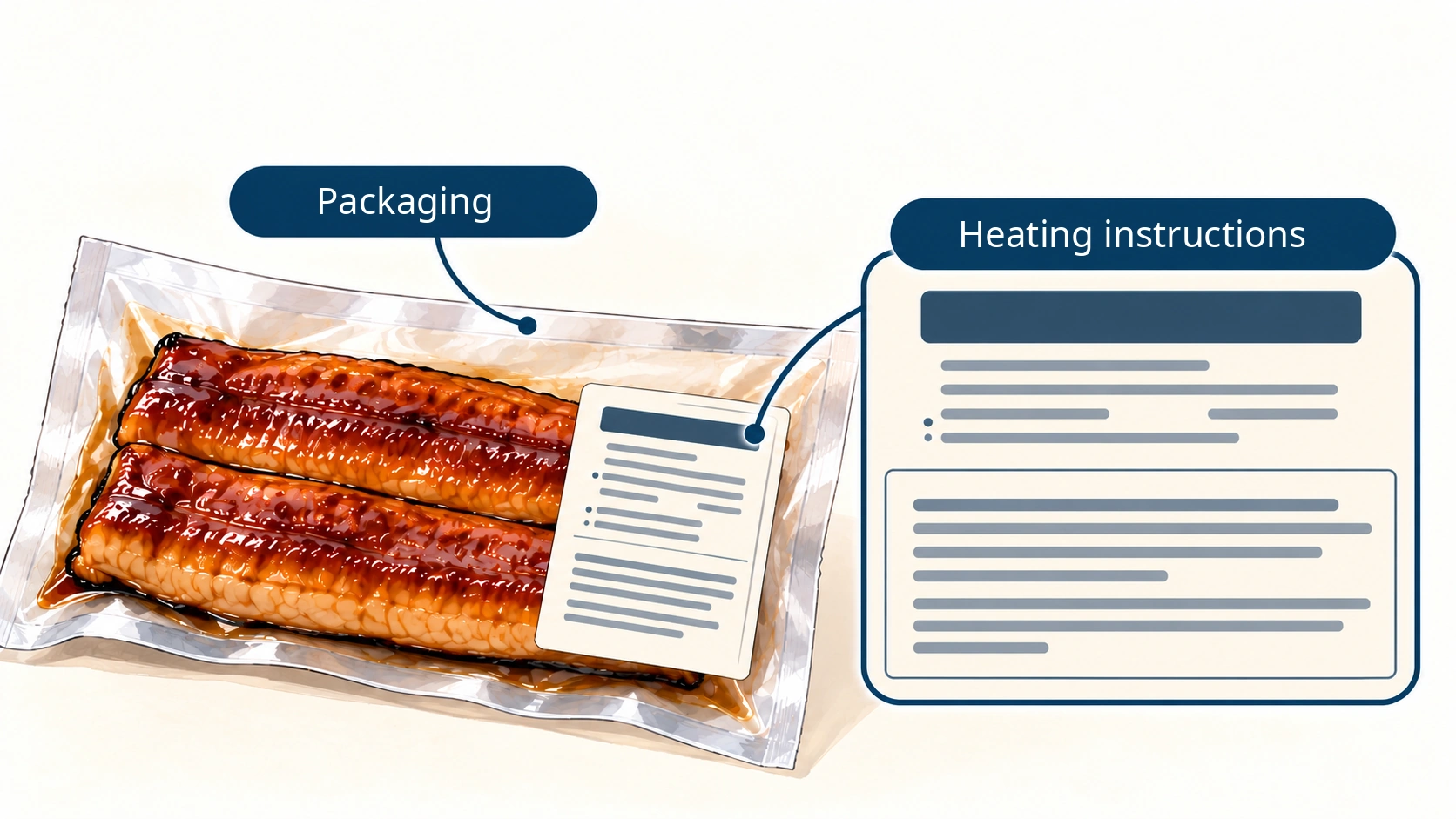
7. Check whether the packaging is heat-compatible
“Vacuum-packed”, “frozen” and “fully cooked” do not establish that a bag itself can go into a steamer. Read the stated heating method, heat-resistance information, thawing requirements and any instruction to open the bag. Without explicit permission for heating in the pouch, do not steam it in its packaging; transfer the contents to an appropriate heatproof dish as directed. The diagram's instruction field is illustrative, not a claim about a real product.
Finish and Verify
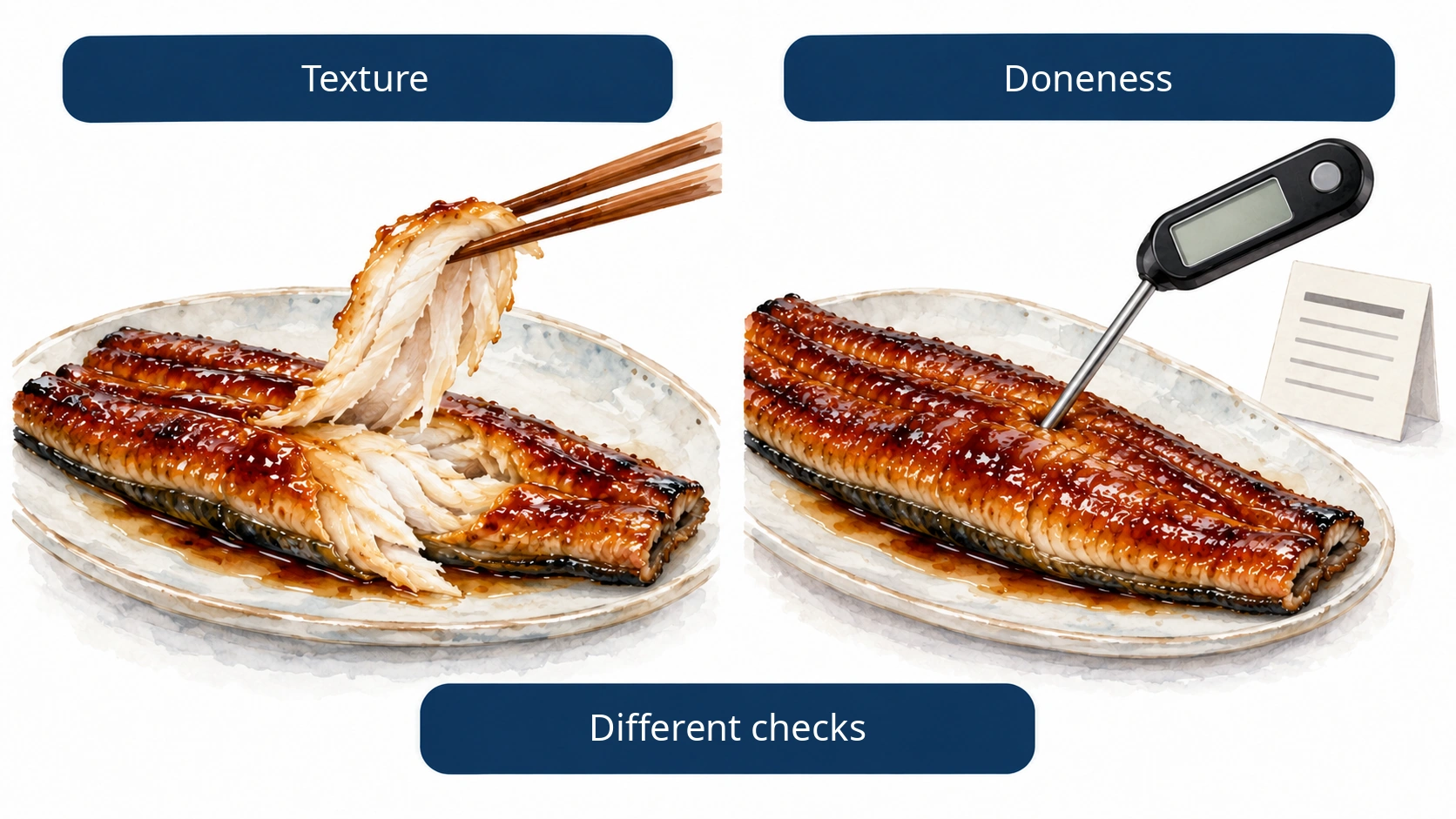
8. Texture and safe cooking are separate checks
“Fluffy” flesh or a glossy glaze describes texture and appearance, not microbiological safety. Japan's Ministry of Health, Labour and Welfare gives 75°C at the centre for at least 1 minute as a general household guideline for foods requiring cooking. This is not a universal steaming time or product instruction for every eel item. For raw eel, make sure the centre is sufficiently cooked; reheat leftovers thoroughly too. Japan’s health ministry
The ministry's natural-toxin profile also notes that raw serum from eel-order fish can be toxic and that ordinary cooking inactivates this toxin. Keep raw eel blood away from the mouth, eyes and cuts. Do not mistake a statement about serum-toxin inactivation for proof that an entire fillet has finished cooking safely. Japan’s health ministry
Use a clean food thermometer in the centre of the thickest part and check the general household guidance of 75°C for at least one minute. Follow the product instructions too.
9. Distinguish steaming from the subsequent grilling stage
The ministry's account of Kanto kabayaki records a finishing stage in which steamed, simply grilled eel is coated with sauce and grilled again. Follow the remaining stages of the recipe you have chosen rather than treating steaming as the automatic end of cooking. But if the product is already cooked and only needs warming for the table, an additional glaze-grilling step is not inherently required. MAFF Kikkoman
The Decision Order Before Steaming
First distinguish raw, shirayaki and ready-cooked eel; then select the applicable recipe or package directions. Keep the dish above water, allow steam to circulate, check heating in relation to thickness and the centre, and only grill afterwards if your method calls for it. Establishing what you are steaming and why is more useful than memorising one eel-steaming time.
Primary Sources Checked
MAFF, “Unagi no kabayaki”, Tokyo regional cuisine: sequence of grilling, steaming and glaze-grilling
Kikkoman, eel ingredient guide: shirayaki and kabayaki as products
Kikkoman, hitsumabushi-style eel rice: ways to warm cooked kabayaki
Kikkoman, eel-and-shrimp steamed turnip: ingredients for two and staged steaming times
Japan's health ministry, natural-toxin profile for fish serum: raw eel blood
Publisher pages checked on 13 November 2026. Numerical conditions apply only to the dishes and guidance identified in their respective sources.
Related Reading
Related articles