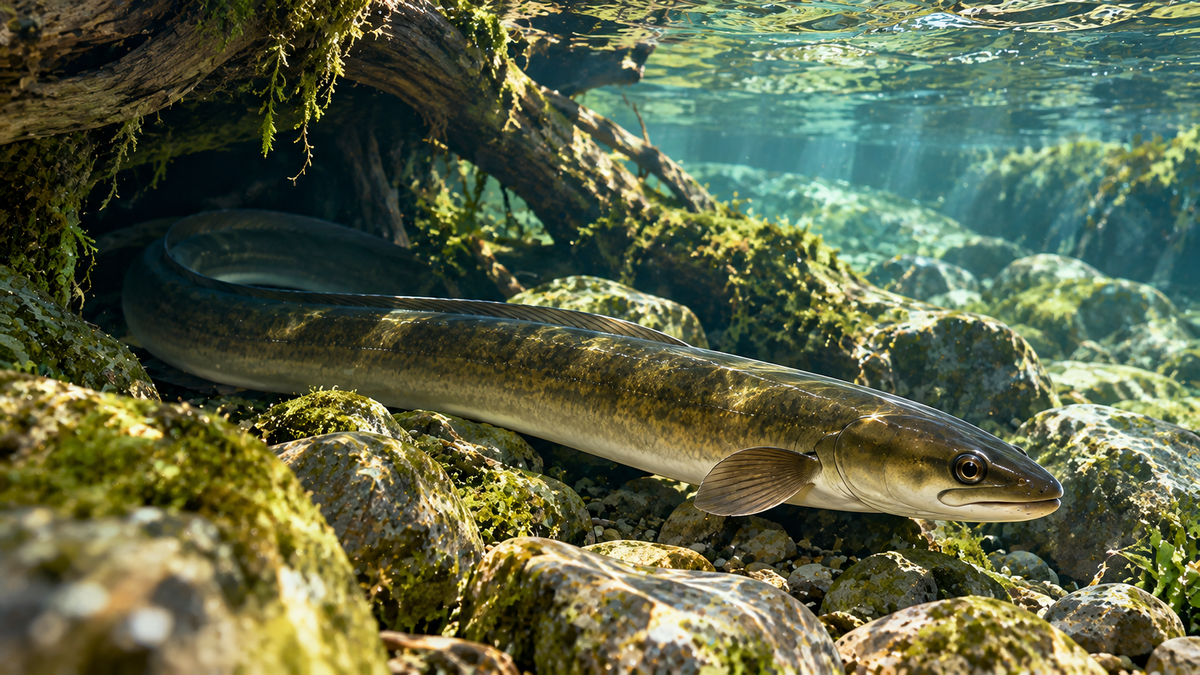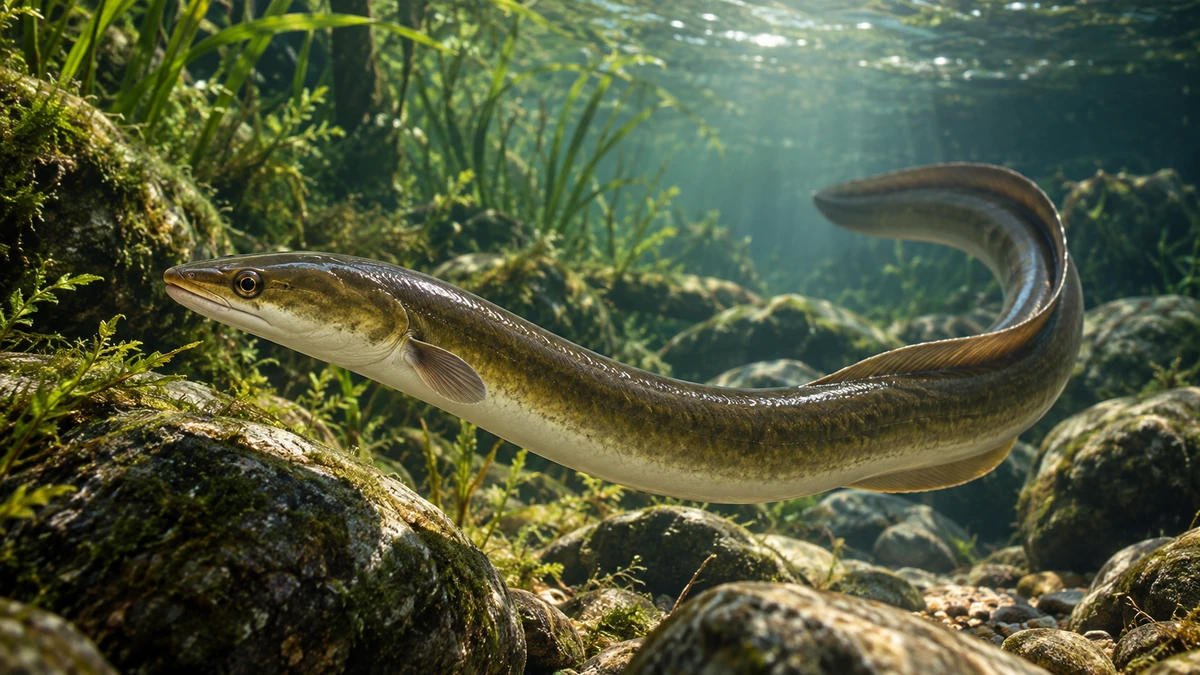
The European eel, Anguilla anguilla, is a fish in the freshwater-eel family Anguillidae. It grows in freshwater, estuaries and coastal waters around Europe and undertakes an Atlantic migration associated with reproduction. Yet where the species lives, movement actually recorded, spawning inferred from evidence, conservation status and binding law are different kinds of information. This species-specific account examines primary sources available on 13 November 2026. It does not import spawning locations or growth figures from the Japanese eel.
Species and range
1. A scientific name identifies one species
The FAO's 2009 species account identifies the European eel as Anguilla anguilla (Linnaeus, 1758), in the family Anguillidae. That is a particular biological species, not simply any elongated fish found in Europe. The Japanese eel, Anguilla japonica, is a different species: its spawning geography, life-history measurements and stock assessments cannot be transferred to A. anguilla. Nor can a dish name or a commercial name reliably identify a fish without species-level documentation. Start with a scientific name and a source that specifies the species being discussed.
Supporting sources: FAO (2009)
2. Separate continental growth habitats from breeding waters
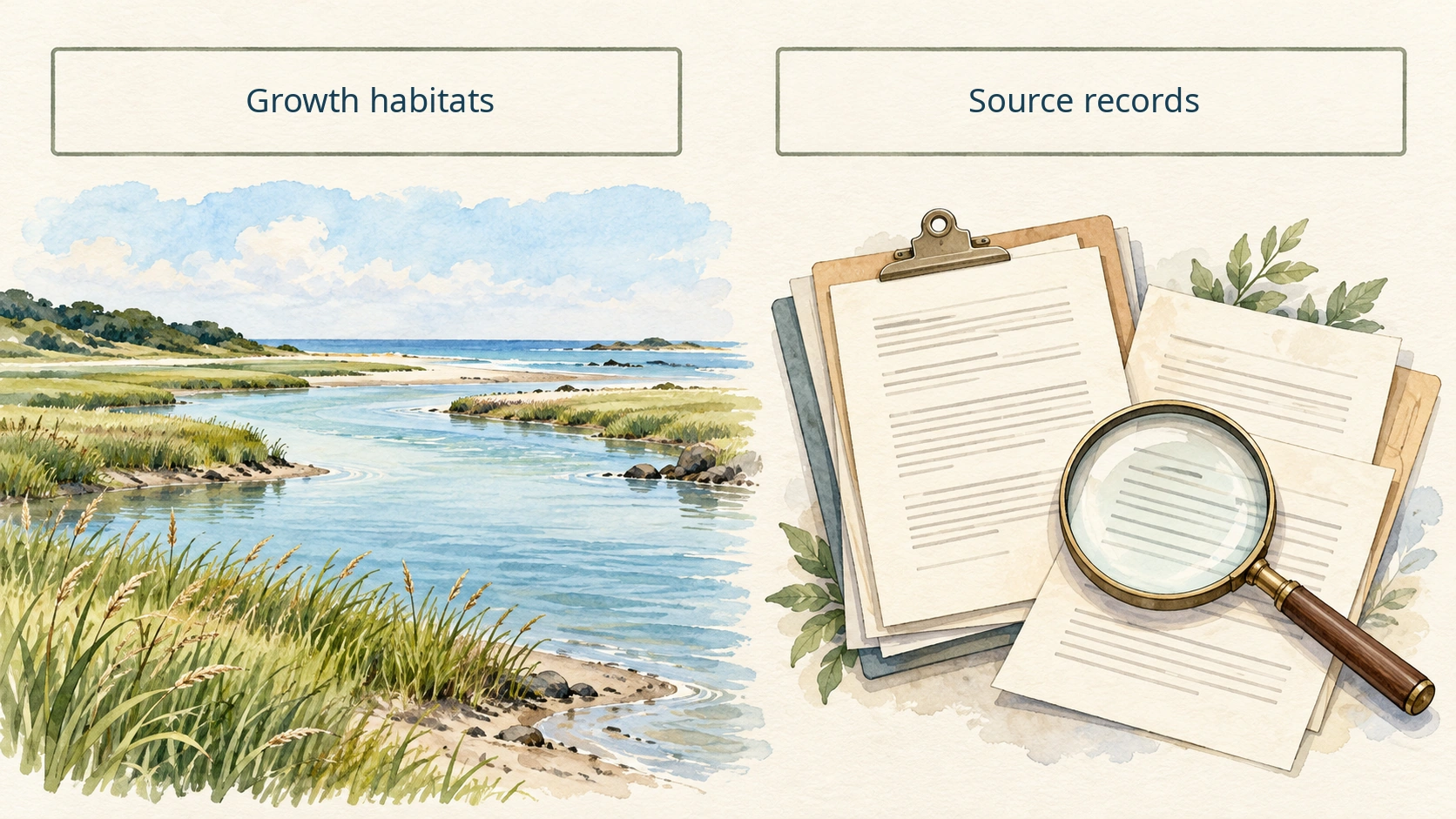
During its continental growth phases the European eel occurs in European rivers, lakes, estuaries and coastal areas, as well as Mediterranean and North African waters. The FAO account describes rivers draining into the North Atlantic, Baltic and Mediterranean; the IUCN species assessment lists countries of non-breeding occurrence. The Sargasso Sea in the western North Atlantic has a different role as the presumed breeding region, not a continental feeding habitat. The illustration depicts a generic estuary and records; it is not a measured map or a range boundary.
Supporting sources: IUCN (2020) · FAO (2009) · OSPAR
3. An eel-shaped fish, not a snake
The eel's long body does not make it a snake. According to FAO morphology, it has small, rounded pectoral fins; its dorsal and anal fins join the caudal fin; and pelvic fins are absent. Tiny scales are embedded in its skin. Colour and appearance also change through development: a growing yellow eel may have a brown-green back and yellowish underside, while the silver stage associated with seaward migration develops more reflective flanks and belly.
Supporting sources: FAO (2009)
Life cycle and habitats
4. From leaf-shaped larva to glass, yellow and silver eel
A useful sequence is the oceanic leaf-shaped leptocephalus larva, the transparent glass eel that metamorphoses near continental waters, the pigmented elver or growing yellow eel, and the silver eel preparing to migrate. OSPAR's overview gives roughly 2–25 years for the yellow-eel growth phase and acknowledges much longer examples. This is a range in a species account, not a universal age at transformation for every location or fish.
Supporting sources: OSPAR · FAO (2009)
5. River, estuary and coast are not obligatory stops
Some European eels enter rivers, but others remain and grow in estuarine brackish water or marine coastal habitats. Describing every individual as completing an identical sea–river–sea itinerary is therefore misleading. The European Tracking Network describes A. anguilla as facultatively catadromous: freshwater residence is not required of every eel during its growth phase. Recognizing alternative habitats matters for conservation, because coastal development, estuarine degradation and fisheries can affect animals that never travel far upstream.
Supporting sources: ETN · OSPAR
6. Larval and later-stage diets need different evidence
Ayala and colleagues' 2018 study compared gut contents of A. anguilla larvae collected in the Sargasso Sea with surrounding particles, using 18S and 16S rRNA gene sequencing. Sequences associated with gelatinous plankton, especially hydrozoans, were important in the larval guts; the results did not support a simplistic assumption that the larvae consume marine snow in the same composition as the surrounding particles. A percentage of DNA sequence reads is not a percentage by weight of food. The feeding ecology of later growth stages must not be inferred by simply copying the larval result.
As one example of feeding during the growth phase, the stomach contents of European eels examined in France’s brackish Mauguio lagoon included small crustaceans, polychaete worms, insect larvae and small fish. Diet can vary with season and the organisms available locally. Bouchereau et al. (2009)
Supporting sources: Ayala et al. (2018) · FAO (2009)
Ocean migration and evidence
7. Why the Sargasso Sea matters
The Sargasso Sea became the proposed breeding region chiefly because early twentieth-century surveys found concentrations of the smallest European-eel leptocephali there. Silver eels are thought to cross the Atlantic, but a single fixed track cannot represent departures from different locations, currents and individual variation. A 2022 tagging paper strengthened evidence that adults can reach this region. It did not, however, film spawning or identify an exact site where all European eels reproduce.
Supporting sources: Wright et al. (2022) · OSPAR
8. What satellite tags actually recorded
Wright et al. (2022) fitted satellite tags to 26 European eels from rivers in the Azores. Twenty-three tags communicated, and 21 of those recorded substantive data. Those 21 tags detached 40–366 days after deployment. Five tag pop-up locations were in the Sargasso Sea, including one in the presumed breeding area. These are movement records, not direct observations of spawning or complete routes for every eel. The reported travel speeds were approximately 3–12 km per day. Wright et al. (2022)
Supporting sources: Wright et al. (2022)
9. Observed movement is not observed spawning
Three lines of evidence should be kept distinct. First, the distribution of very small larvae supports an inference about breeding waters. Second, satellite tags document movements of particular adults. Third, collecting eggs or directly witnessing spawning adults in the wild would constitute a different kind of observation. The 2022 paper explicitly stated that eggs and spawning adults had not yet been sampled in the Sargasso Sea at the time. Arrival is an important advance, but it does not establish that every eel follows one route or spawns on the same date.
Supporting sources: Wright et al. (2022)
Conservation and how to read the sources
10. Multiple pressures threaten the species
The IUCN global assessment classifies Anguilla anguilla as Critically Endangered (CR) under criteria A2bd+4bd. Its assessment date is 7 November 2018 and its publication year is 2020; the two dates should not be confused. Pressures extend beyond harvest: dams and weirs, pumps and turbines, habitat alteration, pollution, disease and parasites, plus uncertainties during ocean life, can all matter. Their relative impact depends on place and life stage.
Supporting sources: IUCN (2020) · ETN
11. Do not confuse Red List status, scientific advice and law
In advice published in 2026 for 2027, ICES recommended zero catches throughout the species’ natural range in all habitats under the precautionary approach. This includes commercial and recreational catches and glass eels taken for restocking or aquaculture. Scientific advice is not itself a law. ICES (2026/2027)
Article 2(4) of EU Regulation 1100/2007 sets a long-term objective for each eel management plan: reduce human-caused mortality so that at least 40% of the best estimate of silver-eel biomass that would have escaped to sea without human influence can escape with high probability. EU 1100/2007
Article 14 of EU Regulation 2026/249 covers EU marine and brackish waters in ICES subareas 3, 4 and 6–9 and adjacent EU brackish waters. It provides for at least six months of commercial fishery closure between 1 April 2026 and 31 March 2027 and prohibits recreational fishing, with specified exceptions. Amending Regulation 2026/786 provides for continued application of specified provisions until the 2027 fishing-opportunities regulation enters into force. Article 4 of Regulation 2026/266 applies to Mediterranean GFCM subareas 1–27 and brackish and freshwaters: for 2026 it provides for at least six months of commercial closure for eels over 12 cm, a conditional two-month allowance for those under 12 cm, and a ban on recreational fishing. Check each provision, exceptions, national measures and current applicability. EU 2026/249 · EU 2026/266 · EU 2026/786

Supporting sources: IUCN (2020) · ICES (2026/2027) · EC 1100/2007 · EU 2026/249 · EU 2026/266 · FAO/GFCM
Primary sources and references
FAO 2009 — FAO species account covering identification, morphology and broad life history (2009).
EC 1100/2007 — Legal framework for European-eel recovery plans, adopted in 2007.
FAO/GFCM — Mediterranean regional management framework, adopted in 2018 and revised in 2023.
Information checked: 2026-11-13.
IUCN assessment copy hosted by FishSec; EU regulations reproduced by Spain’s official BOE.
Related articles