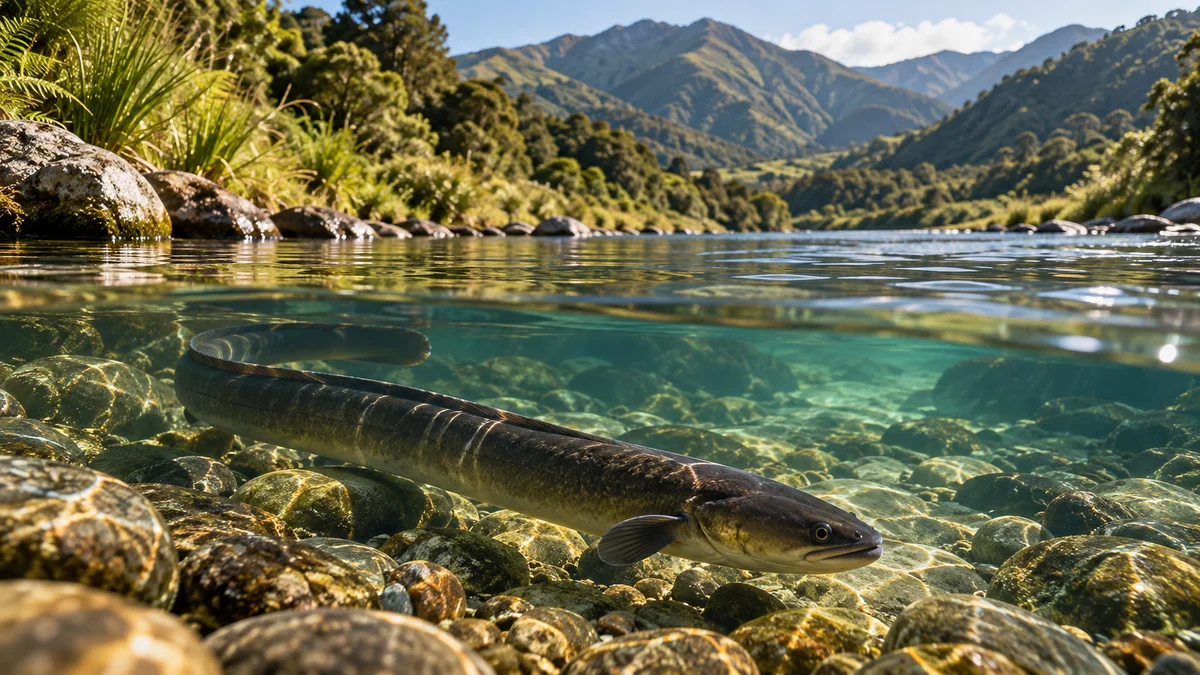
The American eel (Anguilla rostrata) is a freshwater-eel species that grows in rivers, estuaries and coastal waters associated with eastern North America, then migrates toward the Sargasso Sea in the North Atlantic to reproduce. Its common description as a freshwater eel does not mean it spends its entire life in freshwater: it is a catadromous fish, born at sea and capable of using several habitats while growing.
Its life cannot be understood by focusing on one stretch of river or one coastal map. This account distinguishes the U.S. Fish and Wildlife Service (FWS) species profile, Atlantic States Marine Fisheries Commission (ASMFC) assessments and regulations, and original migration research on American eels and broader research on eel larvae. The illustrations are editorial concepts, not field photographs, exact movement tracks or experimental measurements.
Species and range
01 | Identifying the American eel by its scientific name
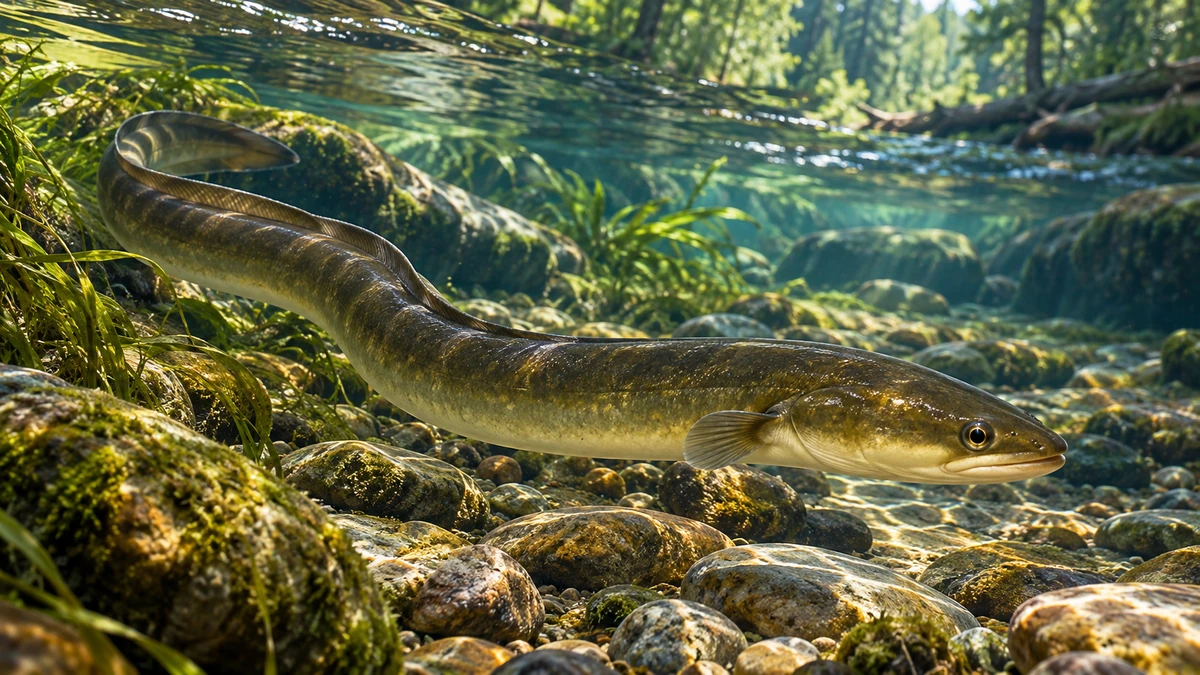
The official FWS scientific name is Anguilla rostrata, and its English common name is American eel. The fish has a long body, relatively small fins and slippery, mucus-covered skin; it swims by undulating much of its body. Although it belongs to the genus Anguilla, its ecological and conservation information must not be copied from Japanese or European eel accounts. Establishing the scientific name and the precise species source first is the simplest safeguard against confusing these distinct animals. FWS
02 | A western Atlantic species connected to North American waters
The FWS account describes a range along the Atlantic side of the Americas, from Venezuela through the eastern North American coast to Greenland and Iceland. Within the United States, it also occurs in Gulf Coast rivers, the Mississippi River system and some inland lakes. A broad range does not establish uniform abundance in every tributary or a single migration distance for all individuals. Descriptions of local occurrence therefore need river-basin or coastal-region evidence, not just a country name or a shaded map. FWS
03 | Color and photographs alone cannot confirm a species
Appearance changes with development, and the FWS account also describes differences between females and males. A brown or olive, elongated fish in a photograph is therefore not automatically A. rostrata. A stronger identification combines capture location, diagnostic morphology, qualified identification and a reliable scientific-name record. FAO's ASFIS list standardizes species items for fisheries statistics; it is not an identification certificate for an individual fish pictured in a photograph. FWS FAO ASFIS
Growth and habitats
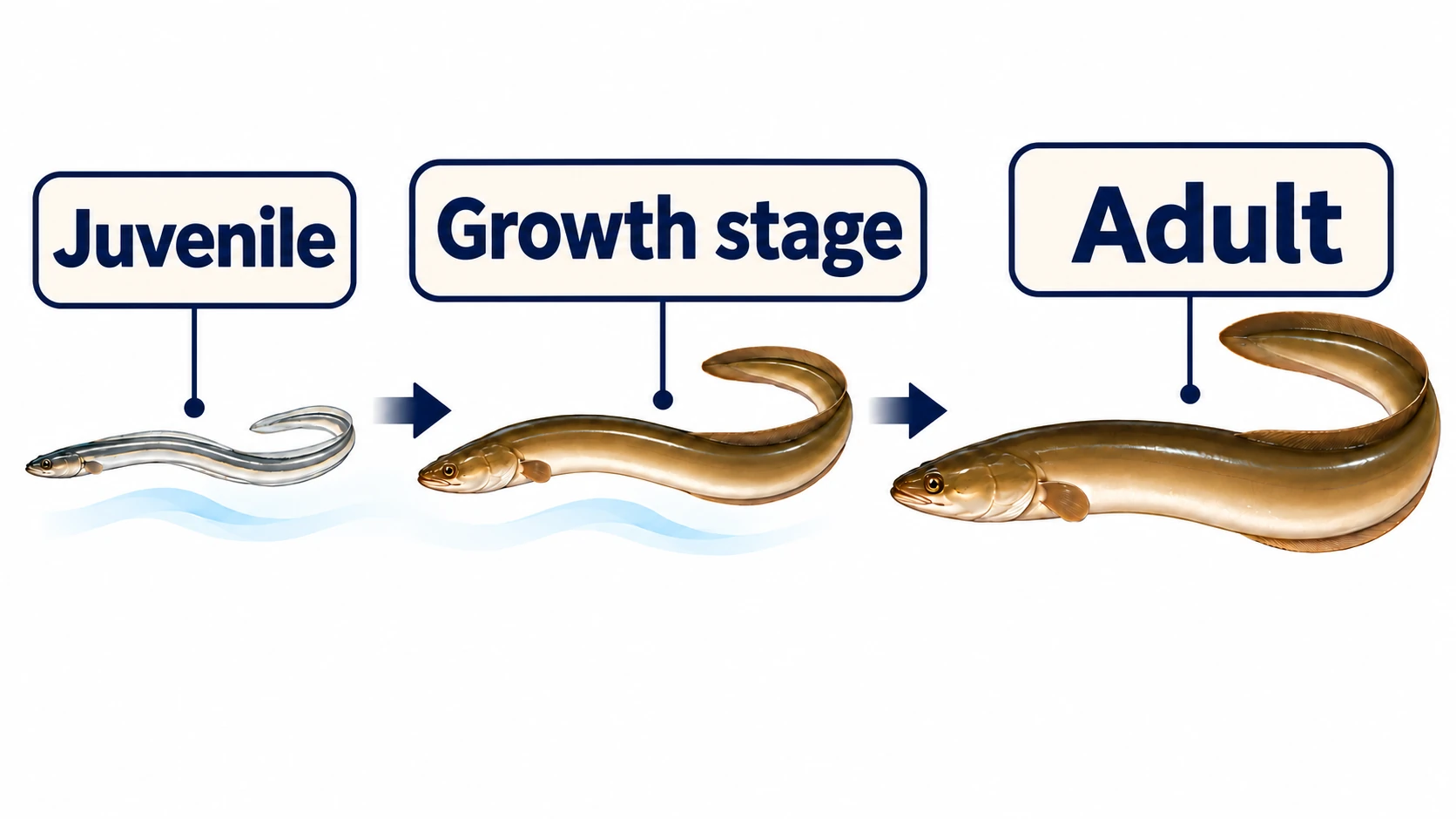
04 | From leptocephalus to glass, yellow and silver eel
An eel born at sea develops through a flattened, transparent, leaf-shaped leptocephalus larva and transforms near the coast into a transparent glass eel. Subsequent names include elver, yellow eel for the growing stage and silver eel for the maturing migrant. These are life-stage terms, not names of separate species. FWS reports lifespans ranging from five to more than 40 years depending partly on habitat conditions, so neither fixed ages nor precise lengths should be inferred from the relative sizes in a schematic illustration. FWS A schematic of selected juvenile, growth and adult stages; it does not show the complete life cycle or measured sizes or ages.
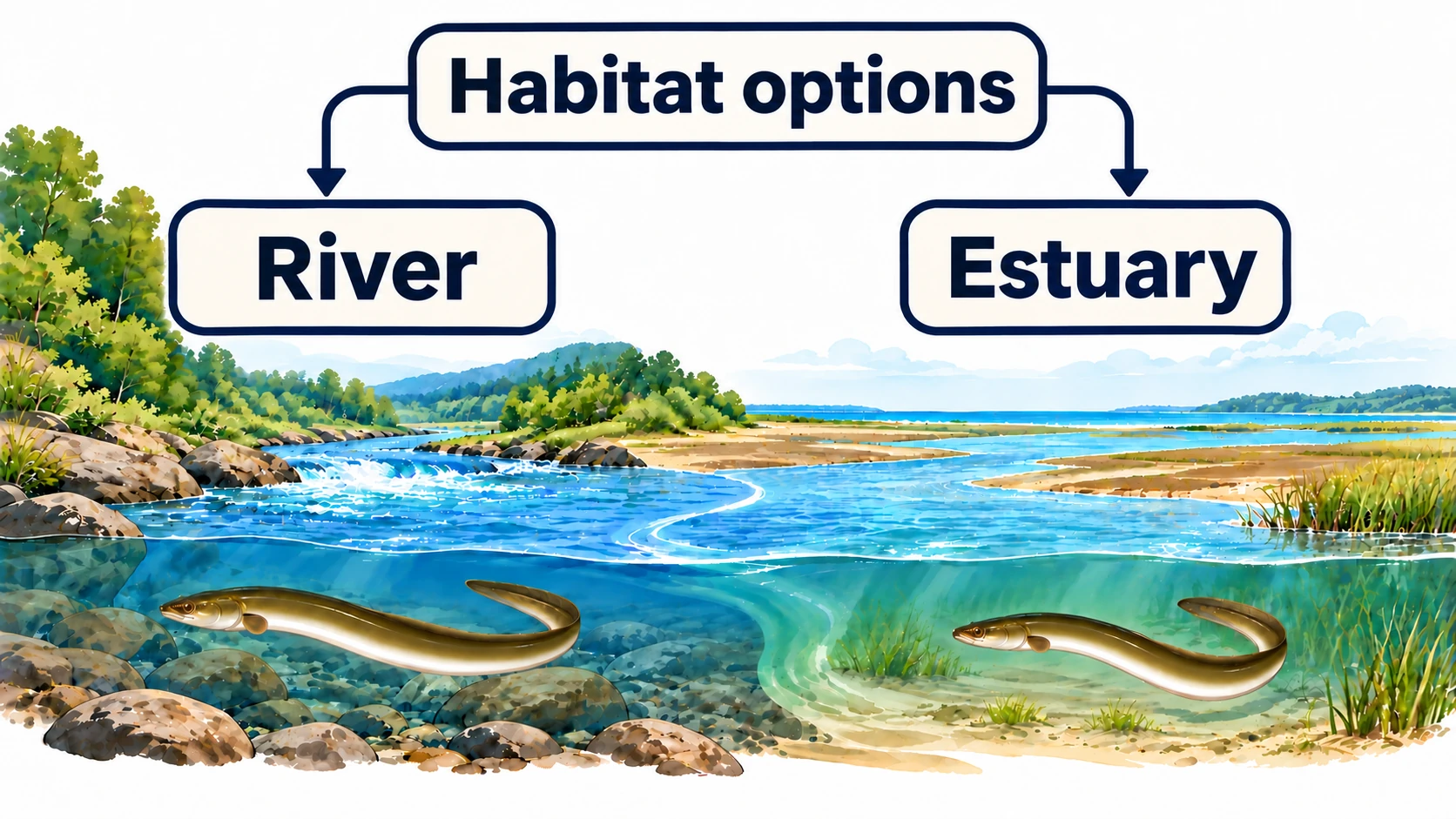
05 | Freshwater, estuaries and coastal habitats
Not every young eel moves far upstream into freshwater. Some use rivers, others remain in brackish estuaries or coastal marine environments, and their habitat histories vary. FWS describes sheltering among submerged wood, vegetation and other cover during daylight and more active nighttime feeding. Treating river and estuary as connected parts of a habitat network explains why protecting only inland water, or only the coast, would overlook important phases of this animal's life. FWS Freshwater and brackish habitats are alternatives, not a compulsory route; the scene is illustrative.
06 | Consider larval feeding separately from the growing eel’s diet
FWS states that eels hunt at night and feed on crustaceans, small insects, worms and other fish. That description must not simply be transferred to oceanic leptocephalus larvae. In a 2019 study of larvae collected in the Sargasso Sea, Miller and colleagues observed amorphous organic material and other particles in the gut contents of eel larvae, supporting a hypothesis involving marine-snow particles. The work did not experimentally establish every prey item consumed by every American eel larva, and its conclusions should retain that uncertainty. The study examined larvae of the Anguillidae family and several marine-eel families; it cannot by itself establish what American eel larvae eat. FWS Miller et al. (2019)
Ocean migration
07 | The Sargasso Sea in the reproductive life cycle
The American eel's reproductive area is understood to lie in the Sargasso Sea of the North Atlantic. Maturing silver eels leave rivers and estuaries for the ocean; their offspring develop in oceanic waters and are transported toward the western Atlantic coasts. This broad cycle is supported by FWS and by the distribution of collected larvae. The exact spawning locations and many details of migration remain unresolved. FWS Béguer-Pon et al. (2015)
08 | What field collections and tracking actually demonstrate
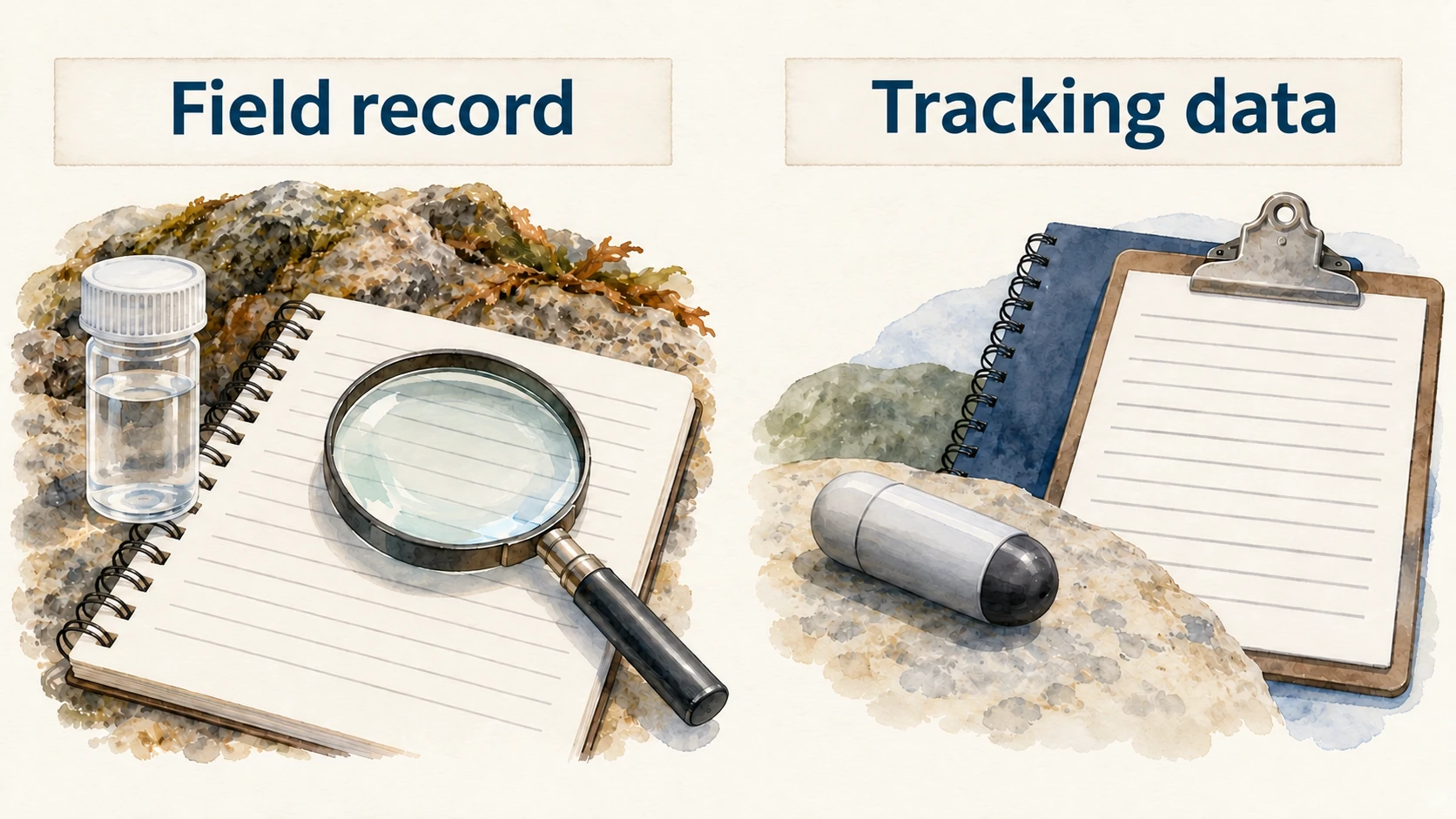
Evidence for the Sargasso Sea first came from collections and geographic patterns of eel larvae and was subsequently strengthened by electronic tracking of migrants. Béguer-Pon and colleagues reported in 2015 on 38 satellite-tagged eels released off Canada on the Scotian Shelf during 2012–2014. Twenty-eight tags transmitted data, eight eels were tracked beyond the continental shelf, and one traveled roughly 2,400 km to near the northern limit of the inferred spawning area. These are observations from specified study conditions, not a survey of every migration route and not direct footage of spawning. The eels in the 2014 group were caught in the St. Lawrence Estuary and transported by land to Nova Scotia before release. The approximately 2,400 km is the reconstructed route of one eel after release, not its entire journey since capture. Béguer-Pon et al. (2015) Collection records and tracking records are distinct evidence types. The equipment is conceptual, not an exact study setup or underwater GPS demonstration.
Conservation and management
09 | Management differs across jurisdictions
On the U.S. Atlantic coast, ASMFC coordinates interstate management from Maine to Florida, but rules on licenses, gear, seasons and possession or harvest are not one universal U.S. regulation. Addendum VI, approved in 2024, maintains the quota for Maine's commercial glass-eel fishery at 9,688 lb per year for 2025–2027. Addendum VII set the annual coastwide commercial yellow-eel landings cap at 518,281 lb for 2025–2027; the Board may update or maintain the cap before the 2028 fishing year. These are fishery-management limits covering defined fisheries and periods, not automatic individual allowances. Anyone considering actual harvest must consult the currently effective rules of the relevant state and jurisdiction. ASMFC Addendum VI Addendum VII
10 | Multiple pressures act throughout the journey
ASMFC characterizes the U.S. coastal American eel stock as 'depleted' using its 2023 benchmark assessment, while the overview lists fishing-mortality status as 'unknown'. Pressures discussed include past fishing, river barriers, turbine mortality during downstream passage, habitat loss, contaminants, disease and ecosystem change. A 2015 FWS decision that listing under the U.S. Endangered Species Act was 'not warranted' belongs to a different legal framework and a different date. It cannot be used to claim that the population is abundant in 2026 or to replace the later ASMFC assessment. ASMFC ASMFC 2023 FWS 2015
11 | Separate assessment dates from management years
A species profile, a scientific stock assessment and an adopted management document do not share one publication or effective date. This article consulted the FWS species account on 2026-11-13, uses the benchmark assessment accepted for management in August 2023 for stock status, and distinguishes the Addenda VI and VII adopted in May 2024. The Maine glass-eel quota specifically refers to 2025–2027. When new board actions or local rules appear, readers should recheck both the year of the scientific evidence and the effective year of the rule. FWS ASMFC ASMFC 2023 Addendum VI Addendum VII Species record, assessment date and management year are separate checks; no trend data or actual official records are shown.

Related articles