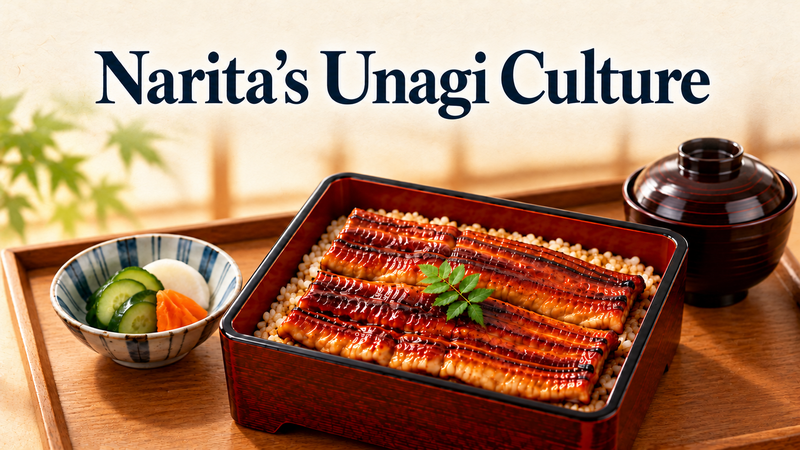
The word “steamed” can give the wrong first impression of Yanagawa’s signature eel dish. Unagi seiro mushi does not start with plain eel that simply goes into a steamer. It brings together sauce-glazed, grilled eel—kabayaki—and seasoned rice, then finishes them with steam. Understanding that final step makes it easier to appreciate what distinguishes this Fukuoka specialty from an ordinary box of eel over rice.
Grilling comes before the final steaming
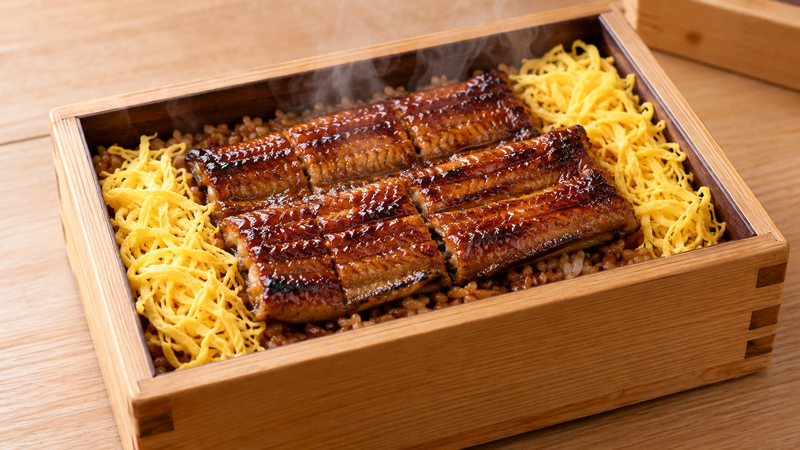
In the familiar Yanagawa preparation, rice seasoned with sauce is topped with kabayaki and thin strips of cooked egg, then steamed. Japan’s Agency for Cultural Affairs identifies it as a local food tradition. Kabayaki and seiro mushi therefore are not mutually exclusive categories: one is part of the other. [1]
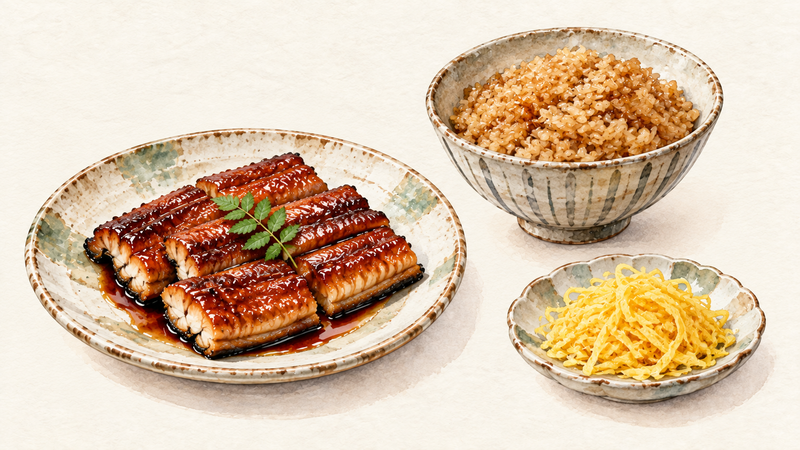
When your meal arrives, pay attention to the rice as well as the eel. Try a little of each separately, then together. This is a suggestion rather than a dining rule, but it helps reveal how the dish is assembled. The rice is already seasoned; it is not simply a neutral base waiting for sauce poured over the top.
Seiro mushi versus unaju: look beyond the box
The following comparison is a guide to typical preparations, not a rule governing every restaurant.
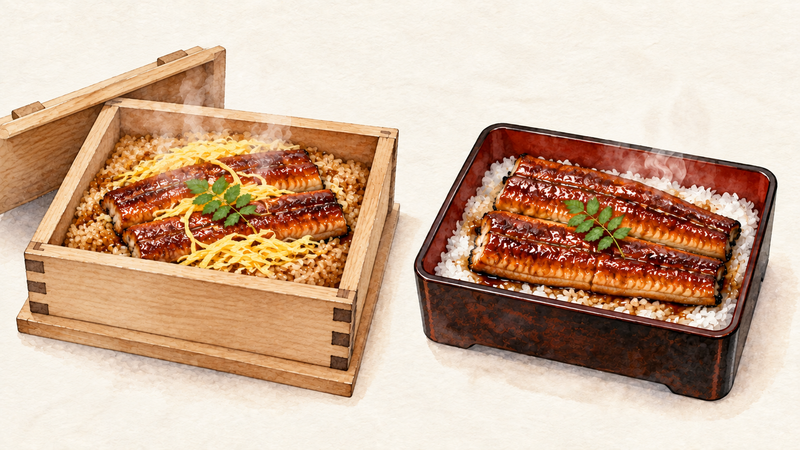
Basic assembly: seiro mushi steams seasoned rice and grilled eel together; typical unaju serves grilled eel over rice in a jubako box.
What to notice: the rice’s seasoning and steamed finish in seiro mushi; the combination of rice, eel and sauce in unaju.
What the name describes: seiro mushi refers to the steaming method; unaju refers primarily to the serving vessel.
For the basic unaju definition, see the Japan Ready-made Meal Association; Hamamatsu City explains the steaming step in Kanto-style kabayaki. [5] [6]
The distinction is not “steamed eel versus eel that is never steamed.” Eel destined for unaju may also undergo steaming during its preparation. The useful distinction here is steaming the assembled rice-and-eel dish, rather than steaming the eel alone. That is a different question from the familiar comparison between Kanto- and Kansai-style eel preparation.
Nor should every restaurant’s method be compressed into one rigid sequence. Motoyoshiya’s own description specifies two rounds of steaming. That is evidence for the restaurant’s method, not a reason to insist that every version follows an identical process. [2]
Reading the origin story carefully
Motoyoshiya traces the dish’s introduction to the first year of the Tenna era, 1681. The same year appears in the Agency for Cultural Affairs’ account. Here, it is best understood as the dish’s reported origin. A restaurant’s inherited history and a modern cultural summary are not the same thing as independently examining a contemporary seventeenth-century record. There is no need to invent a scene of the first cook discovering steam to make this food interesting. [2] [1]
Yanagawa’s waterways offer another way into the local story. Its tourism association describes the canals as part of everyday water use and transport, not merely a picturesque setting created for visitors. If you take a canal boat ride, look at the water as infrastructure that helped support the town’s life. [3]
Three things to check before ordering
Ask about portion sizes. Labels such as jo and tokujo do not, by themselves, tell you exactly how much rice or eel you will receive. If you hope to share, ask about that too rather than assuming it is permitted.
Check the egg and accompaniments. Shredded egg is a familiar part of this dish. If you need to avoid it, discuss the preparation before ordering; simply removing a topping may not address your needs.
Match the meal to your boat route. Canal operators have different boarding locations and routes. Choose the trip and check its start and finish before deciding where lunch fits. Allow room for the meal rather than assuming that the restaurant and boat will run to a tightly synchronized timetable. [3]
Frequently asked questions
Is seiro mushi different from kabayaki? Yes, as a finished dish, but it includes kabayaki. The eel is grilled before it is combined with rice and steamed.
Are all Yanagawa versions the same? No. Check the sauce, portion and arrangement rather than assuming uniformity. For example, the tourism association’s Hinodeya listing describes a version with additional kabayaki between layers of rice. [4]
Can I use this explanation to reheat a takeaway portion? This is a guide to the regional dish, not reheating instructions. Follow the directions supplied with your particular takeaway or frozen product.
Read next
Explore the related guides for more on preparation styles and reheating eel at home.
Sources and editorial note
The sources cited with the sections support the dish description and historical accounts. Ordering and tasting suggestions are editorial guidance. This article does not claim a restaurant visit, interview or kitchen test.
Related articles