To understand types of eel, separate three things: biological species, where the fish grew and its growth stage. Japanese eel is a species name, while glass eel and silver eel describe stages of development. Neither Chinese origin nor a silver body proves that an eel belongs to a different species. Species labeling: Fisheries Agency of Japan; development: Fisheries Agency and Japan Fisheries Research and Education Agency.
Eel is more than one species
Start with biological classification. Before guessing a species from a product name or size, match its Japanese common name with its scientific name to avoid confusing similar terms.
Classifying the eels we eat
The scientific name of the Japanese eel is Anguilla japonica. Anguilla identifies the genus, and japonica is the part identifying the species within it. Its standard Japanese name is Nihon-unagi, which Japan's Fisheries Agency recommends for consumer labeling. The name japonica sometimes used in trade comes from the scientific name. Fisheries Agency, Information on Eels.
Check the Japanese common name and scientific name together. The same fish may have different trade names, so the number of names is not the number of species. In particular, domestic eel and branded eel describe a different aspect from a list of species names.
How many species exist worldwide? Check what is being counted
When a source gives a species count, check its taxonomic treatment and publication date. For example, a 2011 exhibition description from the University Museum, the University of Tokyo, refers to specimens of 19 species and subspecies of Anguilla. This does not mean 19 species plus additional subspecies. University Museum, the University of Tokyo, Eel Exhibition.
Counting a list that mixes species and subspecies as though every entry were a species of the same rank causes double counting. Classification can also change with research. Rather than give a fixed total, this article focuses on representative species needed for comparison and their names. When consulting a field guide's total, first check whether it covers the genus Anguilla or the broader order Anguilliformes.
Representative species to compare
Here we compare representative species whose names you may encounter. Notice which parts of their scientific names match and which differ, while treating each as a distinct fish.
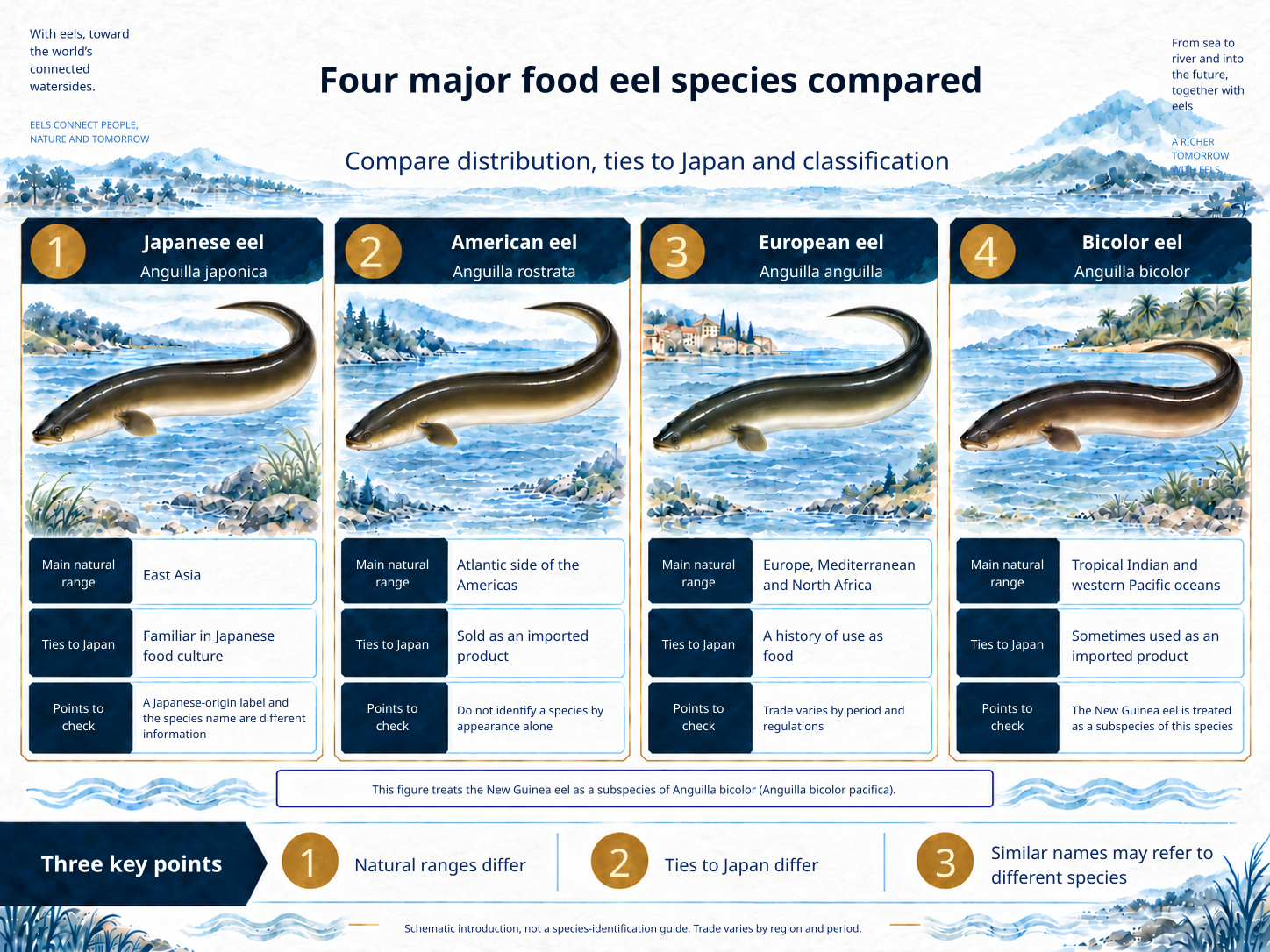
Japanese eel: Anguilla japonica
This species is familiar in Japan, but Japanese in its name does not mean it occurs only in Japan. It is distributed across East Asia and is subject to resource management involving cooperation among Japan, China, South Korea, Chinese Taipei and others. A biological name does not correspond directly to a national border. Fisheries Agency and Japan Fisheries Research and Education Agency, Japanese Eel.
European eel and American eel
The European eel is Anguilla anguilla, and the American eel is Anguilla rostrata. Both belong to the same genus as the Japanese eel but are separate species. Their known spawning area is the Sargasso Sea in the Atlantic, distinct from the Japanese eel's spawning area in the western North Pacific. Tsukamoto (2006).
Similar appearance does not imply identical life-history measurements or resource status. When reading overseas longevity records or growth rates, check which species is involved. Research comparing coastal Japanese eels has also examined growth differences between regions and in relation to other temperate eel species. Kotake et al. (2007).
The names bikara and bicolor: Anguilla bicolor
You may encounter bikara or bicolor in explanations of eel trading or farming. Taxonomic and identification research on Anguilla bicolor has also examined methods for distinguishing its two subspecies. Checking the corresponding scientific name is more reliable than relying on similar-sounding names. Tanaka et al. (2014).
These species provide a starting point for comparison, not a comprehensive ranking of products currently for sale. Avoid treating trade proportions from a particular survey year as if they remain unchanged today.
Giant mottled eel is not a Japanese eel that has grown larger
The giant mottled eel, called O-unagi in Japanese, is a separate species, Anguilla marmorata. Research in Japanese rivers investigates it separately from the Japanese eel. These names do not describe a sequence in which a small Japanese eel becomes a giant mottled eel as it grows. Itakura et al. (2020).
Identification uses more than body patterns: clues include the position of the dorsal-fin origin relative to the anus. The National Museum of Nature and Science also highlights this relationship when comparing Japanese and giant mottled eels. Appearance changes with camera angle and developmental stage, so do not force a definite identification from a single photograph. National Museum of Nature and Science, Eel.
Are glass eels, yellow eels and silver eels different species?
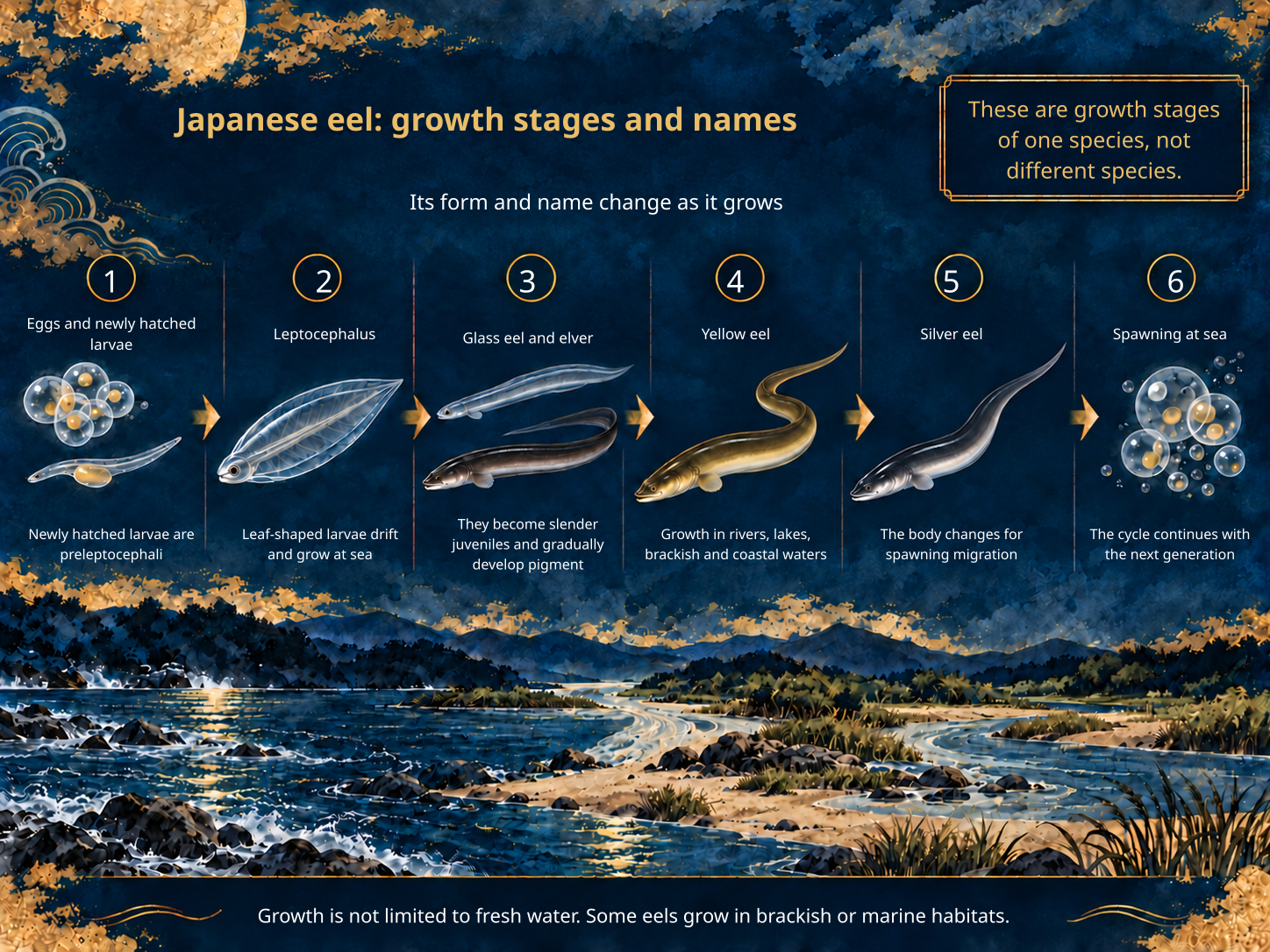
A glass eel is the slender, nearly transparent stage following metamorphosis from a leaf-shaped larva. Pigmentation then increases, the eel passes through its growth phase and silvering occurs in preparation for spawning migration. These terms describe life stages, so they can be used alongside the species name Japanese eel. Life history: Fisheries Agency and Japan Fisheries Research and Education Agency.
Yellow eel and silver eel cannot be separated simply by body color as if sorting yellow and silver paint. Research assessing silvering in Japanese eels combines pectoral-fin and abdominal coloration with biological characteristics to distinguish stages. Okamura et al., A silvering index for the Japanese eel.
For the sequence of development, see The Life Cycle of the Eel (article-12). For the relationship with living environments, see Eel Ecology (article-13).
Read species, origin and wild or farmed status separately
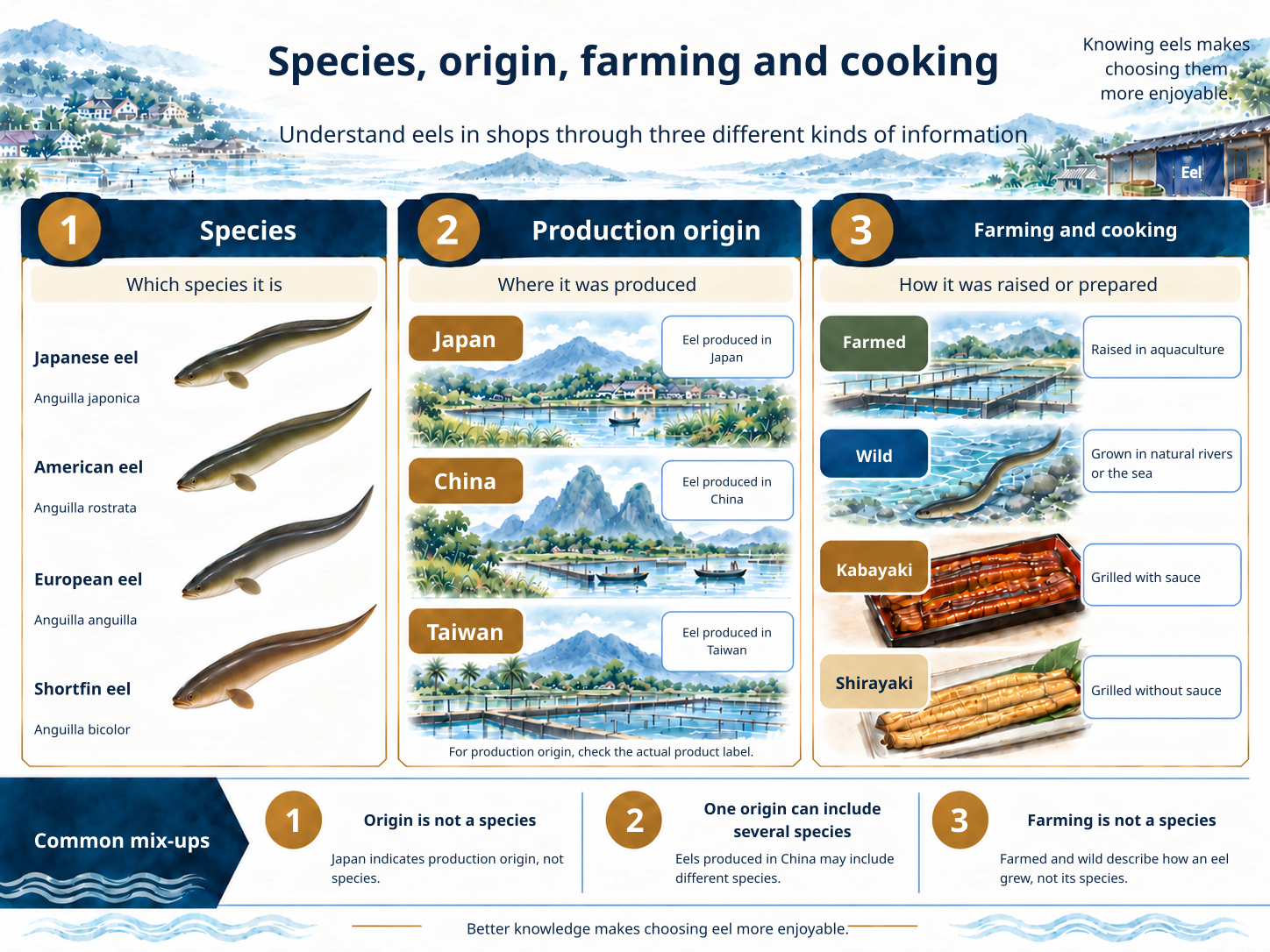
When comparing products, ask separately what fish it is, where it was raised or processed, and how it was produced. These are different questions; one label does not answer all of them.
Japanese eel names a fish, rather than meaning farmed in Japan. Identifying the species alone also does not determine flesh thickness, grilling results or whether you will like the taste. Compare information supported by the seller's description and keep unknown details distinct to avoid misunderstandings. Eel-Producing Regions (article-06) explains origin labels, while Eel Aquaculture (article-01) explains farming.
Conger and freshwater eels: consider taxonomic ranks as well as species
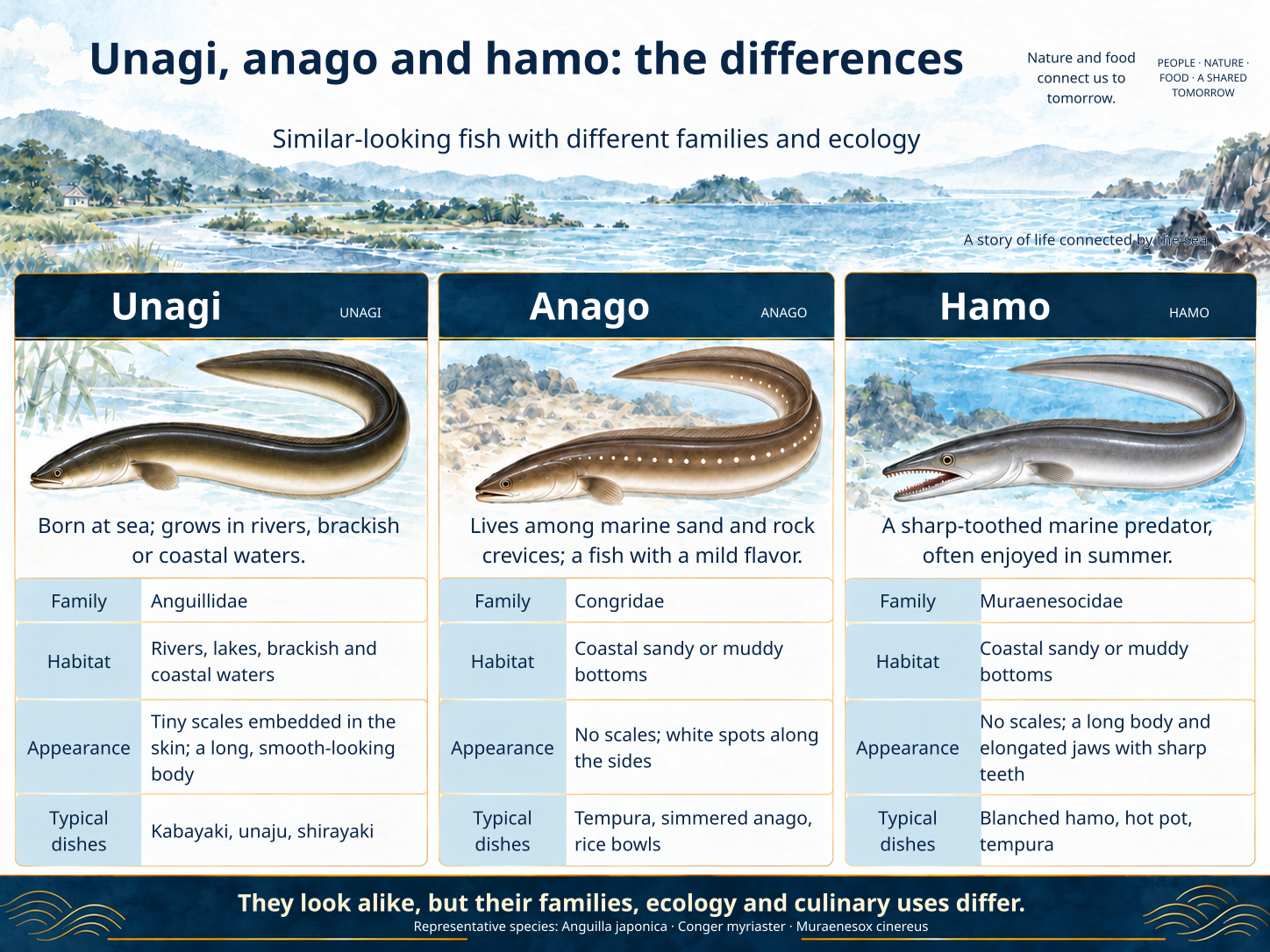
The Japanese eel belongs to the order Anguilliformes, family Anguillidae and genus Anguilla. Conger eels belong to the family Congridae within the same order. Sharing an order is different from sharing a genus, so conger eels cannot be added to the number of Anguilla species. JAMSTEC Japanese eel taxonomy; Kagoshima University Museum fish guide.
Narrowing the classification from order to family, genus and species explains both their resemblance and why they are different fish more clearly than grouping them by dishes or appearance alone. Differences Between Unagi and Anago (article-11) compares their appearance and ways of eating them in more detail.
Frequently asked questions
- Are electric eels related to the eels we eat?
- Electric eels belong to the genus Electrophorus, not Anguilla. Despite their long bodies and similar common name, they are not included in Anguilla species counts. A 2019 taxonomic study examines Electrophorus species, a separate subject from edible Anguilla eels. de Santana et al. (2019).
- Can the species be identified in processed products?
- Appearance alone may not be enough. DNA testing can identify species, and studies have applied it to processed eel products. Distinguish guessing from a product's appearance from identification through testing. Research on DNA species identification in processed products.
Related articles